Most ecommerce platforms will not let you sell CBD, and many that do will not process the payments. That single constraint, not design or price, is what separates a working CBD store from a stalled one.
So instead of ranking every store builder on the market, we focused on the eight platforms that genuinely welcome CBD merchants and pair cleanly with high-risk payment processing, then pressure-tested each against the way this category actually operates: state-level shipping limits, third-party payment gateways, subscriptions and compliance.
Our top pick for most sellers is Wix. It offers the most guided, compliant route online for US-based CBD businesses, with a step-by-step declaration flow and a short list of approved payment partners.
If you expect to scale into serious B2B volume, BigCommerce is the stronger long-term home. Below we break down all eight, the CBD-friendly payment processors you’ll need to bolt on, and the federal rule change that now decides what you’re even allowed to sell.
Best eCommerce Platforms for Selling CBD Products
Key takeaways
- Wix is the easiest compliant launch for US sellers, while BigCommerce scales best for growing B2B and B2C brands.
- No major platform processes CBD payments in-house, so budget for a high-risk, CBD-friendly payment processor from day one.
- A new federal total-THC limit of 0.4mg per container takes effect on 12 November and resets what is legal to sell, so audit your catalogue before then.
- Shopify, WooCommerce, Square Online and Spree Commerce all support CBD, but each handles payments and hosting differently.
Consumer demand for CBD has climbed steadily over the past decade, and it remains a promising niche for launching an online business. It is also a category where the rules are shifting, which brings us to the single most important thing to understand before you build.
A federal change is reshaping the category. The Continuing Appropriations and Extensions Act, 2026 redefines hemp so that products exceeding roughly 0.4 milligrams of total THC per container become federally non-compliant, with enforcement scheduled to begin on 12 November 2026. Before that date, audit your catalogue against the new total-THC threshold, because non-compliant SKUs create risk that flows straight through to your payment processing and banking relationships. Treat this as a live compliance deadline, not a footnote, and verify current federal and state rules before you launch.
This guide walks through the ecommerce platforms available for launching a CBD store, then covers CBD-friendly payment processing. Let’s begin with the basics.
What are CBD products?
CBD is one of more than 100 cannabinoids found in hemp and Cannabis Sativa plants. The best known cannabinoid is THC (tetrahydrocannabinol), which is responsible for the intoxicating effects associated with cannabis. CBD is different: it does not produce that intoxicating effect, and it is widely used in wellness and personal-care products.
The industry keeps introducing new hemp-derived formats, so if you want to start a CBD business there is a wide range of products to consider selling. These are among the most popular categories on the market right now:
Sublingual tinctures
Tinctures are CBD oil wellness products made with a concentrated form of CBD. They are taken by placing a few drops under the tongue and letting the oil absorb.
CBD-infused foods
There are numerous snackable CBD products on the market today, including gummies, chocolate, candies and honey sticks. Most of them position hemp as closer to a wellness treat than a medicine.
Vaporiser concentrates
Concentrates such as CBD waxes and oils are another popular format. They are designed to be used with an electronic device that vaporises the product for inhalation.
CBD topicals
Topicals for targeted comfort include creams, gels and sprays. These are applied directly to the skin to treat a specific area of the body.
CBD capsules and pills
Some customers prefer capsules or pills for consistent, measured dosing, often as part of a daily wellness routine.
CBD is not exclusive to humans, either. Many growing businesses sell CBD products for pets such as cats and dogs. Whichever products you choose to sell, be careful with the medical and health claims you make: these products are not FDA approved, and unsupported claims are a common cause of both regulatory trouble and payment-processor account closures.
Why is choosing an ecommerce platform for CBD products difficult?
Because of CBD’s regulatory status and legal issues surrounding the cannabis industry, some eCommerce platforms do not allow the creation of online CBD stores. We will discuss why cannabis merchants need to choose an appropriate ecommerce platform for selling CBD products online.
Every industry faces unique challenges. Online CBD vendors are not excluded. As it is a new sector that has only recently gained legal status, it has unique challenges that hinder the ability of start-ups to thrive.
With so many off-the-shelf online stores and integrations readily available, determining the best CBD eCommerce platform for your online store can be difficult. Many CBD product sellers have difficulty finding an e-commerce platform that caters to all aspects of their business across different touch points, such as brand, messaging, product information, curation, purchasing, and personalization.
Some ecommerce solutions support CBD, while others do not. Furthermore, how you choose to process and accept payments is a critical component of increasing sales in your online store.
However, CBD payments cannot always be processed through ecommerce platforms. Choosing a third-party CBD-friendly payment processor or payment gateway that synchronizes with your online store is frequently required.
So, which ecommerce platform is best for CBD products? In the following section, we’ll look at some alternatives.
Best eCommerce Platforms for Selling CBD Products
1. Wix
Wix doesn’t have the ultra-advanced sales tools or huge app marketplace that something like Shopify has, but it does give CBD sellers an easy route online in 2026. For companies based in the US, in particular, there’s a step-by-step setup process, where you complete a declaration, remove unsupported states from your shipping strategy, then link in a payment provider.
The payment provider link is a bit tricky, because Wix Payments can’t be used for CBD, but you do get the option of something like Square, Bankful, Priority Payments, or Evergreen Payments Northwest instead. Once you’re approved, you also get lots of useful tools for everything from managing products and fulfillment, to sending emails, chatting with customers, and using SEO.
Plus, as of 2026, Wix has significantly improved its editor with the AI assistant, Aria. It can create the first version of your site, create page sections, and produce drafts of content, then you can edit everything in the standard Wix Editor backend.
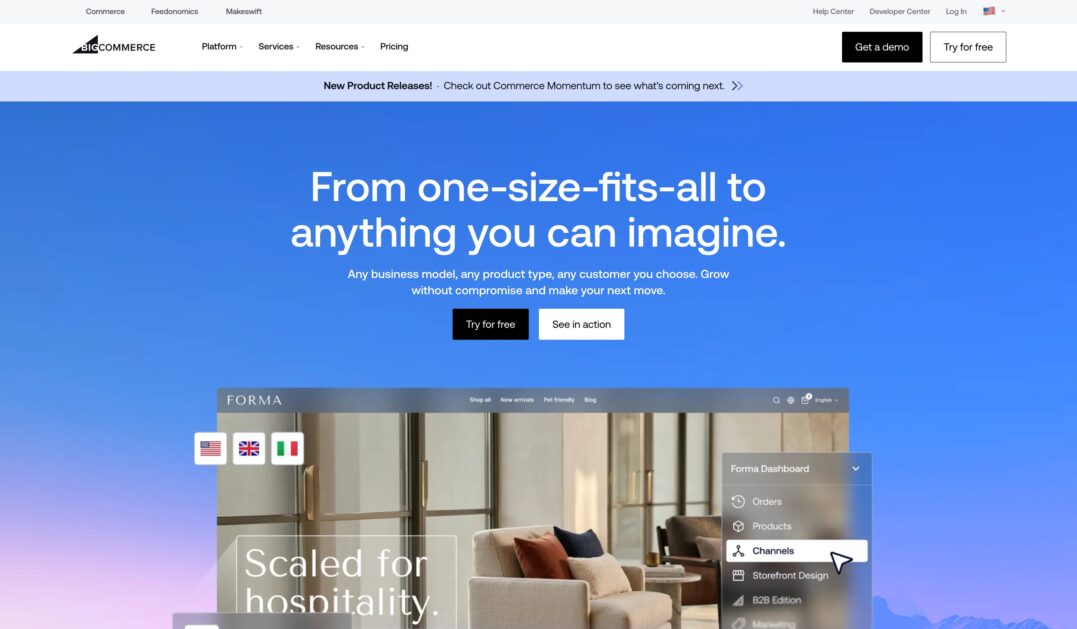
2. BigCommerce
BigCommerce is easily the best CBD ecommerce site available online. This website provides the most user-friendly and adaptable platform for retailers to expand their CBD businesses online. It also includes several important software and tools that you can use to conduct your CBD business smoothly.
BigCommerce comes out on top as the platform with almost everything your CBD business could need to establish and grow, from B2B (business-to-business) to B2C (business-to-customer). This company is well-known for harnessing some of the most popular brands. BigCommerce works well for both new ventures and established large-scale CBD business owners.
Furthermore, you can use this platform to launch your digital marketing campaign and turn it into an extremely powerful platform that is ideal for the job.
3. Shopify

Yes! Shopify is also the market leader in selling various CBD products. While the eCommerce platform does not explicitly prohibit the sale of Cannabidiol products, its Stripe-powered mode of payment does not accept CBD-related payments.
However, you should not be discouraged from working with this esteemed eCommerce platform because you can still employ a third-party payment gateway supported by Shopify. Of course, the downside is that it affects your conversion rates.
However, this is the biggest store for customers to shop for CBD edibles online without further hassle.
4. Dukaan

Dukaan is an all-in-one, no-code platform that makes it easy to launch and manage an online store. You can add features, configure payments and adjust the look and feel of your storefront without touching code.
Its biggest strength is speed and simplicity: you can get a store live in minutes, and because it’s built mobile-first, it suits the large share of customers who shop from their phones. It is especially popular with sellers in India, so check payment and shipping support for your own market before committing.
5. Shift4Shop

CBD and hemp have strong online sales potential, and Shift4Shop comes loaded with the tools you need to build a store around them. For US merchants who process through Shift4 Payments, the platform is free to use with no monthly fee, which makes it one of the more cost-effective options in this list.
Shift4Shop makes it simpler to stay compliant, with support for age verification and integration with the high-risk payment processors this category requires. Rich categorisation helps customers navigate a wide range of products, and product bundles make it easy to offer starter kits and variety packs. Since many CBD products are replenished on a routine basis, you can also offer subscriptions, and the built-in SEO tools help customers find you where direct advertising is restricted.
6. WooCommerce

WooCommerce is a free WordPress plugin that turns a self-hosted WordPress site into a full ecommerce store, with functionality comparable to hosted platforms. Sellers get the tools they need to list products, take orders and manage their brand from anywhere.
Its appeal for CBD is control. WooCommerce gives you complete customisation flexibility, and because it’s open source, there’s no platform that can unilaterally shut down your store. Payment support comes down to the gateway you integrate, so you’ll pair it with a CBD-friendly processor. That combination of ownership and flexibility makes WooCommerce a strong option for launching a CBD store.
7. Square Online

Square Online lets you sell CBD both online and in person, subject to federal and state law. Its consistent, transparent pricing is a welcome approach to CBD payment processing, particularly for smaller businesses that need to watch every cost. Square built out its CBD program specifically to serve this category, rather than treating it as an exception.
Because Square’s POS and online store builder work together, you can sell across channels in whatever way suits your business, which is useful if you run both a physical shop and a website.
8. SpreeCommerce
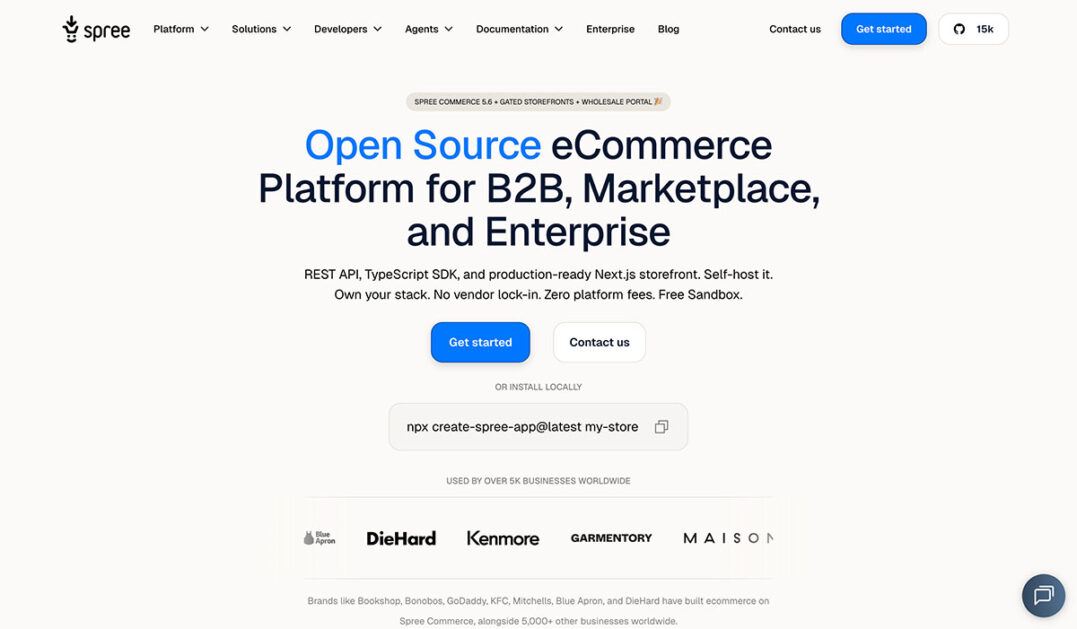
Spree Commerce is an open-source ecommerce framework built on Ruby on Rails, aimed at developer-led teams that want full control of their stack. It is not a hosted, plug-and-play SaaS builder like the others on this list: you self-host it, and you own the code, the deployment and the infrastructure.
Since its version 5 release, Spree has offered a clear split between a free Community Edition and a paid Enterprise Edition. The Community Edition is open source with no licensing fee, though you do pay for development, DevOps and hosting. The Enterprise Edition layers on B2B, multi-store and multi-vendor marketplace features plus dedicated support. For a CBD business with development resources, that ownership model can be an advantage, since it removes the risk of a platform revoking your account, but it demands far more technical capacity than a hosted builder.
Platforms at a glance
| Platform | Model | Best for | CBD payments |
|---|---|---|---|
| Wix | Hosted builder | Simple, guided US setup | Third-party (Wix Payments not supported) |
| BigCommerce | Hosted (SaaS) | Scaling B2B and B2C brands | Third-party CBD-friendly gateways |
| Shopify | Hosted (SaaS) | Feature depth and app ecosystem | Third-party (Shopify Payments not supported) |
| Dukaan | Hosted, no-code | Fast, mobile-first launches | Depends on market and integrations |
| Shift4Shop | Hosted (SaaS) | US sellers wanting low cost | High-risk processors, free with Shift4 Payments |
| WooCommerce | Self-hosted (WordPress) | Control and customisation | Integrated CBD-friendly gateway |
| Square Online | Hosted builder | Omnichannel and in-person | Native CBD program |
| Spree Commerce | Open source, self-hosted | Developer-led, B2B, marketplaces | Provider-agnostic, self-integrated |
CBD-friendly payment processing services
Because of ongoing regulatory uncertainty, CBD sits in the high-risk category. As a result, many mainstream gateways avoid CBD sellers to limit their operational risk. You are not out of options, though: you can work with a specialist processor that is experienced in high-risk transactions.
Processors such as PayPal and Stripe will not serve this category, and while Square does support CBD, it works best at lower volumes. To get you started, here are five specialists worth looking at:
- USAePay (now part of NMI)
- PaymentCloud
- SMB Global
- Easy Pay Direct
- PayKings
Wondering what makes a good CBD payment processor? Here are four things to look for.
High-risk experience
Your processor should have a track record with high-risk transactions and strong security, which is essential for protecting you from fraud. A quick way to gauge this is to check which other industries they serve. Processors that also work with online dating, pharmaceuticals and gaming tend to understand high-risk requirements, since those are high-risk categories too.
Transaction fees
Whichever processor you use, you’ll pay transaction fees to accept cards and other digital payments. Some companies charge more than others, and depending on your sales volume those fees can add up quickly and eat into your margin, so compare rates carefully.
Customer service
Few sellers want to untangle payment problems alone, so make sure your provider offers strong customer service with technically capable staff who can resolve issues quickly.
Integrations
You want a processor that integrates cleanly with your store, which keeps setup and ongoing management simple. Since you want to be paid reliably for your time and effort, don’t rush this step: settle on the right processor before you launch.
Conclusion
CBD has become a genuine ecommerce category, and sellers who already have compliant stores up and running are seeing the benefit. The right platform depends on your priorities: guided simplicity (Wix), room to scale (BigCommerce), ecosystem depth (Shopify), speed (Dukaan), low cost (Shift4Shop), control (WooCommerce), omnichannel selling (Square Online) or full ownership (Spree Commerce).
Whichever you choose, pair it with a CBD-friendly processor and, above all, get your total-THC compliance in order ahead of the 2026 federal deadline. The final call on which platform fits your business best rests with you.