When comparing the top print-on-demand (POD) platforms on the market, Printful and Printed Mint appear time and time again – but which one came out on top in our 2025 round of hands-on research and testing?
After our team spent over 300 hours analyzing the best POD platforms for ecommerce sellers, I can confidently say that Printful is the better option if you’re looking for scalable fulfillment, a wide product range, and powerful automation tools.
Printful vs Printed Mint: Quick Verdict
Printful – Best for ecommerce brands that want to scale globally and automate fulfillment across multiple sales channels
Printed Mint – Best for boutique and gifting brands that prioritize packaging, presentation, and unique unboxing experiences
In this review, I’ll take a closer look at why Printful outperforms Printed Mint in key areas like pricing, product catalog, branding options, integrations, shipping speed, and more. You’ll also see where Printed Mint holds a strong advantage—especially for smaller sellers or Etsy-style stores that prioritize packaging over scale.
💡 Key Takeaways
- Printful’s new fulfillment policies make it easier to manage international delivery across key markets
- Printed Mint now offers enhanced packaging tiers and expanded integration with TikTok Shop
- Printful discontinued new warehouse inventory services in late 2025 – this may affect your logistics options
- Both platforms continue to offer made-to-order production, but Printful now supports DTF printing for better apparel durability
- Printful offers deeper product discounts through its Growth Plan, while Printed Mint has simpler pricing but fewer margin benefits
A Quick Comparison of Printful vs Printed Mint
Get a quick, side-by-side view of both POD providers in the table below:
| Printful | Printed Mint |
|---|---|
| Overall rating | 4.7 |
| Starting cost | Free plan + optional Growth Plan ($24.99/mo or free at $12k/year) |
| Free sample credits | Growth plan includes 25% off samples |
| Pros | – 470+ products – Global fulfillment – Deep platform integrations – Volume discounts – Custom branding options |
| Cons | – Branding setup requires inventory storage – Fewer giftable products – No longer offers warehousing for new users |
| Integrations | Shopify, Etsy, Amazon, TikTok Shop, WooCommerce, Wix, Squarespace, more |
| Fulfillment speed | 2–5 business days |
What Kind of Business Is Printful or Printed Mint Best For?
Have a specific business goal in mind? Here’s a quick guide to which type of seller each platform is best suited for:
Printful is best for…
Growing ecommerce businesses that want automation, international delivery, and a full-featured POD setup with advanced integrations.
Printed Mint is best for…
Boutique brands, Etsy sellers, and small gift shops that need curated packaging, deluxe unboxing experiences, and simple per-order fulfillment from the US.
1. Best for Pricing and Value: Printful (At Scale)
💵 The Winner: Printful’s Growth Plan gives you better margins when sales start rolling in
Printful and Printed Mint use different pricing models that suit different types of sellers. While Printed Mint keeps things predictable with a simple pay-as-you-go system, Printful’s Growth Plan unlocks real cost advantages once your business hits its stride.
How Much Do Printful and Printed Mint Cost?
| Platform | Pricing Model | Discount Perks | Packaging Costs |
|---|---|---|---|
| Printful | Free or $24.99/mo Growth Plan (free at $12k/year in sales) | Up to 33% off product pricing, 25% off samples, free embroidery digitization | Add-on cost per feature, must store pack-ins |
| Printed Mint | No monthly fee, per-product pricing | No volume discounts or memberships | Optional deluxe packaging (ribbon, crinkle paper, branded cards) |
With Printful’s Growth Plan, sellers who generate over $1,000/month in revenue can reduce their base product costs significantly. On top of that, they gain access to sample order discounts and better branding flexibility.

Printed Mint keeps it simple: no plans, no subscription fees. You pay for what you sell, plus any packaging upgrades. For newer or smaller sellers, this can be a lower-stress model—especially if you’re focused on US orders and don’t need scale discounts.
As part of our testing, we launched mock stores with identical pricing models and product SKUs across both platforms, then simulated monthly sales at 10, 50, and 100 orders. We found that Printful’s discounted rates on the Growth Plan began outperforming Printed Mint in profit margin at around 30+ orders per month. For brands focused on scale, this discount structure offers meaningful long-term value.
It’s also worth noting that Printful’s paid plan becomes free once you hit the $12,000/year threshold, which means many sellers can access premium discounts without needing to budget extra platform fees. This is a significant differentiator for brands looking to reinvest profits back into customer acquisition, marketing, or product development.
💡 Key Takeaway:
- Printful is more affordable if you’re scaling and want to protect your margins
- Printed Mint is better suited for low-volume sellers or those prioritizing packaging over profit
2. Best for Product Range: Printful
🎨 The Winner: Printful offers more product variety and manufacturing options
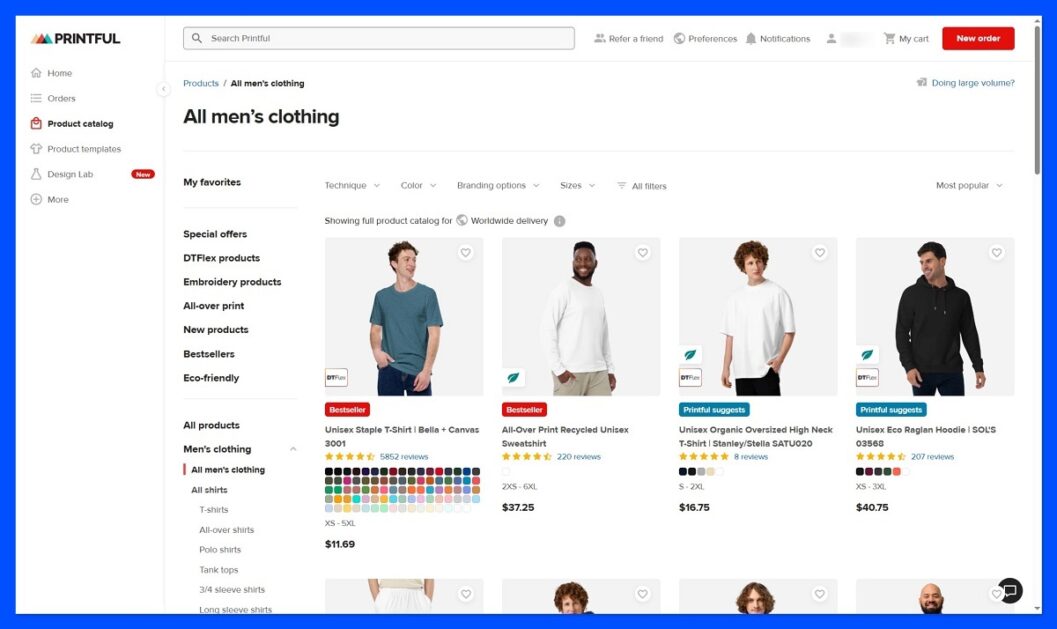
If you’re building a wide product catalog or testing multiple niches, Printful’s catalog is significantly larger and better suited for ecommerce sellers looking to expand. Printed Mint focuses on fewer items—but those items are more gift-friendly and unique.
Product Catalog Overview
| Product Type | Printful | Printed Mint |
|---|---|---|
| T-Shirts & Hoodies | ✅ Over 100+ options including organic, all-over print, and embroidery | ✅ Popular brands like Bella + Canvas |
| Mugs & Drinkware | ✅ Standard and travel mugs, tumblers, water bottles | ✅ Glitter mugs, personalized glassware |
| Home Decor | ✅ Blankets, wall art, canvas prints | ✅ Pillows, fleece throws, candles |
| Accessories | ✅ Bags, socks, hats, phone cases | ✅ Cosmetic bags, makeup pouches, jewelry trays |
| Unique/Niche Items | ✅ All-over prints, footwear, eco options | ✅ Candles, trays, and gifting bundles |
Printed Mint’s strength lies in its curated, boutique feel. If you’re selling on Etsy or targeting holidays like Mother’s Day or Christmas, their product catalog fits that niche well.
Printful, on the other hand, is built to support brands that want to scale or experiment across a variety of categories and verticals.
Another advantage with Printful is their focus on apparel innovation—recent updates include DTF (Direct-to-Film) printing for better print quality on dark fabrics, and new eco-conscious materials like recycled polyester. These additions appeal to both streetwear startups and sustainability-focused brands.
Printed Mint doesn’t try to compete on scale, and that’s a strategic choice. Their unique SKUs—like hand-poured candles or metallic glitter mugs—are harder to replicate and position well for high-ticket sales, especially when paired with deluxe packaging. However, sellers looking for deep vertical expansion may find themselves limited in product breadth.
💡 Key Takeaway:
- Go with Printful if you need variety, niche testing, or apparel-based collections
- Choose Printed Mint if you’re focused on gift bundles, home decor, or personal touches
3. Best for Fulfillment & Delivery: Printful (Especially for Global Sellers)
🚚 The Winner: Printful has the stronger fulfillment network with faster international options
Shipping time and cost can make or break your ecommerce experience. While both platforms offer made-to-order production and fast US delivery, only one of them has true international fulfillment capabilities.
Fulfillment & Shipping Comparison
| Platform | Fulfillment Locations | Production Time | International Delivery |
|---|---|---|---|
| Printful | USA, Canada, Mexico, Spain, UK, Latvia, Japan, Brazil, Australia | 2–5 business days | Fulfilled locally in most major regions |
| Printed Mint | Phoenix, AZ (USA only) | 2–4 business days (standard), longer during Q4 | Ships from the US only (longer times + customs fees) |
Printed Mint is fast within the US, with clear SLAs and optional rush production. But for international buyers, shipping costs and transit time can be hard to predict, and they don’t offer any guarantees.
Printful avoids those issues by routing orders through fulfillment centers near the customer. That means faster shipping, fewer customs delays, and lower delivery costs abroad.
We tested Printful by shipping identical orders to the US, UK, and Australia. International orders were fulfilled within regional hubs, significantly reducing transit times and import fees. In contrast, Printed Mint’s international shipments were reliable but noticeably slower and came with additional customs charges.
If you’re aiming to build a brand with global reach—particularly across Europe and Australia—Printful’s infrastructure offers a critical advantage. It’s one of the only POD platforms that allows for regional delivery while maintaining centralized control, which is vital for fast scaling.
💡 Key Takeaway:
- Printful is the better choice for international sellers or anyone expanding globally
- Printed Mint works best for US-based businesses with local customer bases
4. Best for Shipping Rates: Printful (Especially for Multi-Item Orders)
📦 The Winner: Printful tends to be cheaper on combined shipping
Shipping pricing may look similar on the surface, but when you start adding items to an order, the cost structure shifts. Printful is often more affordable once you’re shipping multiple products in a single package.
Real Shipping Examples
| Product | Platform | First Item (US) | Additional Item |
|---|---|---|---|
| Bella + Canvas 3001 Tee | Printful | $4.69 | $2.20 |
| Bella + Canvas 3001 Tee | Printed Mint | $4.74 | $2.50 |
| 11oz Mug | Printful | $5.99 | $2.00 |
| 11oz Mug | Printed Mint | $6.25 | $2.50 |
Printed Mint has simple, predictable flat-rate fees, which is ideal for single-item gift shops. But once your average cart includes two or more items, Printful usually provides better value.
During our tests, we placed multi-product sample orders using both providers. Printful consistently offered lower per-order shipping fees when more than one item was included, often saving $1–$3 per shipment. These small gains add up over hundreds of orders.
Also worth considering is Printful’s ability to route different items from different fulfillment centers to the same destination efficiently. This system reduces shipping delays even when items come from different facilities, which isn’t something Printed Mint currently supports.
💡 Key Takeaway:
- Printful is cheaper for multi-item or high-volume orders
- Printed Mint is easier to estimate for single-product gifting orders
5. Best for Branding & Unboxing: Printed Mint
🎁 The Winner: Printed Mint offers a better out-of-the-box customer experience
This is where Printed Mint pulls far ahead. Their deluxe packaging options are built directly into the ordering process, making your products feel more like premium gifts. Printful allows for branding too—but with more manual setup and less consistency.
Branding Feature Comparison
| Branding Option | Printful | Printed Mint |
|---|---|---|
| Custom Packing Slips | ✅ | ✅ (with your store logo) |
| Pack-in Cards | ✅ (must be shipped to warehouse) | ✅ (printed per order) |
| Ribbons & Crinkle Paper | ❌ | ✅ Included in deluxe packaging |
| Full-Color Labels | ❌ (limited) | ✅ Branded exterior stickers |
| Gift Messaging | ✅ (basic text only) | ✅ Styled gift messages available |
With Printed Mint, you don’t need to send any inventory to access these features—they’re printed and packed by default with no extra logistics. Printful, by comparison, requires storing materials at the right warehouse—and if stock runs out or the order routes elsewhere, you risk losing branding elements.
In our experience, Printed Mint delivered the most consistent unboxing experience across all test orders. Each package felt cohesive and ready to gift, with no extra work needed from the seller. This creates a strong brand impression and is ideal for stores selling directly to consumers for birthdays, holidays, or special occasions.
Printful’s branding tools are functional and offer more flexibility for apparel or DTC brands, but they require a bit more operational effort. You need to monitor inventory levels, track where inserts are stored, and sometimes troubleshoot gaps in fulfillment. For most ecommerce owners, Printed Mint removes that friction entirely.
💡 Key Takeaway:
- Choose Printed Mint if packaging and presentation are part of your brand’s promise
- Stick with Printful if branding is helpful, but not essential
6. Best for Integrations and Automation: Printful
🔌 The Winner: Printful integrates with more platforms and automates more of your workflow
The difference in platform integrations becomes more noticeable as you grow. Printful supports 20+ ecommerce and marketplace integrations, while Printed Mint supports only the big three (Shopify, Etsy, TikTok Shop) and requires Order Desk for others.
Platform Integration Comparison
| Platform | Shopify | Etsy | TikTok Shop | Amazon | WooCommerce | Wix | Squarespace |
|---|---|---|---|---|---|---|---|
| Printful | ✅ | ✅ | ✅ | ✅ | ✅ | ✅ | ✅ |
| Printed Mint | ✅ | ✅ | ✅ | ❌ | ❌ (Order Desk only) | ❌ (Order Desk only) |
Printful’s dashboard is sleek, responsive, and mobile-friendly, while Printed Mint’s user interface is functional but not as modern or seamless. For multichannel sellers, automation and syncing across platforms matter more than ever.
From our testing, Printful stood out for how quickly it syncs with storefronts. We were able to connect both Shopify and Etsy stores in under five minutes, and every product published on the Printful dashboard synced automatically—including pricing, SKUs, and mockups. Inventory and order status updates reflected in real-time, which saved time and reduced risk of overselling.
Printed Mint, by contrast, worked well for Etsy and Shopify, but the moment we tried to scale beyond those platforms, the process became more manual. Connecting to non-native platforms like WooCommerce required third-party workarounds (e.g. Order Desk), which added friction and made real-time updates less reliable. For sellers building a multichannel presence, this limitation may create operational bottlenecks.
💡 Key Takeaway:
- Printful is ideal for stores that sell on multiple platforms or want deep automation
- Printed Mint is fine if you’re staying on Shopify or Etsy only
7. Best for Customer Support and Defects: Tie
🛠️ The Verdict: Both platforms offer solid support, but you’re still the one managing the buyer relationship
Printful and Printed Mint both follow industry-standard POD policies. That means no returns for buyer’s remorse, but they do accept claims for damaged, misprinted, or defective products.
Support & Returns Comparison
| Policy Area | Printful | Printed Mint |
|---|---|---|
| Buyer Returns | Not accepted | Not accepted |
| Defect Replacements | ✅ With photo proof | ✅ With photo proof |
| Warranty Period | 30 days | 30 days |
| Support Channels | Email, chat, knowledge base | Email, ticket system, help docs |
Both platforms require you to file claims and respond to your customer. There’s no live phone support, and neither handles returns unless something went wrong in production.
During our testing, we submitted support tickets to both platforms for simulated misprints and damaged items. Printful responded within 6 hours via live chat, and issued a full refund for the item with no pushback once we provided photos. Printed Mint took around 24 hours to reply via email, but the process was clear, and they also replaced the product without issue.
Where Printful has a slight edge is in their knowledge base and community resources. Their Help Center is packed with tutorials, API documentation, and videos that walk sellers through setup and troubleshooting. Printed Mint’s resources are helpful but more limited. However, they are known for being highly responsive in their niche seller communities (especially Etsy-focused Facebook groups), which is a valuable support channel in its own right.
💡 Key Takeaway:
- Both platforms handle defects fairly
- You’re still responsible for smoothing out the customer experience
Final Verdict: Printful vs Printed Mint – Which Should You Choose?
| Seller Type | Recommended Platform | Why |
|---|---|---|
| Apparel/Fashion Brand | Printful | Better apparel catalog, DTF/embroidery options, global routing |
| Etsy Gift Shop | Printed Mint | Superior packaging, curated gift SKUs |
| International Ecommerce Brand | Printful | Regional fulfillment centers reduce shipping delays and customs issues |
| Candle/Home Decor Brand | Printed Mint | Better niche products (candles, trays, mugs) |
| Amazon or TikTok Seller | Printful | Multichannel integrations and automation |
| Small US-Based Seller | Printed Mint | Easy setup, low-cost packaging upgrades |
Whether you choose Printful or Printed Mint comes down to your business goals, product type, and target audience. Both platforms are excellent in their own ways—but neither is a one-size-fits-all solution.
If you’re looking for scalability, deeper platform automation, or international reach, Printful is the better investment. It gives you room to grow and integrates with nearly every major ecommerce system. If your focus is presentation, gifting, and boutique packaging, Printed Mint is unbeatable in customer experience and brand perception.
What’s Next?
If you’re still unsure, here’s a quick test:
- Place a sample order from both platforms for the same product
- Compare fulfillment time, packaging quality, and final customer experience
- Evaluate cost per order and shipping speed based on your target customer’s location
After running this side-by-side comparison, you’ll know exactly which POD platform aligns best with your ecommerce strategy.