Storenvy Reviews and User Ratings

Storenvy Overview
The number of free ecommerce platforms promising to help indie creators launch a store without spending a cent keeps growing, and choosing the right one can feel surprisingly difficult.
Storenvy is one of the longer-running options in this space, pitched at artists, makers, and small brands who want a custom storefront plus marketplace access without monthly fees.
But is it actually a sensible choice in 2026? In this updated Storenvy review, I’m going to help you find out.
Quick verdict
Storenvy is a niche, no-monthly-fee ecommerce platform that works best as a low-commitment starting point for indie creators with existing social media audiences. It combines a custom storefront with a small marketplace, and charges no commission on sales you drive yourself, which is genuinely unusual at this price point.
That said, the platform has significant limitations. Its design tools feel dated, SEO functionality is weak, there are no native print-on-demand integrations, and customer support has a poor reputation. Marketplace traffic is also a fraction of what you’d get on Etsy.
Overall, Storenvy can work as a stepping stone for budget-conscious sellers testing an idea, but most growing businesses will outgrow it quickly and end up migrating to a more robust platform like Shopify or WooCommerce.
I’ll begin my full review with a quick look at how Storenvy works.
How Storenvy works
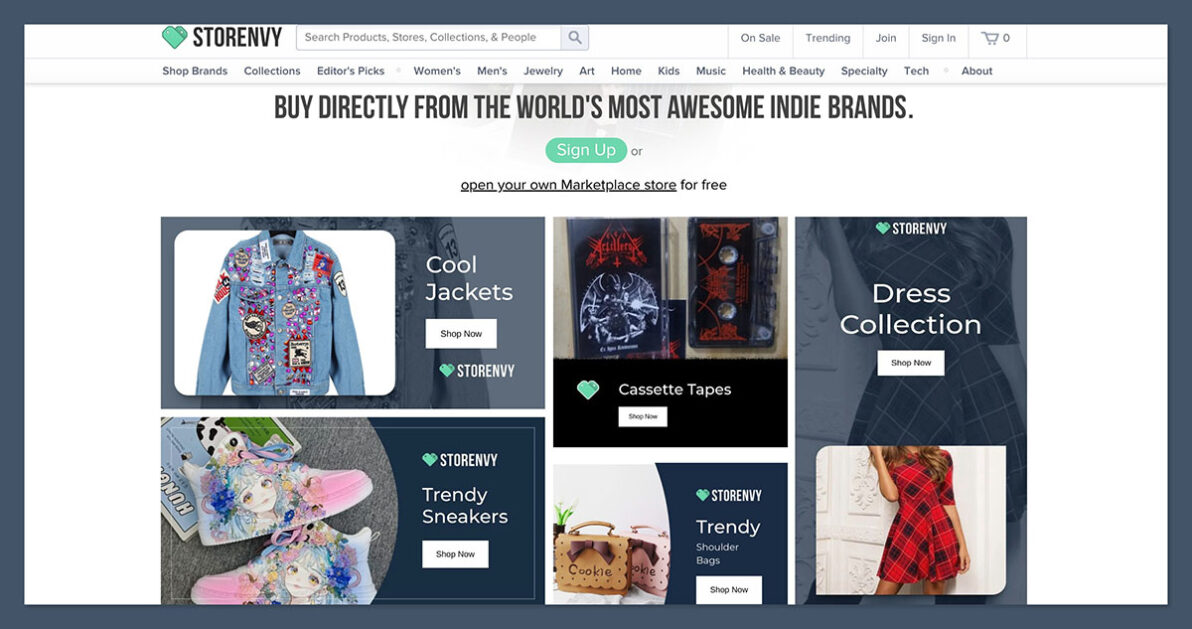
Storenvy is a hosted ecommerce solution, meaning you don’t need to install any software or arrange your own web hosting. You build and manage your store in a web browser, so as long as you have internet access, you can run a Storenvy business from anywhere.
What makes Storenvy a bit different from most competitors is its dual-channel structure. When you create a store, you get two things at once:
- A custom storefront that lives on your own subdomain (or custom domain on paid plans)
- The option to list your products on the Storenvy marketplace, where other shoppers browsing the site can discover them
The marketplace isn’t automatic, though. You have to apply for inclusion and be approved before your products appear there.
The commercial model is unusual too. Storenvy charges no monthly fee on its free plan, and takes 0% commission on sales generated through your own marketing efforts. It only takes a cut (15%) on sales that come specifically through marketplace traffic. Standard payment processing fees from Stripe or PayPal (around 2.9% + 30¢) still apply on top of this.
This positioning explains who Storenvy is really for: indie sellers, artists, print-on-demand creators, and small brands who already have an audience on Instagram, TikTok, or Pinterest and want a low-risk place to send buyers.
Now let’s look at design.
Storenvy themes and design
Storenvy provides a small selection of free templates that serve as the starting point for your store design. By comparison to most modern ecommerce platforms I’ve tested, the choice here is very limited.
The free templates are functional but minimal, and even on paid plans the design options remain restricted. You don’t get a modern drag-and-drop visual editor, which is now standard on competing platforms like Shopify, Wix, or Squarespace. Instead, customization happens through basic template settings, or by editing HTML and CSS directly if you want to push the design further.
A couple of specific frustrations I’d flag:
- There’s no preview functionality, so you can’t reliably check how design changes will look before they go live
- Checkout pages can’t be customized
- Product URLs are auto-generated with no option to edit them
- Premium themes are reserved for the Pro plan or higher
If you’re comfortable with code, you can push the design further, but the average user is going to find the customization options noticeably behind what’s available elsewhere in 2026. Modern shoppers expect polished, mobile-optimized storefronts, and Storenvy makes it harder than it should be to deliver that.
Now let’s look at how easy the platform is to actually use day to day.
Interface and ease-of-use
Storenvy’s interface is straightforward and unintimidating, which is one of its genuine strengths for absolute beginners. Setup is quick, and you don’t even need to enter credit card information to create a free account.
The dashboard gives you access to the core selling functions: adding products, managing orders, viewing basic stats, and configuring your storefront. For someone who has never run an online store before, the learning curve is gentle.
That said, the simplicity is partly a function of having fewer features. Compared to a platform like Shopify, you get fewer settings, fewer integrations, and fewer ways to grow into more advanced selling.
Product management
Adding products in Storenvy follows the pattern you’d expect: you enter a title, description, price, inventory level, product variants like size and color, images, and category tags.
However, a few gaps become obvious quickly:
- Bulk product upload is restricted to paid plans
- There are no advanced inventory features like low-stock alerts or automatic restocking notifications
- You can’t create automated product collections (a la Shopify’s smart collections) based on tags or keywords
- Variant management is basic and doesn’t scale well for products with many options
For a small catalog of handmade or limited-run items, this is perfectly workable. For anyone planning to scale beyond a few dozen products, it starts to feel restrictive.
Sales channels
Unlike platforms that emphasize multi-channel selling, Storenvy is essentially a two-channel system: your custom storefront and the Storenvy marketplace. There are no native integrations with Facebook Shops, Instagram Shopping, TikTok Shop, Amazon, or eBay built into the platform.
If you want to sell on other channels, you’ll need to manage them separately or use third-party tools to bridge inventory and orders between systems. This is a significant gap compared to Shopify, which has become known specifically for its multi-channel selling capabilities.
Working with products on Storenvy
Product variants and options
Storenvy supports standard product variants like size, color, and style, but the implementation is basic. There’s no equivalent of Shopify’s recently expanded 2,048-variant limit, and the platform doesn’t offer apps or extensions to lift its restrictions in the way Shopify does.
For sellers offering simple variations on a small range of products, this is fine. For anyone selling customized or highly configurable items, you’ll likely run into limits quickly.
Selling digital products
Storenvy can be used to sell digital products, but the experience is rudimentary. You can attach a digital file to a product, but there’s no dedicated digital downloads system with the features you’d expect on a more developed platform, such as bundling digital with physical goods, license key delivery, or sophisticated file delivery management.
If digital products are central to your business, you’ll almost certainly want a more capable platform.
Print-on-demand integration
This is one of Storenvy’s biggest gaps. There are no native integrations with major print-on-demand services like Printful or Printify, which is a significant problem given that many of Storenvy’s target users (indie artists, designers, illustrators) rely heavily on POD fulfillment.
Sellers have to set up workflows manually, typically using one of these approaches:
| Integration method | Description |
|---|---|
| Order Desk | Third-party tool that syncs Storenvy orders with Printful, Printify, and other POD providers |
| Zapier | Custom automation workflows for order routing between Storenvy and POD platforms |
| Manual fulfillment | Logging into POD platforms and entering each order by hand |
All of these add cost or operational friction. If POD is core to your business and you’re processing more than a handful of orders per week, the lack of native integration becomes a real operational drag.
Shipping and fulfillment
Storenvy’s shipping setup is one of its more dated areas. It supports PayPal and Stripe for payment processing, but offers no built-in shipping carrier integrations.
What this means in practice:
- You have to manually create shipping rates by region and weight
- There’s no access to real-time carrier rates from USPS, UPS, FedEx, or other major carriers
- There’s no automated label printing built into the platform
- Tracking number management is manual
For more sophisticated shipping needs, sellers typically turn to third-party tools like ShipStation, ShippingEasy, or Pirate Ship. These work fine, but they’re additional tools to manage and pay for, and the lack of any built-in shipping intelligence stands out compared to current standards on competing platforms.
SEO and marketing
Search engine optimization (SEO)
Is Storenvy good for SEO? The short answer is no.
SEO is one of Storenvy’s weakest areas, and this matters because the platform’s marketing tools are limited enough that organic search traffic could in theory have been an important channel for users. Unfortunately, the platform doesn’t really support that approach.
Specific limitations include:
- You can’t directly control meta titles and descriptions beyond what’s auto-generated from product fields
- URLs are auto-generated with no customization options
- There’s no blogging functionality built into the platform at all
- No SEO apps or extensions exist to fill these gaps
- Structured data and schema markup aren’t supported
- There’s no equivalent to Shopify’s automatic 301 redirect prompts when you change URLs
By comparison, Shopify gives you fine-grained control over titles, descriptions, robots.txt, image alt text, and 301 redirects, and integrates with tools like Yoast. Storenvy provides none of this.
The practical implication is that if you’re hoping to grow organic traffic from Google, Storenvy is going to make that very difficult. Most successful Storenvy sellers I came across in my research drive almost all of their traffic from social media instead.
Email marketing
Storenvy includes basic email marketing tools on its paid plans, but the functionality is rudimentary. There’s no integration with major email marketing platforms like Klaviyo or Mailchimp, which most growing ecommerce businesses rely on, and there’s no abandoned cart recovery.
Discount and coupon functionality is basic but functional. You can create simple discount codes, but there’s nothing approaching the sophistication of Shopify Flow or the automation systems available on more mature platforms.
Blogging
There’s no built-in blogging tool on Storenvy. This is a significant gap, because content marketing is one of the most effective ways to grow organic traffic, and most competing ecommerce platforms (including Shopify, despite its own blogging limitations) at least provide the option.
If content marketing is part of your growth strategy, you’ll need to host a blog elsewhere and link to your store, which is a more cumbersome setup than having everything under one roof.
The Storenvy marketplace
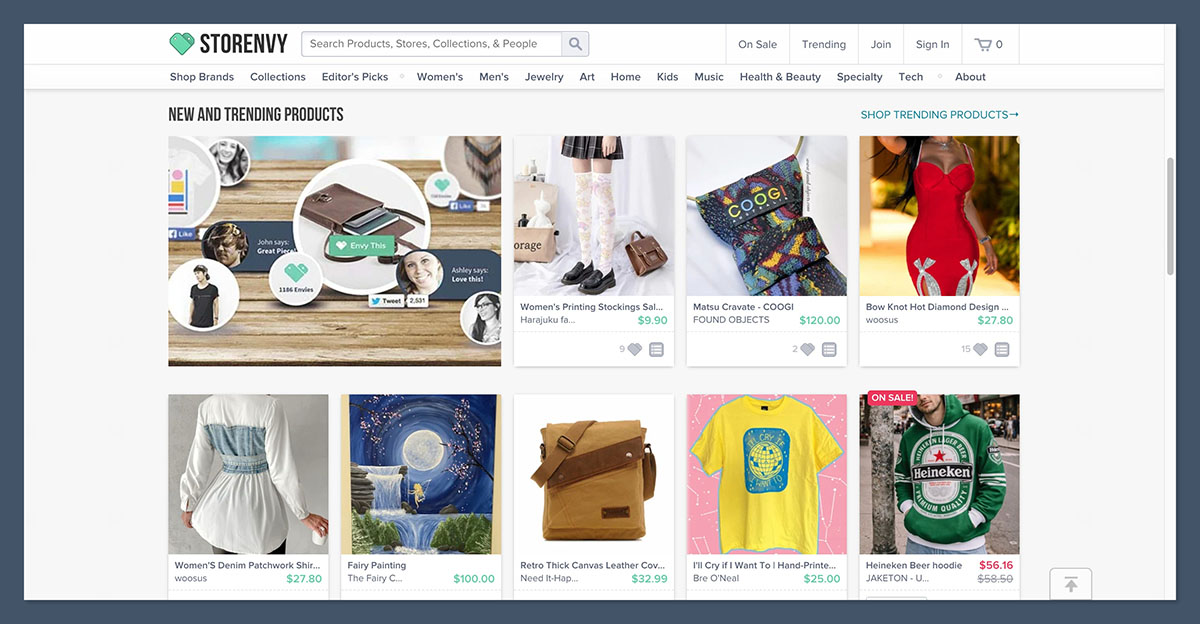
One of the things Storenvy is best known for is its marketplace, which functions a bit like a smaller, more curated Etsy. The marketplace features indie, handmade, and alternative brands, and inclusion requires application and approval.
The marketplace can drive incremental sales, but expectations need to be calibrated. As of mid-2025, Storenvy’s marketplace receives around 630,000 monthly visits. By comparison, Etsy attracts hundreds of millions of monthly visitors. The traffic gap is enormous.
What this means in practice is that the marketplace is unlikely to be a primary growth driver. Real seller data backs this up: most successful Storenvy merchants drive around 90% of their traffic from external sources like Instagram and TikTok, with the marketplace acting as a secondary discovery channel rather than a main source of customers.
That doesn’t make the marketplace useless. For a creator already promoting on social media, even a trickle of incremental marketplace traffic is a bonus. But anyone counting on marketplace discovery as their main route to customers should adjust expectations.
Note on visibility: Marketplace visibility on Storenvy depends largely on product photography and descriptions rather than SEO optimization. Strong visuals and clear copy will do more for you than keyword strategy here.
Storenvy pricing and value for money
Storenvy’s pricing structure is genuinely unusual, and it’s the platform’s main selling point.
| Plan | Monthly cost | Key features | Commission |
|---|---|---|---|
| Free | $0 | Basic store, marketplace access, unlimited products | 15% on marketplace sales only |
| Plus | $7.99 | Custom domain, email marketing tools | 15% on marketplace sales |
| Pro | $19.99 | Advanced inventory, premium themes | 15% on marketplace sales |
| Ultimate | $39.99 | Enhanced analytics, branding, priority support | 15% on marketplace sales |
A few things worth highlighting:
- The free plan genuinely is free — no credit card required at signup, and unlimited product listings included
- The 15% marketplace commission applies only to sales that come through Storenvy marketplace traffic. Sales you drive to your custom store through your own marketing efforts incur 0% platform commission
- Standard payment processing fees (around 2.9% + 30¢ via Stripe or PayPal) apply on top of any commission
- The same 15% marketplace commission applies regardless of which plan you’re on — paying more doesn’t lower it
For a creator who drives most of their traffic from social media, the math can be very favorable. You pay nothing to Storenvy on those sales, only standard payment processing fees, which is genuinely competitive against any monthly-fee platform.
That said, you need to weigh the savings against the platform’s limitations. If you’re saving $39 a month versus a Shopify Basic plan but missing out on better SEO, native POD integration, real shipping tools, and more sophisticated marketing features, the savings can quickly become a false economy as your business grows.
Customer support
This is one of Storenvy’s clearer weak spots. The platform offers email-only customer support during business hours (Monday to Friday, 9am to 5pm Pacific time), with response times of up to 24 hours. There’s no live chat and no phone support, even on the highest-tier paid plan.
Customer reviews of the support experience reveal significant trust concerns. On Trustpilot and similar consumer review sites, common complaints include orders not being fulfilled, poor communication from support, buyers not receiving refunds, and sellers being suspended without warning or clear explanation. Some review sites show ratings as low as 1 to 1.5 out of 5.
It’s worth noting that aggregate review scores for marketplace platforms can be skewed by frustrated buyers rather than reflecting the seller experience accurately. But the volume and consistency of negative feedback around support responsiveness is hard to dismiss, and it stands in sharp contrast to platforms like Shopify and Wix, which still provide 24/7 live support on most plans.
Competitive comparison
How does Storenvy stack up against the main alternatives?
| Platform | Monthly fee | Marketplace | POD integration | SEO tools | Customization | Support |
|---|---|---|---|---|---|---|
| Storenvy | $0 | Yes (small) | Manual only | Weak | Very limited | Email only |
| Shopify | $39+ | No | Native | Strong | High | 24/7 live chat |
| Etsy | $0 + fees | Yes (large) | Some | Weak | Limited | Ticket system |
| WooCommerce | Free + hosting | No | Via plugins | Strong | Advanced | Community |
| Big Cartel | $0 to $9.99 | No | Limited | Limited | Basic | Email only |
Storenvy occupies a fairly specific niche: budget-conscious creators who already have an audience to draw from and who prioritize zero upfront costs over advanced features. Outside that niche, most sellers will find a better fit elsewhere.
Market performance and platform health
One thing worth considering before committing to any platform is its trajectory. Storenvy’s traffic data tells a mixed story.
As of mid-2025, Storenvy received approximately 630,000 monthly visits, a 17.1% decrease from the previous month. The platform ranks around #67,017 globally and #18,134 in the United States. Q1 2026 data showed that the number of Storenvy stores decreased by 1.6% quarter-over-quarter, although it was up 6% year-over-year.
Traffic to the platform comes primarily from direct visits (around 40%) and Pinterest (around 16%), with the core audience based in the US, Canada, and the UK.
None of this is catastrophic, but it does suggest Storenvy isn’t growing in the way many of its competitors are. For sellers thinking about long-term platform investment, this is worth weighing alongside the feature comparison.
Real-life Storenvy user reviews
As part of my research for this piece, I looked at how real Storenvy users describe their experience with the platform. A few representative themes emerged.
“Storenvy was perfect when I was just starting out and didn’t want to commit to a monthly fee. I drove all my traffic from Instagram and TikTok, so the lack of marketplace traffic didn’t really matter to me. But once I started scaling, the lack of SEO tools and integrations became a real problem. I moved to Shopify last year and haven’t looked back.” — Indie apparel seller, US
“I run a small print shop selling art prints and the order volume is around 20 orders per month. Storenvy was free, which was the main attraction, but the design tools are really dated and I spent way more time than I should have trying to make the store look professional. Eventually migrated to Shopify for better tools and the difference in customer experience was immediate.” — Art print seller
In terms of wider feedback, aggregate review scores for Storenvy vary significantly by source:
| Site | Rating (out of 5) |
|---|---|
| G2 | 3.5 out of 5 |
| SpotSaaS | 3.1 out of 5 |
| Trustpilot | 1.5 out of 5 (heavily skewed by buyer complaints) |
The pattern here mirrors what we see with several marketplace-style platforms: seller-focused review sites show middling but workable scores, while consumer review sites trend much more negative due to buyer fulfillment and refund complaints. As a seller, you’re more likely to have an experience closer to the G2 score, but the Trustpilot data is still worth being aware of, particularly around customer support reliability.
Storenvy review: conclusion
Storenvy is a specific tool for a specific kind of user. For an indie creator or artist with a small inventory, an existing social media following, and a strong preference for zero upfront cost, it can be a genuinely sensible way to set up a storefront and start selling.
The free plan really is free, the dual-channel structure (custom store plus marketplace) provides some flexibility, and the 0% commission on self-driven sales is a real advantage compared to most monthly-fee platforms.
However, the limitations are significant and become more painful the further you try to grow. Design tools are dated, SEO is weak, there are no native POD integrations, shipping setup is manual, customer support has reliability issues, and the marketplace audience is small enough that it can’t really substitute for the discovery you’d get on Etsy or for the multi-channel selling you’d get on Shopify.
Most successful Storenvy users I came across in my research ended up migrating to a more developed platform within a year or two. That migration is doable, but it’s worth thinking about upfront: are you setting up Storenvy as a quick test, or as a long-term home for your business? For the former, it’s a reasonable choice. For the latter, you’re likely to find yourself replatforming sooner than you’d like.
A more complete summary of pros and cons follows below.
Reasons I think you should use Storenvy
- It’s genuinely free to start with, no credit card required
- You pay 0% platform commission on sales you drive yourself
- The dual-channel structure gives you a custom store plus marketplace exposure in one signup
- Setup is quick and the interface is beginner-friendly
- Unlimited product listings are included on all plans, including the free one
- The marketplace can drive some incremental sales for indie and handmade products
- It’s well suited to creators with existing audiences on Instagram, TikTok, or Pinterest
- The free plan removes financial risk when testing a product idea
Reasons I think you should avoid Storenvy
- Design and customization tools are very limited and feel dated by 2026 standards
- There’s no modern drag-and-drop visual editor
- SEO functionality is weak — no custom URLs, no meta control beyond product fields, no blogging
- There are no native integrations with print-on-demand services like Printful or Printify
- Shipping setup is manual with no real-time carrier rate integrations
- The marketplace traffic is a fraction of what Etsy offers
- Customer support is email-only with documented reliability issues
- There’s no abandoned cart recovery and no integration with major email marketing platforms
- Bulk product upload is restricted to paid plans
- You can’t customize checkout pages or product URLs
- The platform isn’t growing in the way most major competitors are
- Limited scalability — most successful sellers eventually migrate to a more capable platform
Overall score: 3 out of 5
Storenvy alternatives
There are several alternatives to Storenvy worth considering, depending on what you prioritize.
Shopify is the obvious step up if you need more robust tools, native POD integrations, and serious SEO capability. It costs more (from $39 per month after the introductory trial period), but it scales significantly further and is widely considered the strongest hosted ecommerce platform on the market.
Etsy is the natural comparison for indie and handmade sellers who want marketplace exposure. Etsy’s audience is dramatically larger than Storenvy’s, though listing fees and transaction fees add up, and customization is even more limited.
WooCommerce, paired with WordPress, is the strongest option if you want full control, advanced customization, and serious SEO capability without paying monthly platform fees. The trade-off is more setup work and hosting costs.
Big Cartel is the closest direct alternative to Storenvy in spirit: a low-cost, beginner-friendly platform aimed at indie creators. It doesn’t have a marketplace, but it’s similarly easy to set up.
Squarespace is worth considering if visual design quality matters to you and your ecommerce needs are relatively simple. Its drag-and-drop editor is significantly more polished than anything on Storenvy.
Storenvy review FAQ
Is Storenvy really free?
Yes, the free plan has no monthly fee and no credit card requirement at signup. You’ll only pay the 15% marketplace commission on sales that come specifically through Storenvy marketplace traffic, plus standard payment processing fees (around 2.9% + 30¢) on all transactions. Sales you drive through your own marketing have no platform commission.
Does Storenvy charge transaction fees?
Storenvy charges a 15% commission only on sales that originate from marketplace traffic. Sales generated through your own marketing efforts to your custom store have 0% platform commission. Standard payment processing fees from Stripe or PayPal apply to all transactions regardless of source.
Can I sell print-on-demand products on Storenvy?
Yes, but with significant friction. Storenvy has no native integrations with Printful, Printify, or other major POD services. You’ll need to use a third-party tool like Order Desk or Zapier to automate order routing, or fulfill orders manually. For high-volume POD sellers, this operational overhead is one of the strongest reasons to consider a platform like Shopify instead.
How does Storenvy compare to Etsy?
Etsy has a dramatically larger marketplace audience and is better suited to sellers who want marketplace discovery as a primary traffic source. Storenvy gives you more control over your custom storefront and charges no commission on self-driven sales, which can be more cost-effective if you’re already driving traffic from social media. Many sellers actually use both platforms simultaneously.
Can I use a custom domain on Storenvy?
Custom domains are not available on the free plan. You’ll need to upgrade to the Plus plan ($7.99 per month) or higher to connect your own domain.
Is Storenvy good for SEO?
No. SEO is one of Storenvy’s weakest areas. You can’t customize URLs, meta titles and descriptions are limited, there’s no blogging feature, and there’s no support for structured data or schema markup. If organic search traffic is important to your strategy, Shopify or WooCommerce are significantly better choices.
Can I migrate from Storenvy to another platform later?
Yes, and many successful Storenvy sellers eventually do. Most major platforms (Shopify in particular) offer migration tools or third-party migration services that can transfer products, customer data, and order history. The earlier you build a strong off-platform asset (like an email list and social following), the easier the eventual migration will be.
What’s the best alternative to Storenvy?
It depends on what you need. For most growing ecommerce businesses, Shopify is the strongest alternative due to its native integrations, SEO tools, and scalability. For marketplace exposure, Etsy is the natural comparison. For maximum control with no monthly platform fees, WooCommerce on WordPress is the strongest option.