Shopify and Gelato are two names that come up constantly when you’re researching how to sell custom products online.
But here’s the thing – they’re not actually competitors. After spending weeks testing both platforms for our ecommerce blog, I can tell you they serve completely different purposes.
Shopify is where you build your store. Gelato is how your orders get printed and shipped. Most successful print-on-demand sellers use both.
In this comparison, I’ll break down what each platform actually does, what it costs, and where each one earns its keep – so you can figure out the right setup for your business in 2026.
Shopify vs Gelato: Quick Verdict
Shopify – Best for building and owning your online store (3-day free trial, then $1/month for 3 months)
Gelato – Best for printing and shipping custom products globally (Free plan available, Gelato+ from $23.99/month)
These two platforms aren’t interchangeable. One is your storefront; the other is your production line. If you’re starting a print-on-demand business, you’ll probably end up using both.
Quick Comparison: Shopify vs Gelato
Get a quick and clear overview of where each platform fits in the table below:
| Feature | Shopify | Gelato |
|---|---|---|
| Primary Role | Storefront & Checkout | Manufacturing & Shipping |
| Starting Price | $39/mo (Basic plan) | $0/mo (Free plan) |
| Free Trial | 3 days + $1/mo for 3 months | Free forever plan + 14-day Gelato+ trial |
| Inventory Required? | No (software only) | No (print-on-demand) |
| Best For | Owning your brand & data | Getting products to customers fast |
| Global Reach | Sell in 175+ countries | 140+ print partners in 32 countries |
| Integration | 8,000+ third-party apps | Connects to Shopify, Etsy, WooCommerce |
Shopify vs Gelato Pros and Cons
| Shopify | Gelato | |
|---|---|---|
| Overall rating | 4.8 | 4.5 |
| Starting Price | $0/mo (Free plan) | |
| Free plan or free trial | 3-day free trial | Free forever plan + 14-day Gelato+ trial |
| Pros | • Reliable infrastructure that scales from $0 to $100M+ in revenue | • Excellent for international sellers – local shipping is cheaper and faster |
| • Best-in-class checkout with Shop Pay driving higher conversion rates | • Outstanding print quality, especially for wall art, fine art, and stationery | |
| • Massive app ecosystem means you can bolt on almost any feature | • No upfront costs – the free plan lets you start selling immediately | |
| • Strong multichannel selling across social, marketplaces, and in-person | • Fully automated workflow from order to delivery | |
| Cons | • Monthly fees add up – especially once you layer in paid apps and premium themes | • Smaller product catalog than competitors like Printify |
| • Transaction fees bite if your margins are thin and you’re not using Shopify Payments | • Base product pricing can be higher if you’re not on a paid subscription plan | |
| • Limited free templates – only 13 free themes out of 190+ | • Some users report inconsistent customer support on complex technical issues |
Key Takeaways
- Shopify handles everything customer-facing: your website, checkout, payments, and marketing
- Gelato handles everything behind the scenes: printing, packing, and shipping your orders
- You can start with Gelato’s free plan and Shopify’s $1/month intro deal to test the full setup for almost nothing.
- Gelato’s local fulfillment network is a serious advantage for EU/UK sellers.
- These platforms are complementary, not competing. Most POD sellers use both together.
1. Shopify: The Sales Engine
Shopify is a complete ecommerce ecosystem. It handles your domain, website design, payment processing, marketing tools, and analytics. When someone lands on your store, adds something to their cart, and checks out – that’s all Shopify.

I’ve tested Shopify extensively, and there’s a reason it powers millions of stores globally. The platform has matured significantly, and in 2026 the experience feels polished from the moment you sign up.
The onboarding asks a few questions about your business and then walks you through a setup checklist that actually helps, rather than just dumping you into a blank dashboard.
Key Features
- Website Builder: Shopify’s section-based editor is intuitive, even if it’s not drag-and-drop in the traditional sense. You stack elements like image carousels, text blocks, and product grids on top of one another. It’s restrictive in some ways, but the upside is that your store will always look clean and professional. There are over 190 themes to choose from, though only around 13 are free.
- Shopify Payments: The built-in payment gateway eliminates the need for third-party processors. Shop Pay, Shopify’s accelerated checkout, consistently delivers some of the highest conversion rates in ecommerce. If you use a third-party payment gateway instead, Shopify charges an additional 0.6% to 2.0% per transaction depending on your plan.
- App Store: Over 8,000 third-party apps cover everything from SEO and email marketing to reviews, upsells, and automation. The catch? Shopify leans heavily on this ecosystem. Some functionality you’d expect built-in requires downloading an app, and many of the best ones carry their own monthly fees.
- Multichannel Selling: You can connect your store to Instagram, TikTok, Amazon, and other marketplaces from one dashboard. Syncing inventory across channels is seamless, which saves hours of manual work.
- AI Tools: Shopify Magic helps generate product descriptions, email subject lines, and other marketing copy. It’s not going to replace a good copywriter, but it speeds things up when you’re listing dozens of products.
Shopify Pricing
Shopify’s pricing depends on whether you pay monthly or annually. Annual billing knocks 25% off across the board. Here’s the breakdown:
| Plan | Monthly | Annual (per month) | Online Transaction Fee* |
|---|---|---|---|
| Starter | $5 | — | 5% (no full website) |
| Basic | $39 | $29 | 2.9% + 30¢ |
| Grow | $105 | $79 | 2.6% + 30¢ |
| Advanced | $399 | $299 | 2.4% + 30¢ |
*Credit card rates via Shopify Payments. An additional 0.6%–2.0% fee applies if you use a third-party payment gateway.

✍️ Author’s Note Shopify’s $1/month introductory deal for the first three months is genuinely useful. It gives you enough time to build your store, connect Gelato, list your first products, and start running ads before you’re paying full price. Don’t underestimate how valuable that runway is when you’re bootstrapping. |
| Shopify is unmatched as a storefront for print-on-demand businesses Shopify gives you full control over your brand, customer experience, and data. Its payment processing, marketing tools, and app ecosystem make it the strongest foundation for any ecommerce business that wants to grow beyond a hobby. |
2. Gelato: The Production Line
Gelato is a global print-on-demand fulfillment network.
When a customer buys from your Shopify store, Gelato automatically receives the order, routes it to the printing partner closest to your customer, and ships it directly to them. You never touch a box.

I tested the Gelato integration with Shopify, and the automation is impressive. Once connected, orders flow through without any manual intervention. A customer in London gets their poster printed in the UK. Someone in Chicago gets theirs from a facility in the US.
That local production model is Gelato’s biggest selling point – it cuts shipping times and reduces costs compared to services that ship everything from a single warehouse.
Key Features
- Local Fulfillment: Gelato operates 140+ production partners across 32 countries. Orders are automatically routed to the nearest facility, which reduces shipping times and carbon emissions. This is a massive advantage for anyone selling into European or UK markets.
- Product Catalog: The catalog includes apparel (t-shirts, hoodies, activewear), wall art, phone cases, mugs, tote bags, stationery, and more. It’s not the largest catalog in the POD space – competitors like Printify offer more variety – but the quality of Gelato’s prints, particularly for wall art and fine art products, is consistently excellent.
- Branding Options: On the Gelato+ paid plan, you get access to branded packaging inserts and labels. It’s a small detail that makes a big difference. Your packages stop looking like they came from a random print shop and start looking like an intentional brand experience.
- Automation & AI Tools: Orders sync automatically from your connected stores. Gelato+ subscribers also get access to Magic Mockups (AI-generated product photos), an SEO title/description generator, and a Price Navigator tool for adjusting margins across your catalog.
- Personalization Studio: Available on Gelato+, this tool lets customers customize products with names, dates, or messages. It handles the personalization automatically – no manual template editing required. Ideal for gift shops and personalized product sellers.
Gelato Pricing
Gelato works on a pay-per-order model with optional subscription plans for discounts and premium tools:
| Plan | Price | Key Benefits |
|---|---|---|
| Free | $0/month | Unlimited products, Shopify/Etsy integration, design editor |
| Gelato+ | $23.99/month | Up to 25% off products, Magic Mockups, branded packaging, AI tools |
| Gelato+ Annual | $19.99/month | Same as Gelato+ with 17% savings, exclusive promotions |
| Platinum | Custom pricing | Up to 35% off, dedicated account manager, high-volume support |
Gelato never charges commission. You pay only the product cost and shipping when an order is placed.
| 🔍 What the Researchers Think Gelato’s local fulfillment model is its biggest differentiator. In our testing, orders shipped to European customers arrived 2–4 days faster than competitors shipping from a single US-based warehouse. For sellers targeting the EU and UK, this alone can justify choosing Gelato over alternatives like Printify or Printful. |
| ⚠️ Top Tip Order samples before you list anything. Gelato offers 50% off your first sample order within 48 hours of signing up. Take advantage of this to check print quality, packaging, and delivery times for your specific products and target markets. |
| Gelato is the strongest choice for global POD fulfillment Gelato’s distributed production network delivers faster shipping and lower costs for international sellers. If you’re selling wall art, apparel, or stationery to customers across multiple countries, Gelato handles the logistics so you can focus on design and marketing. |
3. How They Work Together: The Full Picture
This is the part most comparison articles get wrong. They pit Shopify against Gelato like you need to pick one. You don’t. They do completely different jobs, and the most successful print-on-demand businesses use both.
Here’s how the typical workflow looks:
Step 1: You build your online store on Shopify. You choose a theme, customize your branding, set up your domain, and configure payments.
Step 2: You install the Gelato app from the Shopify App Store. It’s free to install and takes minutes to connect.
Step 3: You design your products in Gelato’s editor and publish them directly to your Shopify store.
Step 4: A customer visits your Shopify store and places an order. Shopify processes the payment.
Step 5: Gelato automatically receives the order, prints the product at the facility closest to your customer, and ships it directly to them.
Step 6: Tracking information syncs back to Shopify. Your customer gets a shipping notification. You didn’t lift a finger.
The entire process – from payment to delivery – is automated. That’s the power of using these two platforms together. Shopify handles the “front end” (what the customer sees), and Gelato handles the “back end” (what happens after they buy).
4. Category-by-Category Comparison
Best for Pricing: It Depends on Your Model
Comparing the pricing of Shopify and Gelato head-to-head doesn’t make much sense because you’re paying for different things.
Shopify is a subscription for your storefront. Gelato is a per-order cost for production. That said, here’s what your total monthly outlay might look like:
Cost Component | Shopify | Gelato |
Platform Fee | $29–$399/month | $0–$23.99/month |
Transaction Fees | 2.4%–2.9% + 30¢ | None (you pay product cost) |
Product Cost | N/A (you source products) | Per-order (varies by product) |
Free Trial | 3 days + $1/mo for 3 months | Free plan forever + 14-day Gelato+ trial |
Hidden Costs | Apps, themes, domain | Shipping fees vary by destination |
For a new POD seller starting lean, you could realistically begin with Shopify Basic at $29/month (annual) and Gelato’s free plan. That means your only ongoing costs are the Shopify subscription plus the per-order production and shipping fees from Gelato. Not bad for a fully automated global business.
🏆 The Winner It’s a different kind of expense You can’t avoid Shopify’s monthly fee if you want a professional store. But Gelato’s free plan means your fulfillment costs scale directly with sales – no revenue, no cost. Together, the entry barrier is surprisingly low. |
Best for Ease of Use: Shopify
Shopify’s onboarding experience is significantly smoother than most ecommerce platforms I’ve tested. You answer a few questions about your business, and within minutes, you’re looking at your dashboard with a clear setup checklist. The editor is intuitive, and the product management backend is well-organized.
Gelato’s interface is clean but has a learning curve. Connecting your store is straightforward, but navigating the product creation workflow, choosing a product, uploading designs, setting up sizing and placement, configuring pricing across regions, takes some getting used to. Once you’ve been through it a few times, it’s fine. But it’s not as immediately obvious as Shopify.
🏆 The Winner Shopify is easier to pick up and start using right away Shopify’s onboarding and editor are designed for people who have never built a website before. Gelato is slightly more complex, but once you understand the workflow, both platforms work together smoothly. |
Best for Product Catalog: Gelato
This one’s straightforward. Shopify doesn’t have a product catalog – it’s a software platform. You source or create your own products. Gelato, on the other hand, gives you a ready-made catalog of items to customize and sell.
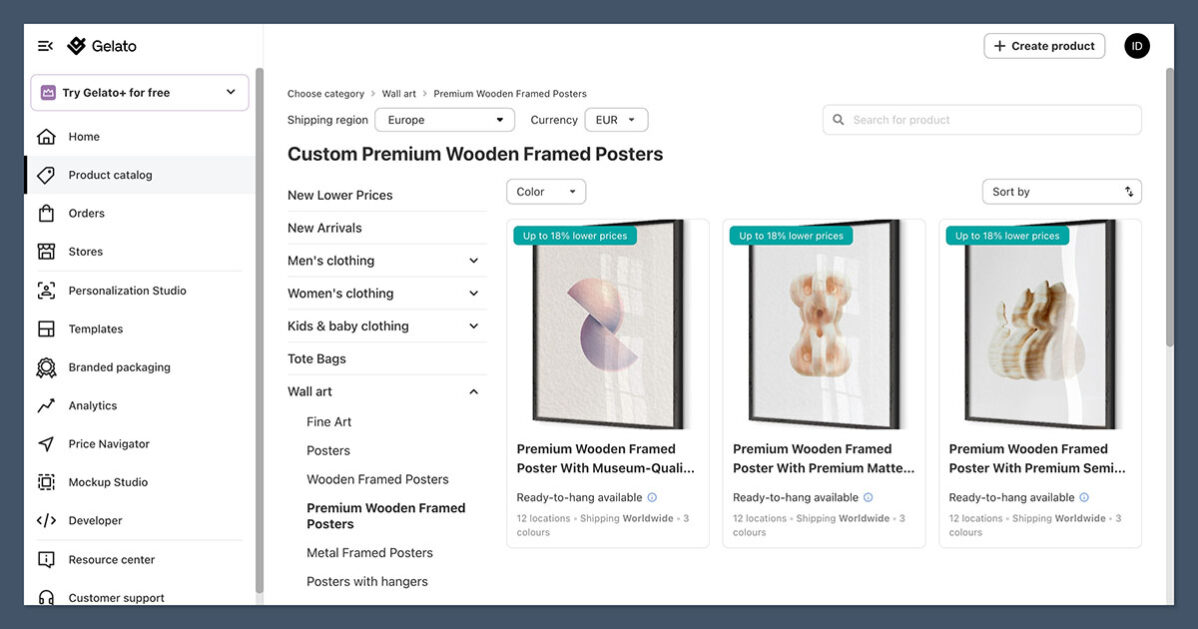
Gelato’s focused catalog delivers consistent print quality
Shopify supplies no products of its own, while Gelato offers 100+ customizable items with a controlled production network that keeps quality consistent across countries.
Shopify doesn’t manufacture anything, so any product comparison is really a comparison between Gelato and the other suppliers you could plug into Shopify. Still, Gelato’s catalog strategy deserves a closer look, because it’s deliberately different from its biggest competitors.
What Can You Sell With Gelato?
Gelato offers over 100 customizable products, with particular depth in print-heavy categories:
- Wall art, posters, framed prints, and canvases
- Core apparel like t-shirts and hoodies
- Mugs, water bottles, and phone cases
- Photobooks, calendars, and cards
That’s a smaller catalog than marketplace-style competitors like Printify, which lists thousands of products across hundreds of independent print providers. The trade-off is consistency.
Because Gelato operates a controlled network with a single quality standard across its partners, sellers tend to report fewer quality surprises and less variability between orders than with marketplace models, where each print provider sets its own standards.
If your brand is built on art prints, photography, or creator merch, Gelato’s catalog covers you well. If you want to sell experimental or unusual products, you’ll need to supplement it with another supplier, which is exactly what Shopify’s multi-app setup makes easy.
Gelato’s AI Merchandising Tools
Gelato has also been investing in AI-assisted tooling that speeds up the product creation side of the business:
- Magic Mockups: AI-generated product mockups, so you don’t need to shoot or design listing images manually
- Instant Collections: Quickly spin up coordinated product collections from a single design
- Velocity Switch: A migration tool that moves existing Shopify or Etsy listings from another POD supplier over to Gelato’s catalog in minutes
That last one matters if you’re an existing POD seller considering a switch. Migration friction is usually the biggest reason sellers stay with an underperforming supplier, and Gelato has clearly built tooling to remove that excuse.
🏆 The Winner Gelato provides the product catalog; Shopify provides the place to sell it These aren’t competing on the same axis. Gelato gives you physical products to sell. Shopify gives you the store to sell them in. |
Best for Marketing: Shopify
Marketing is entirely Shopify’s domain. Gelato doesn’t have marketing tools because that’s not its job. Shopify, on the other hand, gives you a comprehensive marketing toolkit.
Shopify Email lets you build and send branded email campaigns directly from your admin panel. You can connect your store to Instagram, TikTok, Facebook, Pinterest, and Amazon for multichannel selling. The Shopify Marketplace Connect app syncs your products across these channels so you’re not duplicating work. And Shopify’s built-in SEO features – plus integrations with tools like Semrush – help you drive organic traffic.
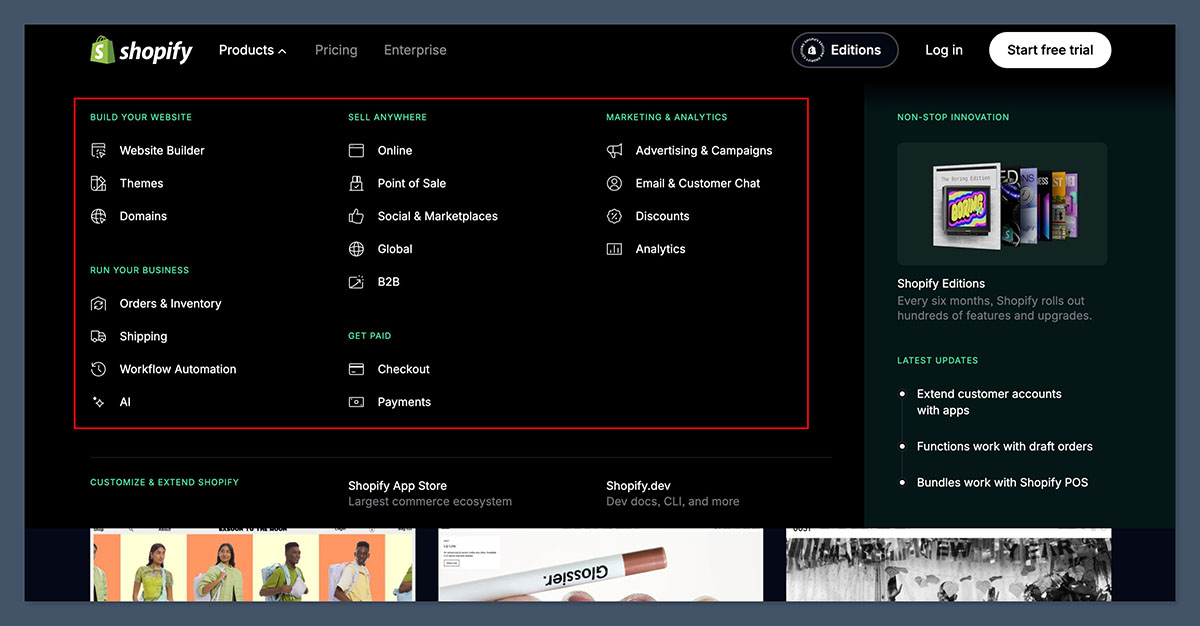
Gelato does provide some AI tools for writing product descriptions and generating mockup images, which indirectly support your marketing. But the heavy lifting happens on Shopify.
🏆 The Winner Shopify’s marketing features are built for growth From email campaigns to social selling to SEO tools, Shopify gives you everything you need to get eyes on your products. Gelato helps you create the content; Shopify helps you distribute it. |
Best for Global Selling: Gelato
If you’re selling to customers in multiple countries – especially in Europe and the UK – Gelato’s local fulfillment model is a game-changer. Orders are printed at the nearest facility to the customer, which means faster delivery, lower shipping costs, and fewer customs headaches.
Shopify supports international selling with multi-currency features, language translations (30+ languages), and the ability to redirect customers based on their location. But Shopify handles the digital side of internationalization. Gelato handles the physical side – actually getting products to customers across borders efficiently.
🏆 The Winner Gelato’s local production network is unmatched for international fulfillment For EU/UK sellers especially, Gelato’s distributed printing network eliminates the pain points of international shipping. Combined with Shopify’s multi-currency and multi-language features, you have a truly global operation. |
Best for Support: Shopify
Shopify offers 24/7 live chat support (AI-assisted with human escalation), an extensive Help Center with guides and video tutorials, and a large community forum. Phone support is available for Shopify Plus merchants. The Help Center is genuinely thorough – I’ve rarely hit a dead end when searching for answers.
Gelato provides 24/7 support through chat and email. Their help documentation covers the basics well, but some users have reported slower response times on complex technical issues. For straightforward questions about orders, integrations, or product setup, Gelato’s support is generally fine. For edge cases, it can be hit or miss.
| 🏆 The Winner Shopify’s support infrastructure is more comprehensive. Shopify’s combination of 24/7 live chat, a detailed Help Center, community forums, and business courses gives merchants more resources to solve problems independently or get direct help. |
5. Who Should Use What?
Use Shopify If…
You want to build a professional, long-term brand. You need full control over your customer’s journey, from the moment they land on your site to the emails they receive after buying. Shopify is for the serious entrepreneur who wants a “home base” for their business – not just a listing on someone else’s marketplace.
Use Gelato If…
You want to sell custom designs globally without the headache of international shipping, customs, and inventory management. Gelato is specifically the best choice for artists selling wall art or stationery, and for sellers focused on EU/UK markets where the local fulfillment network is strongest.
Use Both If…
You’re building a print-on-demand business and want the whole thing automated. Shopify handles the customer-facing side, Gelato handles the fulfillment side, and the two platforms talk to each other seamlessly through the Gelato Shopify app. This is the setup most successful POD sellers use.
| 💡 The Winning Setup Shopify as the “Front-End” + Gelato as the “Back-End” = a fully automated business where customers buy from your branded store and receive locally-produced products within days, anywhere in the world. The entire payment-to-delivery pipeline runs without manual intervention. |
How To Choose Between (and Combine) Shopify and Gelato
Because these platforms solve different problems, the real question is which parts of the stack you need and when. A few scenarios to guide the decision:
You’re brand new to print on demand. Start with the lowest fixed cost setup: Shopify Basic plus Gelato’s free plan. Your only recurring cost is the Shopify subscription, and Gelato only charges you when orders come in. Don’t upgrade anything until volume justifies it.
Your audience is international. Gelato should be high on your supplier shortlist regardless of which platform you build on. Local production in 32 countries is a structural advantage for non-US customers that single-warehouse suppliers can’t replicate.
You sell art prints, posters, or photography. This is Gelato’s strongest category. The catalog depth in wall art, combined with consistent print quality across its network, makes it a natural fit for visual creators.
You want maximum product variety. Keep Shopify as your platform and treat Gelato as one supplier among several. Add a marketplace-style POD app for the long-tail products Gelato doesn’t carry.
You’re scaling past your first few hundred orders a month. Run the Gelato+ break-even math on your actual order mix, and look at whether your Shopify plan still fits. Upgrading both tends to pay for itself at volume through product discounts and lower card rates.
How We Compared Shopify and Gelato
To compare these two platforms fairly given their different roles, I assessed each one against the criteria that matter most to a print on demand business, verified current pricing directly from both companies, and weighted the categories by their impact on a typical seller’s bottom line.
| Area of investigation | What we looked at | Winner |
|---|---|---|
| Pricing | Fixed costs, transaction fees, paid tiers, and break-even points | Gelato |
| Sales features | Checkout, payment options, multi-channel selling, personalization | Shopify |
| Products and quality | Catalog depth, print quality consistency, merchandising tools | Gelato |
| Fulfillment and shipping | Delivery speed, global coverage, shipping costs, sustainability | Gelato |
| Marketing and analytics | SEO tools, email marketing, reporting, integrations | Shopify |
| Setup and ease of use | Onboarding flow, integration speed, automation | Shopify |
Final Verdict on Shopify vs Gelato
There’s no single winner here, because Shopify and Gelato aren’t competing for the same job. Shopify is the best platform for owning your storefront, your customer data, and your growth levers. Gelato is one of the best fulfillment networks you can attach to that store, especially if your customers are spread across multiple continents.
The honest recommendation for most print on demand sellers is both:
- Choose Shopify if you’re deciding where to build. A branded store on your own domain, with full control over funnels, email lists, and SEO, is a long-term asset that no marketplace or supplier dashboard can replace.
- Choose Gelato if you’re deciding who fulfills your orders, particularly for print-centric catalogs and international audiences. Its local production model delivers faster shipping, better margins on global orders, and a sustainability story you can build into your brand.
Start lean with Shopify Basic and Gelato’s free plan, prove your designs sell, and let your order volume tell you when it’s time to upgrade either side of the stack.
FAQs
Is Gelato free to use with Shopify?
Yes. The Gelato app is free to install from the Shopify App Store, and Gelato’s core service has no monthly fee. You only pay production and shipping costs when a customer places an order. You’ll still need a Shopify subscription to run the store itself, starting at $29 per month billed annually.
Does Gelato replace Shopify?
No. Gelato handles production and shipping, but it doesn’t provide a storefront, checkout, or payment processing. You need a sales channel for customers to buy from, and Shopify is the most popular option. Gelato also integrates with Etsy, Order Desk, and custom setups via its API.
How fast does Gelato ship orders?
Around 90% of Gelato’s products are delivered within five days. Because orders are routed to the production hub nearest the customer, delivery times stay consistent across regions instead of degrading for international buyers the way they do with single-warehouse suppliers.
Is Gelato+ worth the subscription?
It depends on your volume. Gelato+ costs $24 per month (or $239 per year) and unlocks product discounts, premium mockups, and branded packaging options. As a rule of thumb, divide the subscription price by your average per-order saving. For most sellers, the plan pays for itself at around 8 to 12 orders per month. Below that, the free plan is the better deal.
How does Gelato compare to Printful or Printify?
Gelato’s main advantages are its localized production network and consistent quality standards. Printify offers a much larger catalog through its marketplace of independent print providers, but with more variability in quality and shipping. Printful operates its own facilities with strong branding options but a more centralized footprint. For globally distributed audiences, Gelato’s local production typically wins on delivery speed and shipping cost.
Can I use multiple print on demand suppliers on one Shopify store?
Yes, and many sellers do. Shopify lets you run several POD apps side by side, so you can use Gelato for wall art and core apparel while sourcing niche products from other suppliers, all under one storefront and one checkout.