A band selling tees after shows needs a different shop from a ceramicist waiting for their first online customer. Big Cartel vs Etsy is a question of where your buyers come from, and what you pay to reach them.
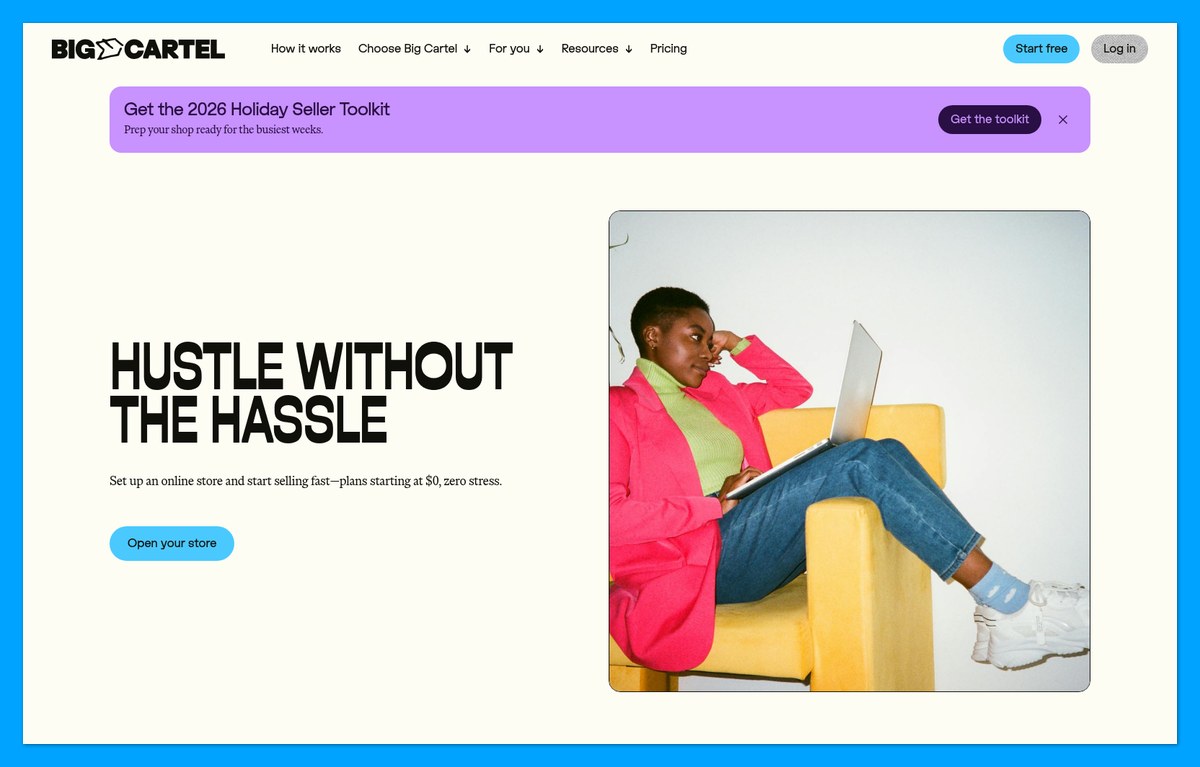
Etsy is a marketplace with 87.5 million active buyers that takes a cut of every online order. Big Cartel is your own storefront for $0, $15 or $30 a month, plus payment processing, but it brings no shoppers of its own.
Etsy’s AI licensing changes have also prompted artists to reconsider where they sell. Etsy rewrote that language on November 23, 2026, ahead of its December 16 effective date. The revision adds a no-copycat commitment, not a blanket ban on AI training.
I compared four typical shops and calculated their fees: an illustrator selling prints, a band selling merch, a crafter with 20 listings, and a print-on-demand seller. Each gets a different recommendation, followed by the AI terms, running two shops, and what fits your stage.
For broader platform coverage, see the Big Cartel review and Etsy review. Start below with the seller whose products and sales channels look most like yours.


Big Cartel and Etsy at a Glance
Etsy charges for selling within a marketplace; Big Cartel charges for a storefront where you supply the visitors.
| Big Cartel | Etsy | |
|---|---|---|
| What it is | Your standalone store; you bring visitors | A marketplace where buyers search across sellers |
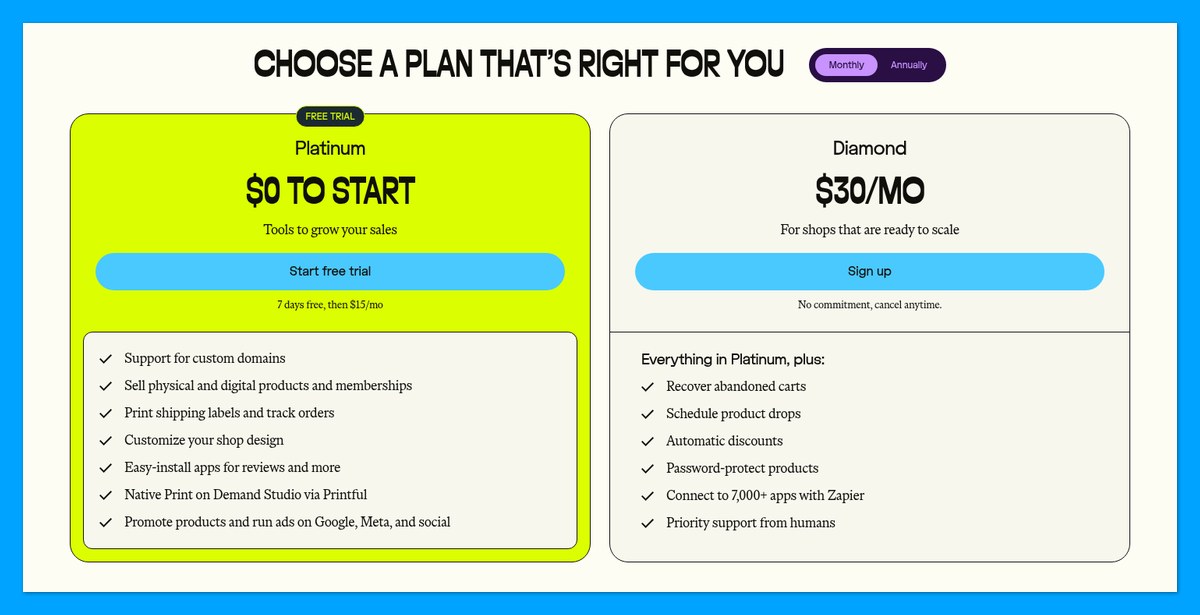
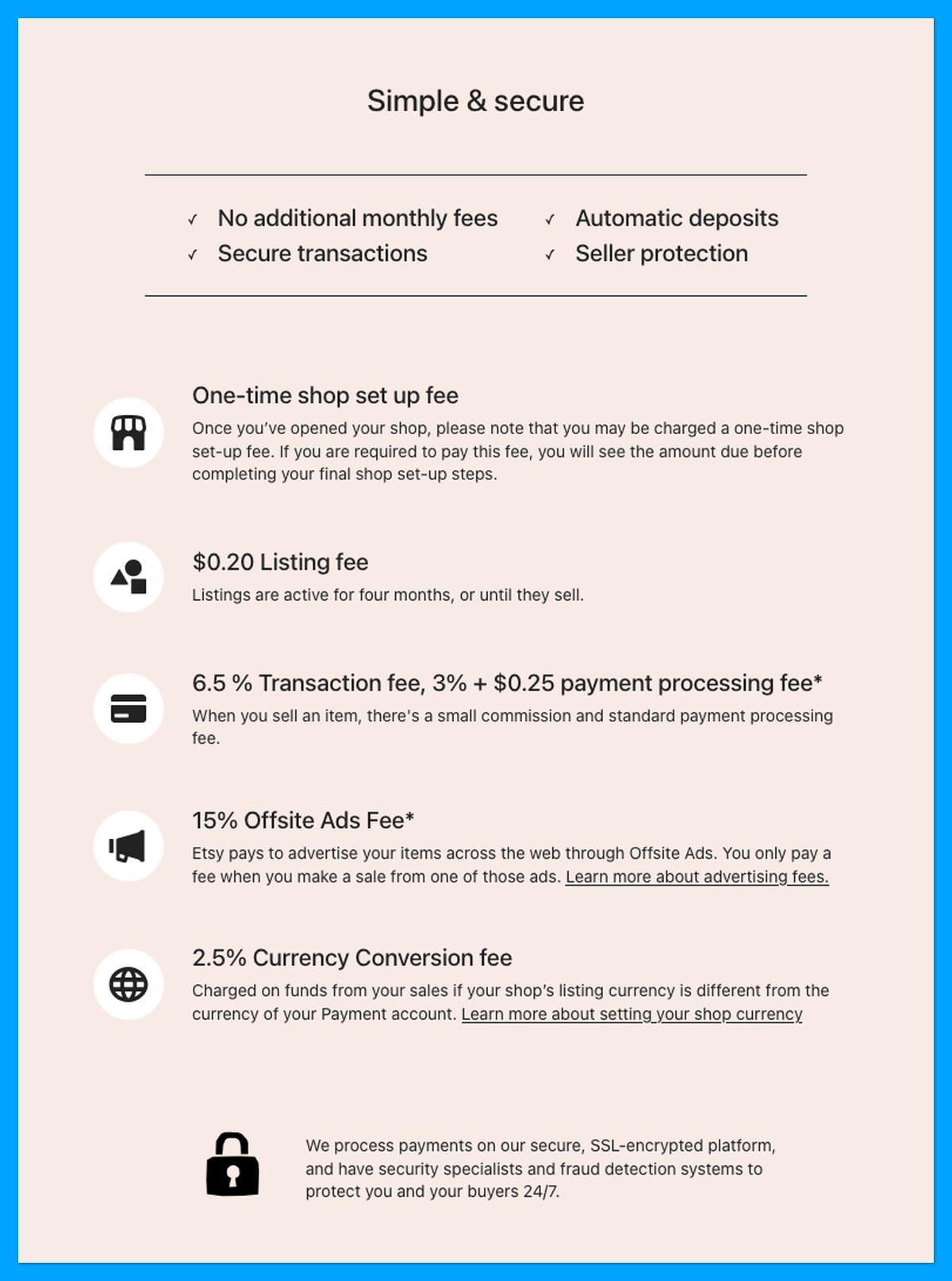
| Monthly cost | Gold $0; Platinum $15; Diamond $30. Annual paid plans: $144 or $288 | No required subscription; optional Etsy Plus $10; separate set-up fee |
| Product cap | Gold 5; Platinum 50; Diamond 500 | No cap; $0.20 to list or renew each item |
| Platform cut per order | 0% on every plan | 6.5% online, including charged shipping; listing fees also apply |
| Payment processing | Stripe 2.9% + $0.30; PayPal Checkout 3.49% + $0.49 | US Etsy Payments 3% + $0.25 |
| Shoppers it brings | No built-in marketplace | 87.5 million active buyers, Q3 2026 |
| Print on demand apps | Paid plans: Printful, Printify, theprintspace, Art of Where | Printful, Printify, Gelato, Art of Where |
| Digital downloads | Paid plans; files up to 1GB; digital variants supported | Five files per listing, 20MB each; no digital variations |
| Selling at markets | Paid plans; app records cash, processes cards through Stripe | Square connection; separate in-person fees |
| Timed drops | Diamond scheduling and password-protected products | No built-in listing scheduler |
| AI training terms | Purpose-limited license; optional crawler blocking; no never-train promise | Express training permission; no-copycat commitment; perpetual license |
Etsy trades margin for access to buyers, though marketplace access doesn’t guarantee orders. Big Cartel reduces platform fees when you already bring the customers, but its lower bill cannot replace sales lost by leaving Etsy search.
How I Worked Out the Fees
I priced four typical US shops using published rates as of November 2026, keeping order volumes identical.
- Etsy: $0.20 per listing or renewal, a 6.5% transaction fee, and US payment processing of 3% + $0.25.
- Big Cartel: The monthly plan price plus Stripe’s 2.9% + $0.30 online card rate.
- PayPal Checkout: 3.49% + $0.49, which costs more in these examples.
Sales tax is excluded, along with Etsy’s one-time set-up fee, which varies by location and appears during registration. Etsy totals allocate one listing charge per sold item; initial catalog uploads and unsold listing renewals cost extra.
Offsite Ads appear separately because the charge applies to attributed orders, not every sale. A buyer must click an ad and order within 30 days.
Annual Big Cartel figures are monthly equivalents of an annual payment, not month-to-month prices. These calculations compare selling fees, not profit: subtract production and fulfillment costs before deciding what you keep from each order.
If You’re an Illustrator Selling Prints
My Call for Illustrators
Choose Big Cartel Platinum once your following buys through your links. An Instagram audience or newsletter that already sells your prints gives you a reason to stop paying marketplace fees on those orders.
While you’re still finding buyers, I favor Etsy for discovery. Big Cartel Gold can hold five physical prints, but it won’t find customers for you or deliver digital downloads.
Count orders from your own channels, not followers. If your newsletter promotes a print collection but Etsy search generates the purchases, you haven’t yet established a replacement sales channel.
The Numbers on 25 Prints a Month
Take 25 print orders at $30 each, with free shipping: $750 in monthly sales.
- Etsy: $82.50 a month. Each order costs $3.30 in fees, or 11% of the sale.
- Big Cartel Platinum: $44.25 a month. Stripe costs $1.17 per order, totaling $29.25, plus the $15 subscription.
- Annual Platinum billing: $41.25 per month equivalent. You pay the subscription annually.
- PayPal Checkout instead of Stripe: $53.43 a month on monthly Platinum billing.
The Stripe comparison leaves a $38.25 monthly gap. With a $2.13 per-order saving, Platinum pays for itself on the eighth order of the month, or the sixth with annual billing.
One Etsy Offsite Ads sale at 15% adds $4.50. Include that charge when calculating what remains after printing and postage.
For an $8 digital printable, Etsy keeps $1.21, or 15.13%. Stripe on Big Cartel costs $0.53, before allocating the paid-plan subscription. A digital-only shop still needs enough orders to cover that subscription.
What Decides It for Illustrators
- Presentation: Platinum supports your own domain and full theme-code editing, with five images per product. Show the framed print, paper detail and a scale reference rather than repeating the same flat image. Gold permits one image per product and no custom domain.
- Fine-art production: theprintspace connects to Big Cartel for fine-art prints but lists no Etsy integration; Art of Where works with either platform. Choose the printer before the storefront, especially if a particular paper or print finish is central to your work.
- Digital delivery: Etsy accepts five files of 20MB each, without digital variations. Big Cartel Platinum allows one file or link per product and 25GB total storage; Diamond allows five files or links. Files can reach 1GB, and one option per digital product lets you offer variants such as file formats or licenses.
- Rights and printing: Illustrators have the highest exposure to content licensing because the artwork itself is the product; read the AI section before uploading a collection. Separately, Etsy’s Ventur Editions printing test may automatically include US and Canadian digital sellers. Opt out shop-wide in Shop Manager if you object; creators receive no extra pay when buyers print their downloads.
Big Cartel cannot combine physical and digital versions in one product. Create separate listings if you sell the same illustration as a shipped print and a downloadable file.
If prints are only part of your catalog, compare the best places to sell art online before moving everything. Use the guide to selling digital products to plan your download range.
Ready to send existing fans to your storefront? Start with Big Cartel and choose the plan that fits your files and catalog.
If You Sell Band Merch
My Call for Bands
Choose Big Cartel when fans arrive from shows, socials and your mailing list. Etsy’s marketplace cut buys you little when someone already knows which band’s tee they want.
Start with Platinum for a straightforward merch catalog. Choose Diamond for scheduled drops and password-protected presales, not simply because you hope to sell more shirts.
A range of tees, posters and stickers can fit within Platinum’s 50-product cap. Before upgrading, identify the release that needs Diamond’s launch controls: a timed tour-shirt drop or a fan-club presale is a stronger reason than an ambitious sales forecast.
The Numbers on Tour and Online
For 40 online orders a month, each containing a $25 tee plus $5 shipping, the totals are Etsy $132.00, Big Cartel Platinum $61.80, or Diamond $76.80 monthly. Big Cartel’s figures include $46.80 in Stripe processing plus the applicable subscription.
Now take 60 tees sold at $25 each from the merch table:
- Etsy through Square: $60.00. Each sale costs $0.80 in Square processing plus $0.20 to Etsy.
- Big Cartel through a Stripe reader: $43.50. Processing costs $0.725 per sale.
- Big Cartel through Tap to Pay: $49.50. Processing costs $0.825 per sale.
Those merch-table figures are transaction costs, excluding hardware and any Big Cartel subscription already counted above. Etsy doesn’t charge its 6.5% transaction fee or Etsy Payments fee on Square sales, but the $0.20 charge remains.
Don’t apply Etsy’s online fee stack to your whole tour takings. Separate website orders from merch-table sales when estimating costs, and include a reader purchase if you need one.
For a band doing both, the online savings support Big Cartel’s case without pretending every in-person sale carries Etsy’s full online fees.
What Decides It for Bands
- Drops and presales: Diamond’s Scheduled Drops can display a Coming Soon product without a price or Add to Cart button. It sends a reminder 24 hours before launch and a notification at launch; release time follows your device clock, so check it while traveling. Password-protected products suit fan-club presales, while Etsy has no built-in listing scheduler.
- Recurring support: Big Cartel’s paid plans support memberships for recurring donations or monthly subscriptions. Use that option for fans who want to support the band between releases instead of buying another tee.
- The merch table: Platinum includes the app’s Cash Register to record cash and take cards through Stripe. Readers start at $59; Tap to Pay works on an iPhone XS or later or compatible Android device. Big Cartel does not remit sales tax for in-person sales, so account for it in your tour bookkeeping.
- Tees without stocked sizes: Printful and Printify connect on paid plans. Use POD for online orders you don’t want to carry on tour; in-person checkout is for stock you actually bring.
- Your sales channels: Etsy prohibits steering its buyers to another venue to complete a purchase. Promote Big Cartel through your own show flyers, newsletter and social accounts.
For a band deciding how merch fits alongside music sales, read Shopify vs Bandcamp. If your question is a standalone store versus a merch-focused service, Shopify vs Spreadshop covers that choice.
If You’re a Crafter With About 20 Listings
My Call for Crafters
Start with Etsy unless craft fairs or Instagram already bring you regular buyers. A small catalog of ceramics or earrings needs people to see it before lower transaction costs become useful.
Add Big Cartel when your own channels generate five or more orders a month at the order value below. That is a more useful trigger than moving because one Etsy fee feels irritating.
If you already have a craft-fair following, you may reach that point immediately. Otherwise, give Etsy’s discovery role more weight than the smaller Big Cartel bill.
The Numbers on 12 Orders a Month
For a shop with 20 listings, take 12 monthly orders at $45 per item plus $8 shipping. The $53 order total matters because Etsy charges its transaction fee on shipping too.
- Etsy: $65.82 a month. The fee is $5.485 per order, or 10.35%.
- Big Cartel Platinum: $37.04 a month. Stripe costs $1.837 per order, totaling $22.04, plus the $15 subscription.
- Monthly gap: $28.78. Gold cannot hold the whole catalog because it stops at five products.
The per-order saving is $3.65. Platinum pays for itself from the fifth monthly order that comes from your own audience, or the fourth on annual billing.
One Offsite Ads sale at 15% adds $7.95. You can opt out below $10,000 in trailing 365-day sales; reaching $10,000 makes participation mandatory at 12%.
I wouldn’t move a ceramics shop just to save $28.78 if those 12 orders come from Etsy search. Keep Etsy available while you establish whether craft-fair customers will buy again through your own links.
What Decides It for Crafters
- Discovery versus competition: Etsy reported 87.5 million active buyers and 5.8 million active sellers in Q3 2026. Your earrings can reach shoppers who have never heard of you, but you compete with other makers and mass-produced listings. Treat marketplace access as an opportunity, not a sales forecast.
- Craft-fair checkout: Etsy connects to Square through Shop Manager > Sales Channels > Sell in person. Square charges 2.6% + $0.15, with Etsy’s $0.20 renewal or manual transaction charge and no 6.5% Etsy cut. Big Cartel’s own in-person app requires Platinum or Diamond, so Gold won’t cover your stall checkout.
- Packing and postage: Platinum includes label printing with advertised shipping discounts of up to 90%. Don’t treat the maximum discount as your expected saving on a box of ceramics. Compare the actual package and service, using the ecommerce shipping guide to plan fulfillment.
- Listing upkeep: Etsy listings renew every four months for $0.20, sold or not, unless you use manual renewals. Review slow-moving pieces before renewing them rather than treating the catalog as a one-time expense. Distinguish charges for unsold stock from the sold-item fees calculated above.
If marketplace discovery is your priority, Amazon Handmade vs Etsy gives you another comparison aimed at handmade sellers.
For a new maker without a buying audience, open an Etsy shop and use your first orders to decide which pieces to replenish. Keep your catalog focused on work you can produce and ship profitably.
If You Run a Print-on-Demand Shop
My Call for POD Sellers
Choose Etsy for niche designs without an audience; choose Big Cartel once your own channels reliably sell them. A mug discovered through marketplace search is a different business from a tee sold to an existing community.
For 150 products, Big Cartel requires Diamond. Platinum works only if your catalog fits within 50 products, and Gold cannot connect POD apps.
Choose the production partner before the storefront. If your designs sell through Instagram, a community newsletter or your own ads, compare the required integration and acquisition costs rather than treating a lower platform fee as the whole saving.
The Numbers on 150 Designs
Take 60 monthly orders at $28 each, shipping included, from a catalog of 150 products.
- Etsy: $186.60 a month, at $3.11 per order.
- Big Cartel Diamond: $96.72 a month, combining $66.72 in Stripe processing with the $30 subscription.
- Diamond on annual billing: $90.72 per month equivalent.
- Platinum: $81.72 a month, but only if the catalog fits within 50 products.
The monthly Diamond comparison leaves a $89.88 gap. That saving assumes the same 60 orders; it doesn’t establish that Etsy shoppers will follow you to a standalone store.
On a $28 order, Etsy Offsite Ads adds $3.36 at 12%, or $4.20 at 15%. Include the applicable rate when checking whether a low-margin mug can support an attributed sale.
I held POD base costs and shipping equal across platforms and left them out. Your printer still needs paying, whichever checkout takes the customer’s money. If you use paid ads to drive Big Cartel orders, subtract that acquisition cost before comparing profit.
What Decides It for POD Sellers
- Available connections: Big Cartel’s paid plans connect to Printful, including its native Print on Demand Studio, plus Printify, theprintspace and Art of Where. Etsy connects to Printful, Printify, Gelato and Art of Where. Gelato lists no Big Cartel integration; theprintspace lists no Etsy integration.
- Manual shipping work: Printful and Printify shipping rates do not sync to Big Cartel. Enter rates for each country in Shop Settings > Shipping before promoting a tee or mug. An imported product isn’t ready to sell until your intended destinations have the correct shipping charges.
- Production-partner disclosure: Etsy requires the production partner on every POD listing; Printful doesn’t add it automatically. With Printify, the partner is filled in at publish only when your Etsy account already lists a partner called “Printify”. Otherwise, correct the listing instead of leaving it categorized as made by you.
- Catalog limits: Platinum caps the store at 50 products and Diamond at 500; Etsy has no cap but charges $0.20 per listing. Count the products you intend to publish, not just your artwork files. Putting a design on a mug and a tee can expand the catalog beyond the number of designs you’re testing.
Use Printful vs Printify to compare likely production partners. For a new shop, the guide to starting a print-on-demand business helps organize the launch work.
Artists selling reproduction prints rather than mainly tees and mugs should also compare the best print-on-demand sites for artists. The fine-art printer connection described in the illustrator section can decide the platform before transaction fees do.
The AI Terms Question, Seller by Seller
Etsy’s Revised Clause 5.C
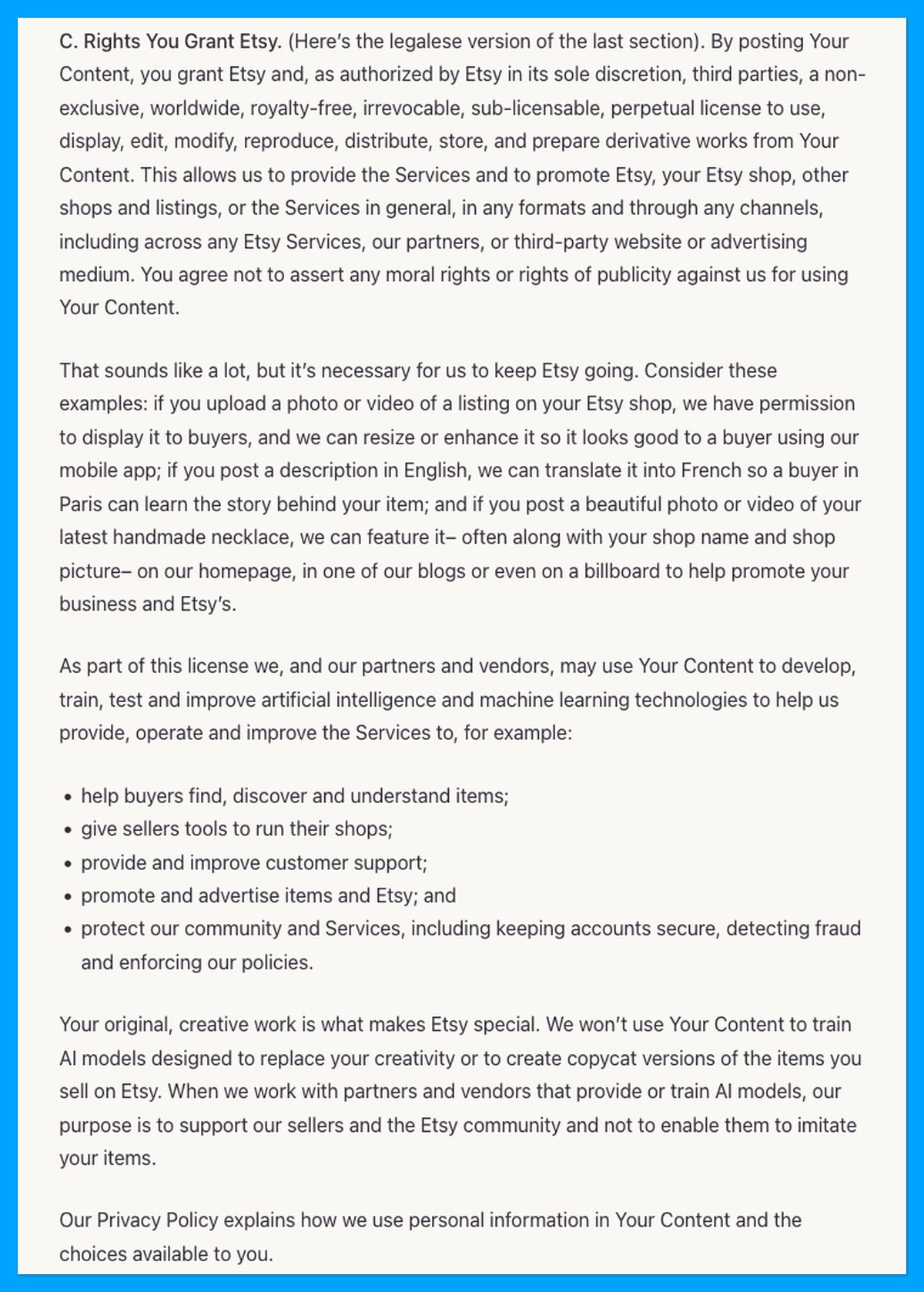
Etsy added a no-copycat commitment on November 23, 2026, but retained AI-training permission. The revised terms still take effect December 16, 2026.
The new sentence says: “We won’t use Your Content to train AI models designed to replace your creativity or to create copycat versions of the items you sell on Etsy.”
Section 5.C also says “we, and our partners and vendors, may use Your Content to develop, train, test and improve artificial intelligence and machine learning technologies”. The service-related purposes begin with “for example”, so the list isn’t exhaustive.
The underlying license remains “irrevocable” and “perpetual”. US sellers have no general AI-training opt-out switch, and closing a shop may not end the license over previously uploaded content.
In her November 23 post, CEO Kruti Patel Goyal acknowledged Etsy “should’ve given you more context”. The rewrite formalizes a narrower commitment than a promise not to train AI at all.
Big Cartel’s Agreement and AI Shield
Big Cartel’s Merchant User Agreement, effective June 29, 2020, limits section 4.4’s license “solely to host Your Store, run the Tools, provide the Services and to otherwise promote and manage the Big Cartel Site and Services”.
Big Cartel agrees to stop using content after termination except for legal requirements, claims investigations, defense and records. While your account is open, though, Big Cartel can sublicense that permission, you cannot revoke it, it extends to subcontractors and vendors, and your content may be used for beta tests.
The agreement, Terms of Service and Privacy Policy contain no AI wording. They do not promise never to train AI.
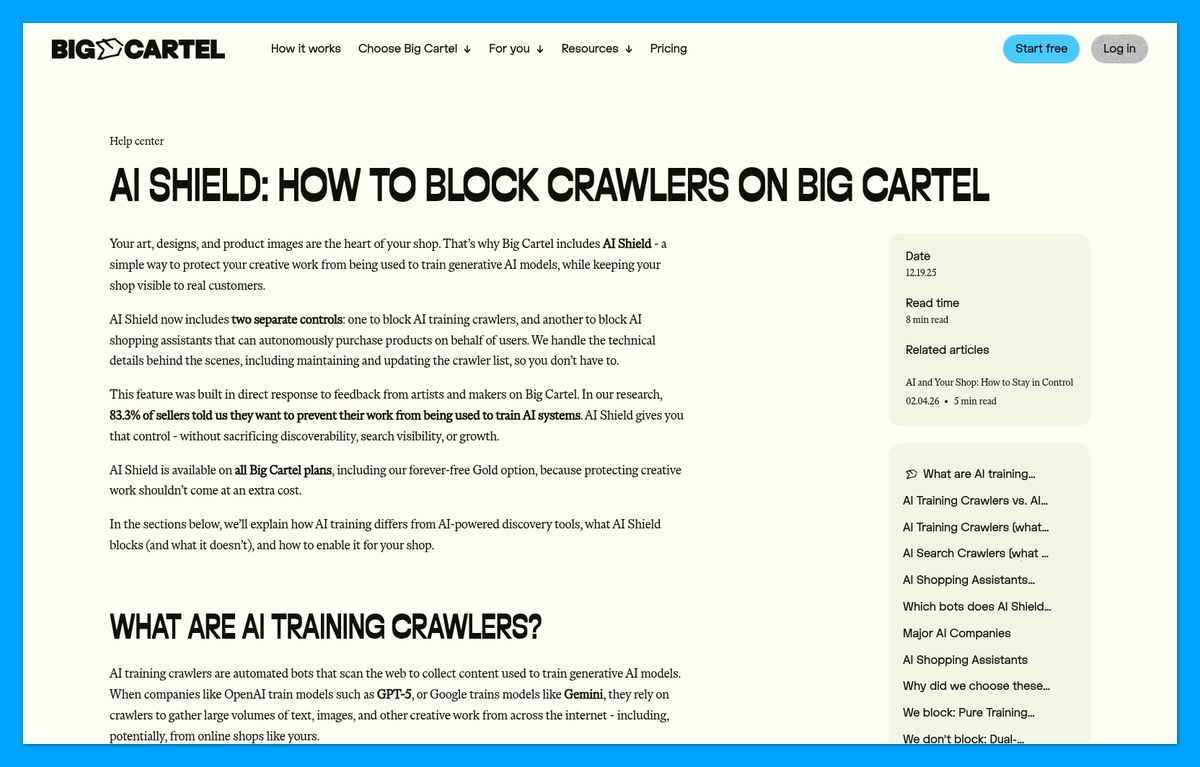
AI Shield controls outside crawlers:
- Availability: Launched December 19, 2025, on all plans, including Gold; off by default.
- Training switch: Shop Settings > AI Shield > “Block AI training bots” adds robots.txt rules blocking ten training crawlers.
- Search visibility: Googlebot, Bingbot and AI search crawlers remain allowed.
- Shopping switch: A separate setting blocks AI shopping assistants such as Amazon’s Buy For Me.
- Limits: It works on an honor system, isn’t retroactive and, in Big Cartel’s words, “does not guarantee protection”.
AI Shield does not change Big Cartel’s own content license. Enable it as a crawler preference, not proof that nobody can collect your artwork.
How Much It Matters for Each Seller
- Illustrators: highest exposure. The artwork itself is what you sell. Read the license before uploading a new print collection.
- Bands: low to medium exposure. Logos and sleeve art deserve attention even when fans primarily buy tees to support the band.
- Crafters: medium exposure. Photos show your physical work, but a model cannot reproduce a ceramic bowl as directly as an image.
- POD sellers: high design exposure. Your designs are the product. Separately from AI training, Etsy’s Ventur Editions printing test is powered by FYUL, the parent company of Printify and Printful.
For an illustrator or POD designer, I would weigh these permissions alongside fees rather than treat them as a minor account setting.
Running Both Without Doubling the Work
Keep Etsy discovery without sending your own newsletter traffic through Etsy checkout. Big Cartel pitches that split directly: “Etsy gets you seen. Big Cartel keeps you in charge.”
- Check your plan cap first. Listings beyond Big Cartel’s product allowance won’t import. Choose the catalog you want to copy before uploading it.
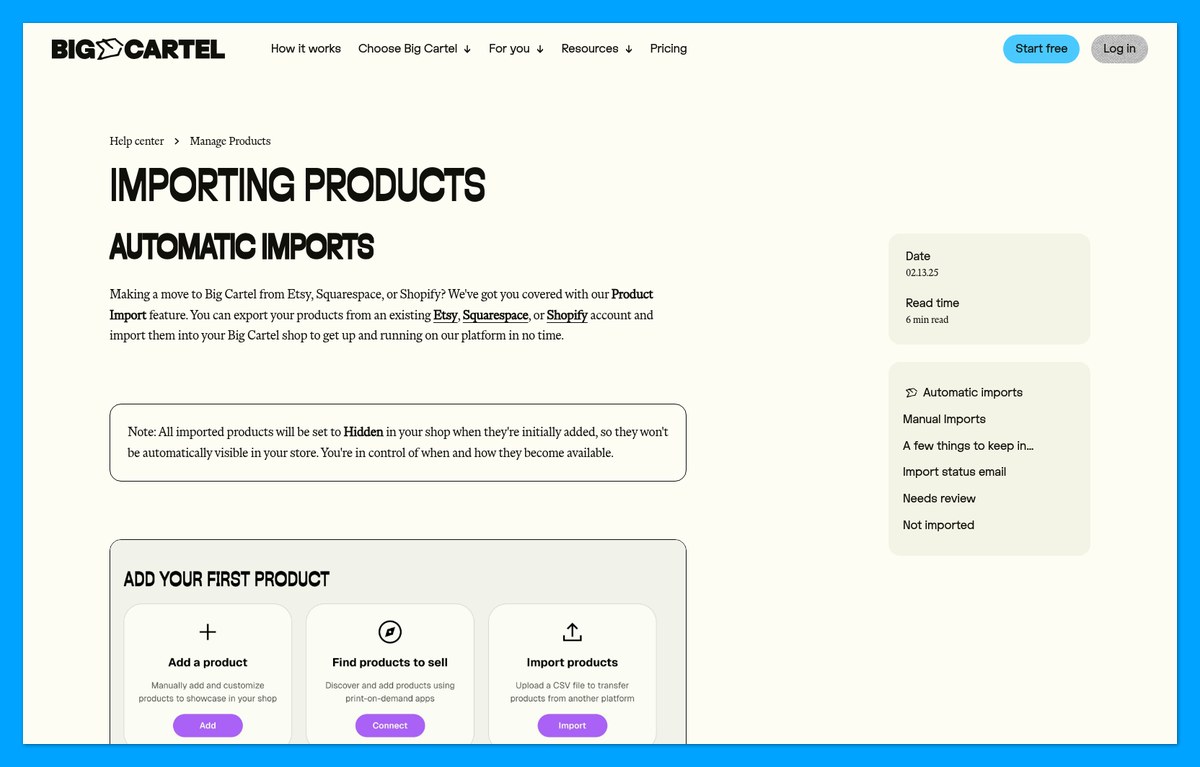
- Copy the listings once. Export your Etsy listings CSV, then use Big Cartel’s Products > Import. This copies products; it doesn’t create ongoing stock synchronization.
- Leave Etsy open during import. Big Cartel needs access to copy listing images. Products arrive Hidden, so review them before publishing; reviews and favorites don’t move.
- Track shared stock yourself. If the same ceramic mug appears in each store, update availability after a sale. A copied listing isn’t a shared inventory record.
- Separate your traffic sources. Promote Big Cartel through your own newsletter, socials and show flyers. Etsy prohibits encouraging its buyers to purchase elsewhere, including using QR codes to send them off Etsy.
If you only want a branded front for an existing Etsy operation, consider Pattern at $15 a month after a 30-day trial. It is Etsy’s own website option, with no additional listing fee for items already on Etsy.
Pattern answers a storefront question, not an objection to Etsy’s content terms. Choose it for that narrower purpose rather than treating it as a move away from Etsy.
Which One Fits Your Stage
Choose using the source of your next order, not just the size of your last fee bill.
-
Starting from zero: Choose Etsy when you need strangers to discover your ceramics, prints or niche tees. Big Cartel Gold lets you test five physical products for $0, but you must bring visitors. Compare the best ecommerce platforms for beginners before paying for a larger store.
-
Getting repeat buyers through your own channels: Run both with a clear division. In my illustrator and crafter examples, monthly Platinum pays off at the fifth to eighth own-audience order. Keep Etsy for discovery while directing your independent newsletter and social traffic to Big Cartel.
-
Selling mostly to an existing audience: Choose Big Cartel Platinum for a catalog within 50 products. Choose Diamond for up to 500 products or when scheduled drops and password-protected presales matter. A band with fans already clicking its links has less reason to pay marketplace fees.
-
Leaving over the AI terms: Consider Big Cartel with AI Shield enabled, provided you accept its limits. The shield doesn’t undo earlier collection, guarantee protection or create a never-train promise. Moving also may not end Etsy’s license over previously uploaded content.
-
Outgrowing 500 products or needing more apps: Compare Big Cartel alternatives, including Shopify. Read Shopify vs Etsy if your decision remains a standalone store versus marketplace discovery, rather than which Big Cartel plan to buy.
Use the worked example closest to your shop, then account separately for production and customer acquisition. A smaller fee bill helps only if you preserve enough profitable orders.
Choose Big Cartel when you can name the channels that will bring your first customers.
Choose Etsy when reaching new shoppers is the service you need most.