Shopify and Bandcamp both help musicians and creators sell directly to fans, but they solve very different problems.
One is a full ecommerce platform built for branded, standalone online stores. The other is a music-first marketplace with discovery baked in.
We have spent dozens of hours testing direct-to-fan tools, modeling the fee math, and weighing where each one actually pays off for independent artists.
The short version: Shopify is the better long-term home if you are building a brand and want to keep more of every sale, while Bandcamp is the stronger starting point if you want built-in discovery and zero monthly overhead.
In this comparison, I will break down exactly where each platform wins, covering pricing and fees, audience reach, product flexibility, branding, ease of use, and who owns your customer relationship.
Most artists end up using both, and I will explain how that hybrid model works at the end.
Shopify vs Bandcamp: Quick Verdict
- Shopify – Best for building a music business and keeping higher margins (get your first 3 months for $1/month)
- Bandcamp – Best for discovery, new-fan reach, and starting with no monthly fees
Quick Comparison: Shopify vs Bandcamp
Here is a side-by-side overview before we get into the detail:
| Shopify | Bandcamp | |
|---|---|---|
| Best for | Established artists building a long-term brand | New and emerging artists wanting reach |
| Starting cost | $39/month (or $29/month billed annually) | $0/month |
| How they make money | Monthly subscription + payment processing | Revenue share on each sale, no subscription |
| Sales fees | 2.9% + $0.30 per transaction (Shopify Payments, Basic plan) | 15% digital (drops to 10% after $5,000 lifetime sales), 10% physical, plus processor fees |
| Built-in discovery | None, you drive all traffic | Yes, millions of active music buyers |
| Customization | Full control, custom domain, 190+ themes | Limited, fixed template, no custom domain |
| Product range | Anything (music, merch, courses, memberships) | Music, merch, and tickets |
| Customer data | You own the email list outright | Contacts stay inside Bandcamp |
| Free trial | 3-day free trial, then $1/month for 3 months | Free to use, no trial needed |
Best for Pricing and Fees: It Depends on Your Volume
This is the category that decides the platform for most artists, and there is no flat winner. The two charge in opposite ways: Shopify takes a fixed monthly fee with low per-sale costs, while Bandcamp charges nothing upfront but takes a meaningful cut of every sale.
Shopify pricing
Shopify runs on a subscription model with three core plans (billed annually):
- Basic – $39/month, or $29/month on annual billing: a full storefront for solo sellers, with unlimited products, abandoned cart recovery, and basic reports
- Grow – $105/month, or $79/month on annual billing: lower transaction fees, up to 5 staff accounts, and standard analytics for scaling businesses
- Advanced – $399/month, or $299/month on annual billing: the lowest core fees, custom reporting, and up to 15 staff accounts for high-volume stores
There is also a $5/month Starter plan for selling through social media and links, plus Shopify Plus for enterprise sellers starting around $2,300/month.
New merchants get a 3-day free trial followed by an introductory deal of $1/month for the first three months.
On top of the subscription, Shopify charges payment processing of 2.9% + $0.30 per online transaction on Basic (dropping to 2.6% on Grow and 2.4% on Advanced) when you use Shopify Payments. If you bring a third-party gateway instead, Shopify adds a 2% surcharge on Basic on top of the gateway’s own fees.
Bandcamp pricing
Bandcamp charges no monthly fee. Instead it takes a revenue share on each sale:
- 15% on digital sales, which permanently drops to 10% once your lifetime sales pass $5,000
- 10% on physical merchandise such as vinyl, CDs, cassettes, and apparel
- Payment processor fees on top, which Bandcamp says typically run 4% to 7% of an average order
That artist-friendly split is real: Bandcamp says sellers keep an average of around 82% of sales on a normal day, and the company has paid out more than $1.5 billion to artists and labels to date.
The Bandcamp Friday advantage.
On select days each year, Bandcamp waives its entire revenue share and artists keep 100% of sales minus only payment processing. The program has returned over $154 million to artists since 2020, including $19 million in 2025 alone.
Bandcamp is running eight of these days in 2026, with the remaining dates being August 7, September 4, October 2, November 6, and December 4. Shopify has no equivalent.
The break-even math
Because the cost structures are inverted, the cheaper platform flips at a predictable point. Below roughly 40 album sales per month, Bandcamp’s zero monthly fee wins. Above that, Shopify’s low per-sale cost pulls ahead. Here is what 100 album sales at $10 each ($1,000 gross) looks like on each:
| Bandcamp | Shopify Basic | |
|---|---|---|
| Gross revenue | $1,000 | $1,000 |
| Platform / revenue share | -$150 (15%) | $0 |
| Payment processing | -$59 (~2.9% + $0.30) | -$59 (2.9% + $0.30) |
| Monthly subscription | $0 | -$39 |
| Net take-home | ~$791 | ~$902 |
Figures use a conservative processor estimate; Bandcamp’s real processor fees can run higher on small orders, which widens the gap further.
At this volume Shopify nets roughly $110 more per month, but that assumes you can generate those 100 sales through your own marketing. The catch is that Shopify gives you no audience, while Bandcamp does. That trade-off is the whole comparison in one line.
The Winner: It depends on your sales volume
Below about 40 sales a month, Bandcamp’s no-fee model is more cost-effective. Above that, Shopify’s lower per-sale cost makes it more profitable, provided you can drive your own traffic.
Best for Discovery and Reaching New Fans: Bandcamp
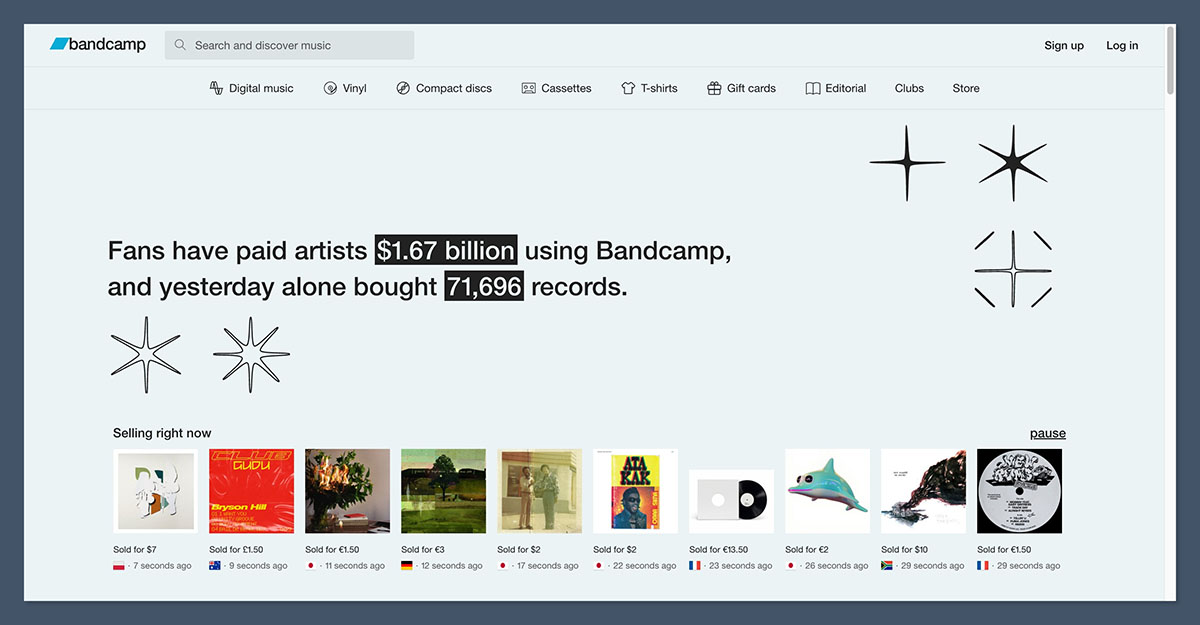
This is Bandcamp’s single biggest edge, and it is one Shopify simply cannot match. Bandcamp is a marketplace, so it hosts millions of active music buyers who browse by genre, follow artists, and find new music through editorial features and recommendations.
Listeners arrive ready to spend, and a portion of your sales can come from people who discovered you on the platform rather than ones you brought yourself.
The revenue impact is significant for smaller artists. Independent acts with modest monthly listener counts consistently earn far more per superfan through Bandcamp’s discovery surface than through a self-hosted store nobody has found yet.
Shopify, by contrast, is a closed storefront. There is no marketplace, no genre browsing, and no built-in audience. Every visitor has to be earned through SEO, social media, paid ads, or email. For an artist without an existing following, that is a steep hill.
The Winner: Bandcamp puts you in front of buyers
A built-in marketplace of active music fans means Bandcamp can generate sales you did not have to market for. Shopify offers nothing comparable.
Best for Selling Online and Flexibility: Shopify

Once you look past music itself, Shopify is in a different weight class.
It is a full ecommerce toolkit with more than 8,000 app integrations, advanced inventory and shipping management, and the ability to sell across Facebook, Instagram, Google Shopping, Amazon, and more from one dashboard.
You also get abandoned cart recovery, upsells, post-purchase offers, full SEO tools, and detailed analytics out of the box.
Crucially, Shopify lets you sell more than music. Courses, memberships, premium bundles, exclusive content, and merch all live comfortably alongside your releases, which matters once an artist starts treating their work like a business with multiple income streams.
Bandcamp covers the essentials well for music: digital sales, streaming previews, pay-what-you-want pricing, physical merch, and fan messaging. It even offers a Shopify inventory sync through Bandcamp Pro ($10/month). But it is purpose-built for music and stops there. Selling anything outside that lane is awkward or impossible.
One small note on Shopify: digital downloads are not native and require a third-party app such as Digital Downloads, Single, or Sky Pilot. It is a minor extra step, but worth knowing if music files are your core product.
The Winner: Shopify is built to do far more
A vast app ecosystem, true omnichannel selling, and the freedom to sell any product type make Shopify the more capable platform for a growing business.
Best for Branding and Customization: Shopify
If you care about your store looking like you, this one is not close. Shopify gives you a custom domain, more than 190 themes, a section-based editor, and full code access for developers. Your store becomes a standalone website that reflects your brand from top to bottom.
Bandcamp offers a recognizable but rigid look. You can upload a profile photo and banner and pick an accent color, but the layout follows Bandcamp’s standard template, and there is no custom domain.
Every Bandcamp page is unmistakably a Bandcamp page, which is good for trust and bad for differentiation.
The Winner: Shopify gives you a real brand home
Custom domains, deep theme control, and full design freedom let you build a store that looks nothing like anyone else’s. Bandcamp keeps you inside its template.
Easiest to Get Started: Bandcamp
Bandcamp wins on speed and simplicity. You can create an account, upload an album, set a price, and be selling within minutes, with no monthly commitment and almost nothing to configure. For an artist who just wants their music available for sale today, it is hard to beat.
Shopify is genuinely beginner-friendly too, with a guided onboarding flow that asks about your business and a clear setup checklist.
But there is simply more to do: choosing a theme, adding a digital download app, configuring payments and shipping, and pointing a domain. The payoff is a far more capable store, but the runway is longer.
The Winner: Bandcamp gets you live fastest
Minimal setup and zero monthly cost make Bandcamp the quickest path to your first sale. Shopify takes more work but rewards it with a more powerful store.
Best for Owning Your Audience: Shopify
This is the quiet category that matters most over the long run. With Shopify, every buyer’s email flows directly into your own marketing tool of choice, whether that is Mailchimp, Klaviyo, or ConvertKit.
You own that list outright, and email remains the highest-ROI channel for direct sales once it reaches any meaningful size.
Bandcamp does collect buyer emails and lets you message fans, but those contacts live inside Bandcamp’s system. You cannot export and fully own that relationship the way you can with your own store.
There is also a stability angle. Bandcamp has changed ownership twice since 2022, first to Epic Games and then to Songtradr, each transition bringing layoffs and uncertainty even though the fee structure held.
A Shopify store runs on infrastructure you control and is not subject to a marketplace’s acquisition decisions.
The Winner: Shopify lets you own the customer relationship
Direct email ownership and full control over your store insulate you from platform changes and compound into real revenue over time.
When to Choose Each Platform
Choose Bandcamp if you:
- Are releasing music for the first time or have fewer than 500 email subscribers
- Generate less than $500/month in direct sales
- Want built-in discovery and fan reach without monthly overhead
- Prefer minimal setup and maintenance
- Focus mainly on digital music and simple merch
Choose Shopify if you:
- Generate consistent sales above $500/month, or roughly 40+ albums monthly
- Have an established audience and email list to drive traffic
- Need full control over branding, checkout, and the customer experience
- Sell beyond music, such as courses, memberships, and premium bundles
- Want to build a long-term brand with maximum ecommerce flexibility
The Hybrid Approach Most Artists Actually Use
The smartest independent artists do not pick one. They run both, and use each for what it does best. Bandcamp captures new fans through discovery and benefits from Bandcamp Fridays, while Shopify serves existing fans with higher-margin products and premium offerings.
The typical path looks like this: start on Bandcamp to build an audience and validate your offers with no monthly cost, then add Shopify once you cross roughly 500 email subscribers or $500/month in direct sales.
From there, cross-promote, directing Bandcamp fans onto your email list, then introducing your Shopify store for exclusive or premium releases. You get Bandcamp’s reach and Shopify’s margins at the same time.
How We Test Ecommerce and Direct-to-Fan Platforms
We assess selling platforms through a structured, repeatable process so our recommendations reflect real hands-on use rather than marketing claims. For this comparison we weighted the areas that matter most to artists and creators:
| Testing area | Weight | What we look at |
|---|---|---|
| Pricing and fees | 30% | Subscription costs, revenue share, processing fees, and break-even volume |
| Sales and product features | 25% | Digital and physical selling, app ecosystem, and product flexibility |
| Audience and discovery | 20% | Built-in reach, new-fan acquisition, and traffic sources |
| Branding and customization | 10% | Themes, custom domains, and design control |
| Ease of use | 10% | Setup speed, onboarding, and day-to-day management |
| Data ownership and stability | 5% | Email ownership, customer data, and platform reliability |
I tested both platforms directly, set up stores on each, and modeled the fee math at multiple sales volumes to make sure the recommendations here reflect real first-hand experience.
Shopify vs Bandcamp: Our Verdict
These two platforms are not really competitors so much as tools for different stages.
Bandcamp is the best place to start. It costs nothing upfront, puts you in front of a real audience, and gets you selling in minutes, which is exactly what a newer artist needs.
Shopify is the platform you grow into. Once you have an audience and consistent sales, its lower per-sale costs, full branding control, unlimited product flexibility, and direct ownership of your customer list make it the stronger long-term home for a music business. For an artist serious about building a brand and maximizing margins, Shopify is the platform that scales with you.
If you can only choose one and you are just starting out, begin with Bandcamp. If you already have a following and want to build a business around it, choose Shopify.
And if you are willing to run both, that hybrid setup is what most successful independent artists are doing in practice.
Frequently Asked Questions
Is Bandcamp cheaper than Shopify?
At low sales volumes, yes. Bandcamp has no monthly fee, so it costs less when you are making only a handful of sales. Above roughly 40 album sales per month, Shopify usually becomes cheaper per dollar earned because its fixed subscription is offset by much lower per-sale fees.
Can I sell digital music directly on Shopify?
Yes, but not natively. Shopify needs a third-party app such as Digital Downloads, Single, or Sky Pilot to deliver digital files. It is a quick add-on, but it is an extra step compared with Bandcamp, where digital delivery is built in.
What is Bandcamp Friday?
Bandcamp Friday is a recurring day on which Bandcamp waives its entire revenue share, so artists keep 100% of sales minus only payment processing. The program has paid out over $154 million to artists since 2020, and Bandcamp is running eight of these days in 2026.
Do I own my fans’ email addresses on Bandcamp?
Not in the way you do on Shopify. Bandcamp collects buyer emails and lets you message fans through the platform, but those contacts stay within Bandcamp’s system. With Shopify, emails flow into your own marketing tool and the list is yours to keep.
Should I use Shopify and Bandcamp together?
For many artists, yes. Bandcamp drives discovery and new-fan reach while Shopify offers higher margins, branding control, and audience ownership. A common approach is to start on Bandcamp, add Shopify once sales grow, and cross-promote between the two.
How much does Bandcamp take from each sale?
Bandcamp takes 15% of digital sales, dropping to 10% permanently once your lifetime sales pass $5,000, and 10% of physical merchandise. Payment processing fees apply on top and typically run 4% to 7% of an average order.