You have a folder of designs and a practical question: if one sells on a $24 tee, what reaches your account? Etsy vs Redbubble is less about which marketplace looks better and more about what you keep after production, shipping and platform fees.
Redbubble is the low-effort way to earn a little from a large design library. Etsy plus a print-on-demand partner can pay several times more per sale, but you take responsibility for the shop. On the worked $24 tee, Redbubble Standard pays $2.00; Etsy with Printify’s Free plan leaves $5.99, with delivery included.
I checked Redbubble’s help center fee articles and User Agreement, Etsy’s fee policy, payout and IP help pages, and Printify and Printful’s current US prices on November 23, 2026. The figures below use US sellers, US buyers and USD, excluding sales tax.
You can start selling on Etsy or put your designs on Redbubble, but first separate two goals: earning from artwork you’ve already made and building a business around your strongest sellers.
A higher margin doesn’t make every design worth listing on Etsy. Redbubble’s assigned account tier, Etsy’s recurring listing costs and the product itself change that decision.

What One Sale Pays You on Each Platform
A $24 price tag doesn’t mean the same checkout total or artist payment. Compare the deductions on one sale before projecting earnings across your library.
A $24 Tee on Redbubble, Tier by Tier
Redbubble calculates artist margin as base price multiplied by markup. Its Classic T-Shirt example uses a $20.00 base, which includes manufacturing and Redbubble’s service fee. Add a 20% markup and the customer sees $24.00, before shipping.
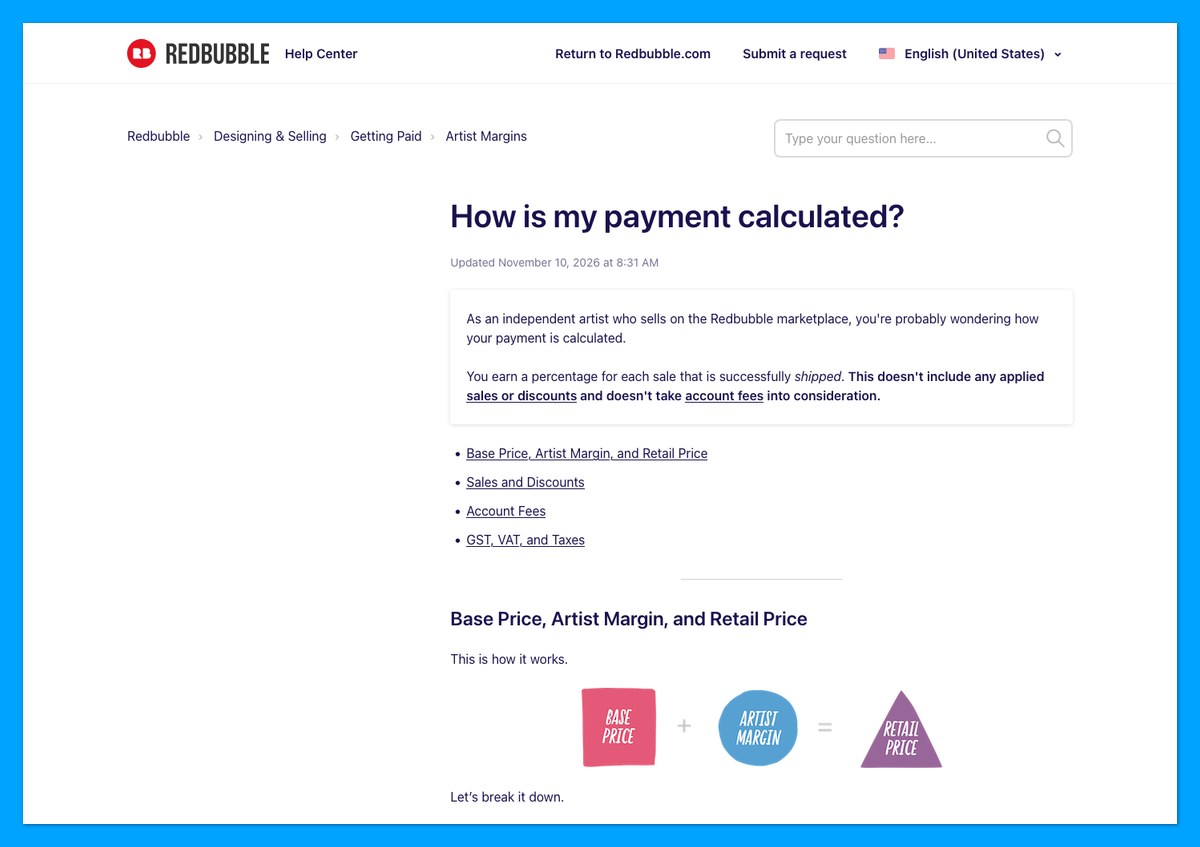
The default markup is 10%, not 20%. Change it on the Product Pricing page, but account for your assigned tier when calculating what you keep.
| Markup | Retail | Gross margin | Standard keeps | Premium keeps | Pro keeps |
|---|---|---|---|---|---|
| 10% (default) | $22.00 | $2.00 | $1.00 | $1.60 | $2.00 |
| 20% | $24.00 | $4.00 | $2.00 | $3.20 | $4.00 |
| 40% | $28.00 | $8.00 | $2.00 | $4.40 | $8.00 |
These figures apply before the monthly fee cap. Standard loses 50% of gross earnings to the platform fee; Premium loses 20%; Pro pays neither that fee nor the excess markup fee.
For Standard and Premium, Redbubble also takes 50% of earnings generated above a 20% markup. At 40%, that means an additional $2.00 fee on this tee.
Standard keeps $2.00 at both 20% and 40% markup. The buyer pays more, but you don’t receive more until the cap changes the calculation.
Total account fees cannot exceed $150 per month, not per product or design. Earnings across your account determine when that limit matters, and Redbubble never charges these fees out of pocket.
The Same $24 Tee on Etsy With Printify or Printful
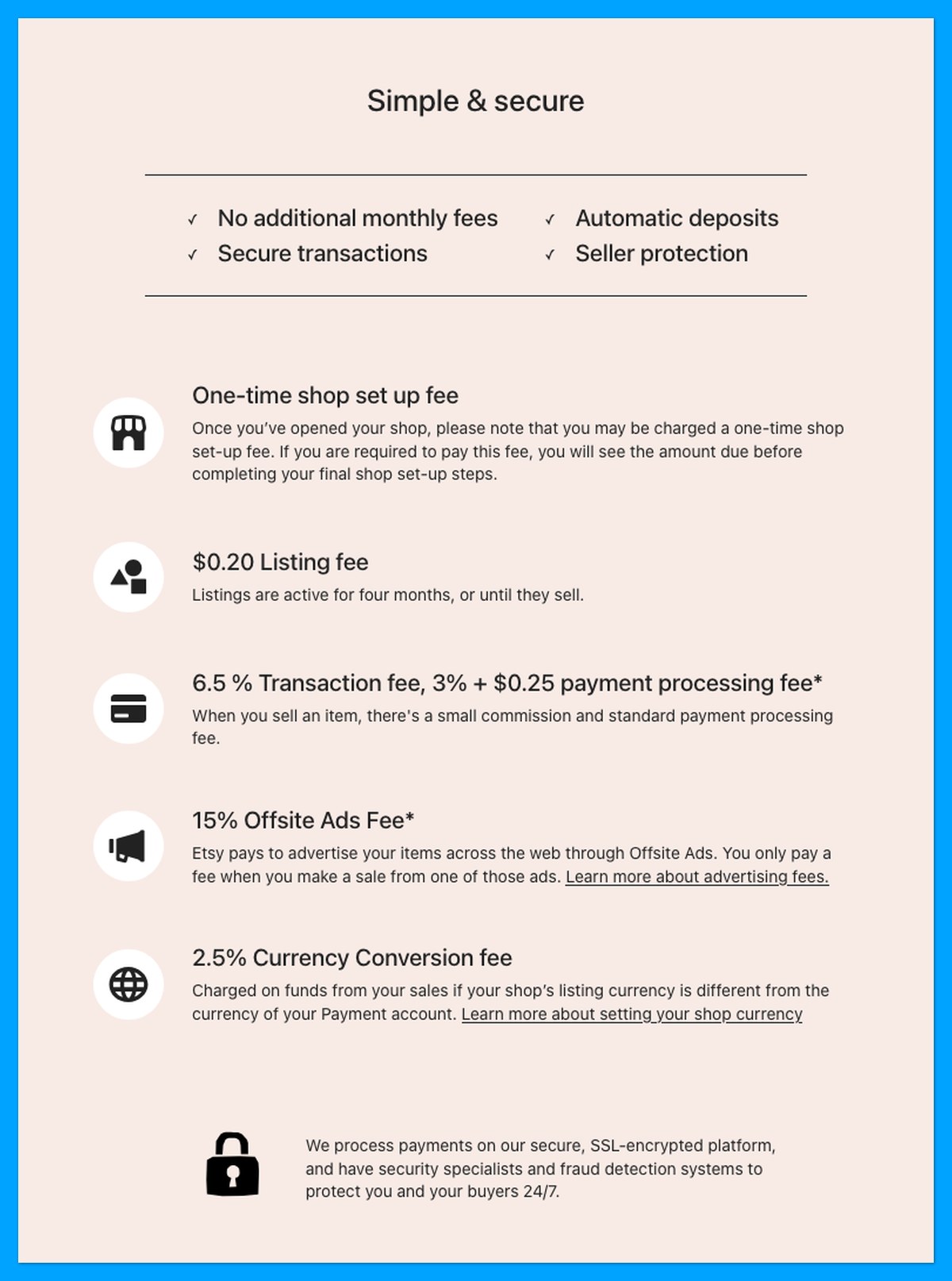
On Etsy, $24.00 with free shipping leaves $21.27 before supplier costs. The $2.73 Etsy deduction consists of:
- Transaction fee: $1.56.
- Payment processing: $0.97.
- Listing renewal: $0.20.
For a Bella+Canvas 3001 tee, Printify Choice and Printful produce these results:
| Supplier | Product + shipping | You keep |
|---|---|---|
| Printify Choice, Free plan | $11.29 + $3.99 = $15.28 | $5.99 |
| Printify Choice, Premium plan | $9.04 + $3.99 = $13.03 | $8.24 |
| Printful | $11.92 + $4.95 = $16.87 | $4.40 |
The Printify figures use its starting product and US Economy shipping prices. The Printful product price is for size L. Printify Premium’s subscription is separate from the per-order figure.
An order attributed to Etsy Offsite Ads at 15% costs another $3.60. That drops the Printify Free result to $2.39 kept, much closer to Redbubble Standard’s payment.
Printful adds a $0.40 surcharge to US-destination orders from October 15, 2026 to January 17, 2027, reducing its $24 tee result to $4.00 during that period.
Etsy’s $24 includes shipping; Redbubble’s does not. Compare checkout totals, not just product-page prices.
Use the Printify review and Printful review to assess the supplier behind those deductions. Your Etsy margin must justify handling the buyer relationship, not just publishing the design.
Stickers and Prints: Where the Math Flips
Single stickers favor Redbubble’s cart-building model, even though the artist payment is small. Its US example uses a $2.00 sticker base.
| Markup | Retail | Gross | Standard | Premium | Pro |
|---|---|---|---|---|---|
| 10% | $2.20 | $0.20 | $0.10 | $0.16 | $0.20 |
| 20% | $2.40 | $0.40 | $0.20 | $0.32 | $0.40 |
| 50% | $3.00 | $1.00 | $0.20 | $0.50 | $1.00 |
For five or more stickers, Redbubble’s 50% base-price discount also halves the margin. At 50% markup, five stickers cost the buyer $7.50 and generate $2.50 before account fees.
On Etsy, a Printful 4″x4″ sticker priced at $6.00 plus $4.49 shipping leaves $2.06, after $1.44 in Etsy fees and $6.99 in fulfillment costs. But the buyer pays $10.49 for one sticker.
Bundles make more sense there: Printful charges $0.05 shipping for each additional sticker.
A $30.00 Etsy 12″x16″ poster with free shipping leaves $10.60, after $3.30 in Etsy fees and $16.10 in fulfillment. These Printful figures leave out the temporary US surcharge; Printful’s pricing explains the cost structure.
Redbubble does not publish poster or art-print base prices outside the logged-in cart. Don’t assume the tee comparison carries over to prints.
Goal 1: Passive Income From a Design Library
Why Redbubble Suits Upload-and-Forget Artists
Redbubble removes the order-management work, making it useful for designs that wouldn’t justify their own shop operation. You pay no listing fees, arrange no shipping and handle no customer-service queue.
The marketplace brings potential buyers, although uploads don’t guarantee sales. Reported coverage of Articore’s FY26 results puts Redbubble at 3.1 million customers, down from 3.5 million.
Complete the first-time setup guide and publish at least five designs to receive a tier classification. Your shop isn’t public until classification.
Enable off-site marketing through Artist Dashboard > Account Settings > Edit Profile to let Redbubble distribute products through external advertising channels.
Among print-on-demand sites for artists, this arrangement suits a broad back catalog. The distinction in Printify vs Redbubble is fundamental: Printify supplies products for your selling operation; Redbubble runs the marketplace transaction.
Your Tier Is Assigned, Not Bought
You cannot purchase Premium status to escape Standard’s 50% platform fee. Redbubble assigns the tier, and Premium classification is not based on sales volume.
Its stated Premium factors include:
- Artwork origin: original work rather than repackaged assets.
- File quality: the quality of the uploaded artwork.
- Consumer appeal: whether the work fits potential buyers.
Standard factors include high volumes of repetitive or low-effort designs and unmodified vector packs or clip art. Inaccurate titles and descriptions, poor file quality and tag spam also count against an account.
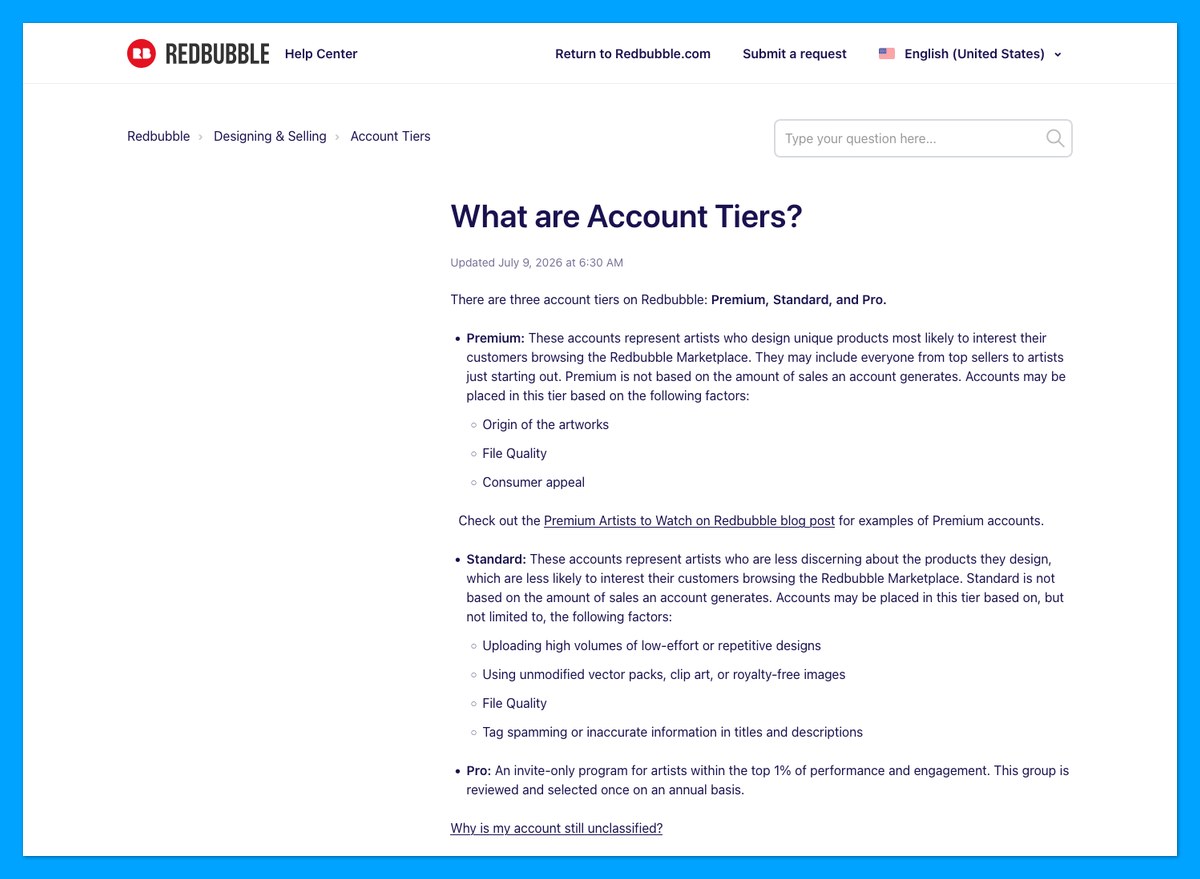
Prioritize original work with suitable files and accurate product descriptions. Uploading more isn’t a substitute for quality, and stuffing unrelated search terms into tags works against the stated classification criteria.
Pro is a separate target: invite-only access for the top 1% by performance and engagement, reviewed annually. Redbubble cannot upgrade Premium accounts to Pro on request.
Budget using your actual tier, not the tier you hope to receive. Gross margin alone doesn’t tell you what Redbubble will pay.
When the $150 Cap Changes the Math
Standard’s fee disadvantage shrinks at higher monthly earnings because account fees stop at $150. At 20% markup, each tee in the example generates $4.00 gross.
| Tee sales/month | Gross earnings | Standard keeps | Premium keeps | Pro keeps |
|---|---|---|---|---|
| 10 | $40 | $20 | $32 | $40 |
| 50 | $200 | $100 | $160 | $200 |
| 75 | $300 | $150 | $240 | $300 |
| 200 | $800 | $650 | $650 | $800 |
Standard reaches the cap at $300 gross earnings. Premium reaches it at $750 gross. From $750 gross onward, Standard and Premium keep the same amount; Pro still keeps everything.
The earlier per-sale deductions describe earnings before the cap, not an unlimited charge on every subsequent sale. Calculate monthly earnings across your account before using those deductions for a sales forecast.
At low volume, the default markup has another consequence. Ten tee sales at 10% markup on Standard generate $20 gross and exactly $10 kept, meeting the payout threshold.
A big library spreads the odds across designs, but an upload only earns once someone buys it.
Markup Moves That Pay, and Ones That Don’t
Set markup for your tier, rather than applying a percentage that looks profitable before fees.
- Do: Use 20% as the Standard starting point. Above that, additional margin goes entirely toward fees until the monthly cap.
- Do: Treat Premium increases selectively. Every $1 of margin above 20% leaves $0.30 after platform and excess markup fees, before the cap.
- Do: Raise Pro markups without those account-fee deductions, while considering the higher buyer price.
- Don’t: Leave every product at the 10% default without reviewing its earnings.
- Don’t: Treat the undiscounted base price as fixed during promotions.
Sitewide sales lower your margin because markup applies to the reduced base price. Sticker bundle discounts work the same way.
Review Product Pricing alongside your assigned tier. For Standard, charging the buyer more can leave your payment unchanged rather than reward the higher price.
Goal 2: Building a Real POD Business
Pricing Control and Margin Per Design
Etsy lets you price the finished product, rather than adding markup to a marketplace-controlled base. At $28.00 with free shipping, Etsy fees total $3.11: $1.82 transaction, $1.09 processing and $0.20 renewal.
| Supplier | You keep on a $28.00 tee |
|---|---|
| Printify Choice, Free plan | $9.61 |
| Printify Choice, Premium plan | $11.86 |
| Printful | $8.02 |
The figures use the same supplier costs as the $24 example, before Offsite Ads and Printful’s temporary surcharge. Etsy has no equivalent to Redbubble Standard’s excess-markup penalty.
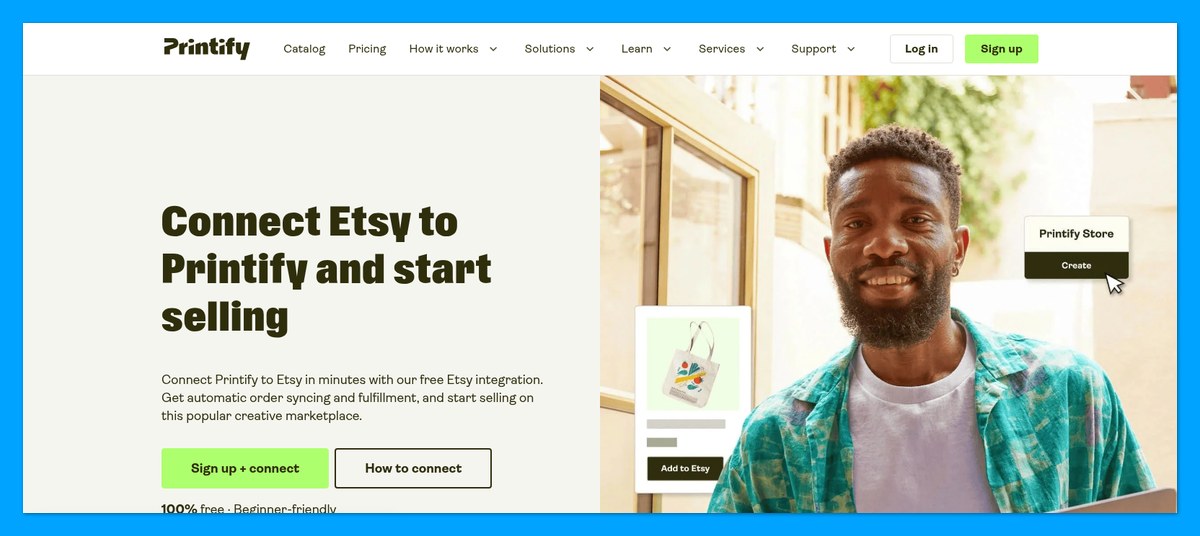
Printify Premium costs $39 per month or $299 per year. It reduces the example tee’s product cost from $11.29 to $9.04, saving $2.25 per order.
I calculated the monthly break-even as $39 divided by $2.25, or 17.33 tees. The 18th tee covers the monthly subscription through those product savings. Don’t subscribe before your order volume supports the fee.
Compare Printify’s plans against actual sales. Use Printful vs Printify to evaluate the supplier choice, and consider Printful using the margin available at your chosen price.
For proven designs, Etsy gives you room to retain more per order. For an unproven library, subscriptions add costs before the artwork earns anything.
Ads, Reviews and Repeat Buyers
Etsy gives your shop its own reviews and buyer conversations, not just a royalty entry. Etsy reported about 88 million active buyers in its Q3 2026 shareholder letter, up 1% year over year.
That audience isn’t a sales forecast. Build listings around a specific product and buyer, rather than relying on the size of Etsy’s marketplace.
Your operating tools include:
- Shop reviews: feedback attached to your selling history.
- Buyer messages: direct conversations about orders.
- CSV downloads: sold order history you can retain and analyze.
Offsite Ads require a separate margin calculation. Shops below $10,000 in sales during the prior 365 days pay 15% on attributed orders and can opt out while below that threshold.
At $10,000 or more, participation becomes mandatory and the rate drops to 12%. The fee is capped at $100 per order, with a 30-day attribution window.
Don’t build repeat-business plans around moving Etsy shoppers elsewhere. Etsy-initiated transactions must stay on Etsy. The policy prohibits encouraging buyers to purchase the item through another venue, including through QR codes.
The Etsy review covers the marketplace tradeoffs. For fulfillment and operating responsibilities beyond uploads, follow the guide to starting a print-on-demand business.
The Costs Redbubble Never Charges You
Etsy charges to keep listings live, even without sales. A listing costs $0.20 and lasts four months; keeping 100 listings live through three four-month cycles costs $60 before a single sale.
Sales renew individual listings with remaining quantity too. Redbubble charges nothing to keep the same 100 designs available.
Other Etsy costs and obligations include:
- Shop setup: a one-time fee may apply, shown during onboarding.
- Etsy Plus: an optional $10 monthly subscription.
- Offsite Ads: an additional deduction on attributed orders.
- Currency conversion: 2.5% when listing currency differs from payment-account currency.
- Supplier funding: production and shipping bills arrive before a new seller’s Etsy money becomes available.
POD belongs under “Designed by a seller”: your original design produced by a disclosed production partner.
In Shop Manager, use “Who made it?” > “Another company or person” and disclose the partner in your shop’s About section. Printify listings default to “Made by seller” if that partner doesn’t exist in the Etsy account, so correct them manually.
If recurring listing costs make a large library unattractive, compare marketplace models in these Society6 alternatives. Keep Etsy focused on designs that justify ongoing shop work.
Who Owns the Customer, and When the Money Lands
Buyer Data and Customer Service
An Etsy shop doesn’t give you unrestricted ownership of the buyer. You manage messages and reviews and can download sold order history as CSV files.
Those records help you evaluate which designs sell. They don’t override Etsy’s rule against completing an Etsy-initiated transaction elsewhere.
Redbubble keeps order support centralized. Customers take problems to its Help Center rather than asking you to coordinate a replacement with a printer.
Your Redbubble sales history arrives through quarterly CSV reports covering only the previous 12 months. Save those reports if you want a longer record of your library’s performance; don’t rely on a future download to recover older sales.
Embedding a Redbubble shop on your website doesn’t change the transaction: buyers must still check out on Redbubble.
Choose Etsy if direct buyer communication is part of the business you want to run. Choose Redbubble if avoiding that responsibility matters more. If you want checkout outside a marketplace, Shopify vs Etsy addresses the next decision.
Payout Timing and Thresholds
A profitable Etsy order can require money from your bank account first. Printify and Printful charge production and shipping when the order is sent to them, while Etsy releases funds later.
| Payment detail | Redbubble | Etsy |
|---|---|---|
| Payout frequency | Monthly; should land by the 15th | Weekly on Mondays by default; daily, biweekly or monthly options |
| Minimum | $10 after fees | $25 USD daily deposit minimum |
| First-sale wait | Previous month’s shipped orders only | New sellers generally eligible 14 days after sale |
| What can freeze it | Suspension; invalid or incomplete payment details prevent payment | Reserves; 5-day hold after bank-detail changes |
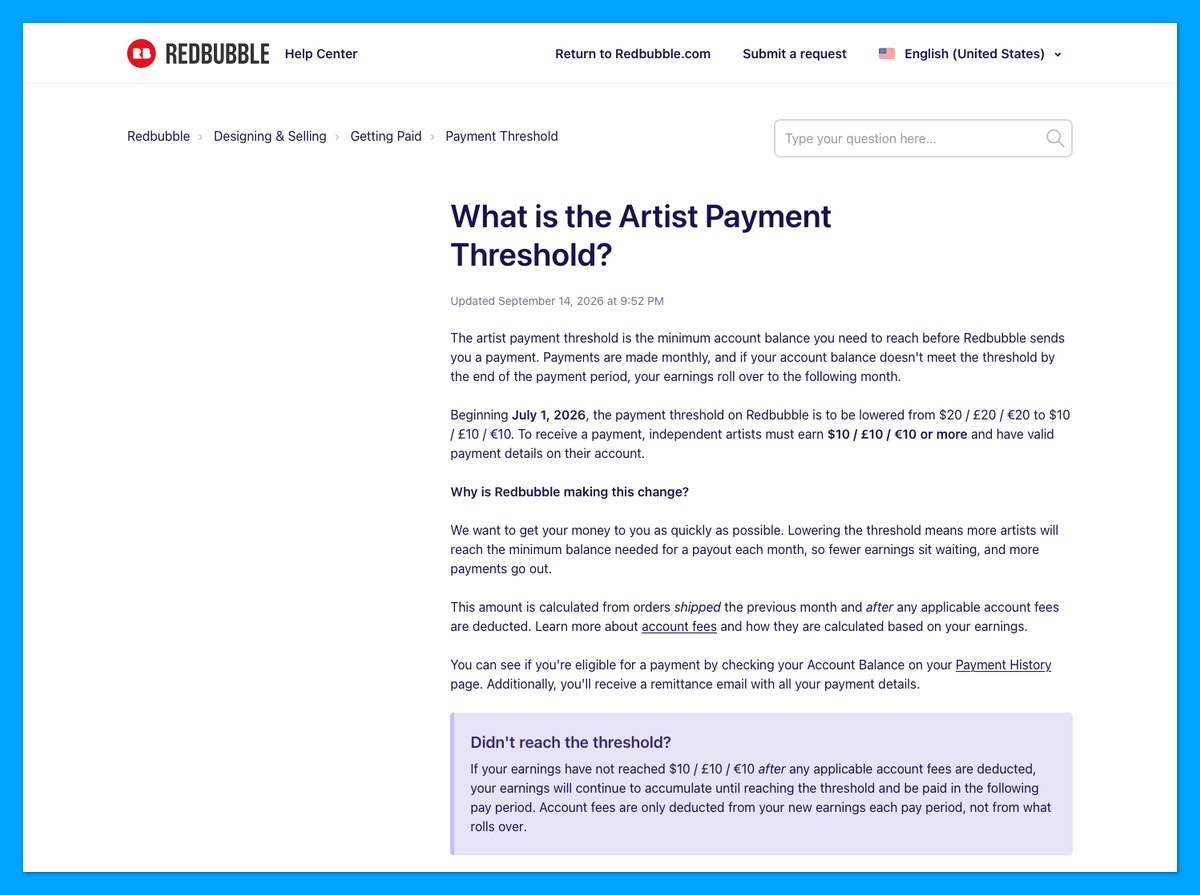
Redbubble lowered its threshold to $10 after fees on July 1, 2026. Unshipped orders roll into the next payment cycle. Balances below the threshold roll forward too, without account fees being charged again on the old balance.
Etsy’s new-seller funds generally become eligible for deposit 14 days after a sale, potentially longer depending on shop standing. Change the schedule through Shop Manager > Finances > Payments Settings. Deposit eligibility and your selected schedule are separate parts of the wait.
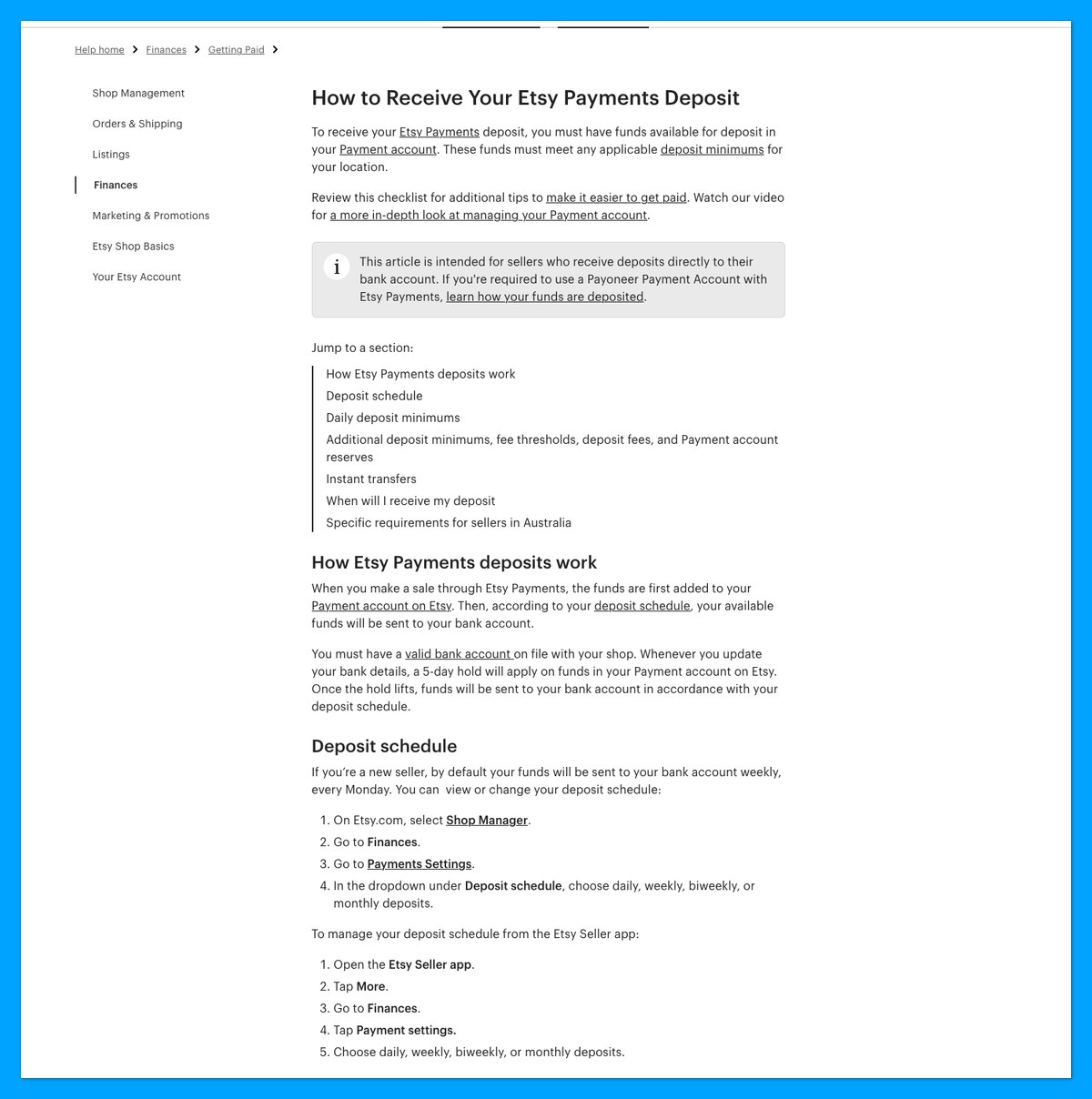
Etsy can reserve a percentage of physical-item sales, including after a first sale. Tracking that shows an order in transit can release reserved funds; otherwise, a default holding period applies. Star Sellers are exempt from reserves.
Before enabling Etsy orders, budget for supplier charges during the payout gap. Your per-order margin is what remains after costs, not money Etsy necessarily deposits before your printer bills you.
Takedowns, Suspensions and Account Risk
On Redbubble, a rights-holder takedown report can remove the affected work, leaving you unable to view or update it. Retain evidence of how you created each design so you can respond without access to the listing.
You can submit a Counter Notice. Redbubble may forward it, including your contact details, to the complainant, who may pursue legal action in the US. If no legal action follows after 14 days, you may ask Redbubble to reinstate the work.
Its repeat-infringer policy allows account-level action up to permanent disablement. A suspension removes products from sale and search and freezes the account balance. You cannot log in while suspended.
Appeals must be filed within 60 days. Redbubble may take up to two weeks and only replies if it reinstates the account. Its help guidance says accounts suspended for spam, fraud or policy violations aren’t reinstated.
Fan art is allowed only through Redbubble’s Partner Program and the relevant licensor terms. Don’t treat existing fan-art listings as permission for your uploads.
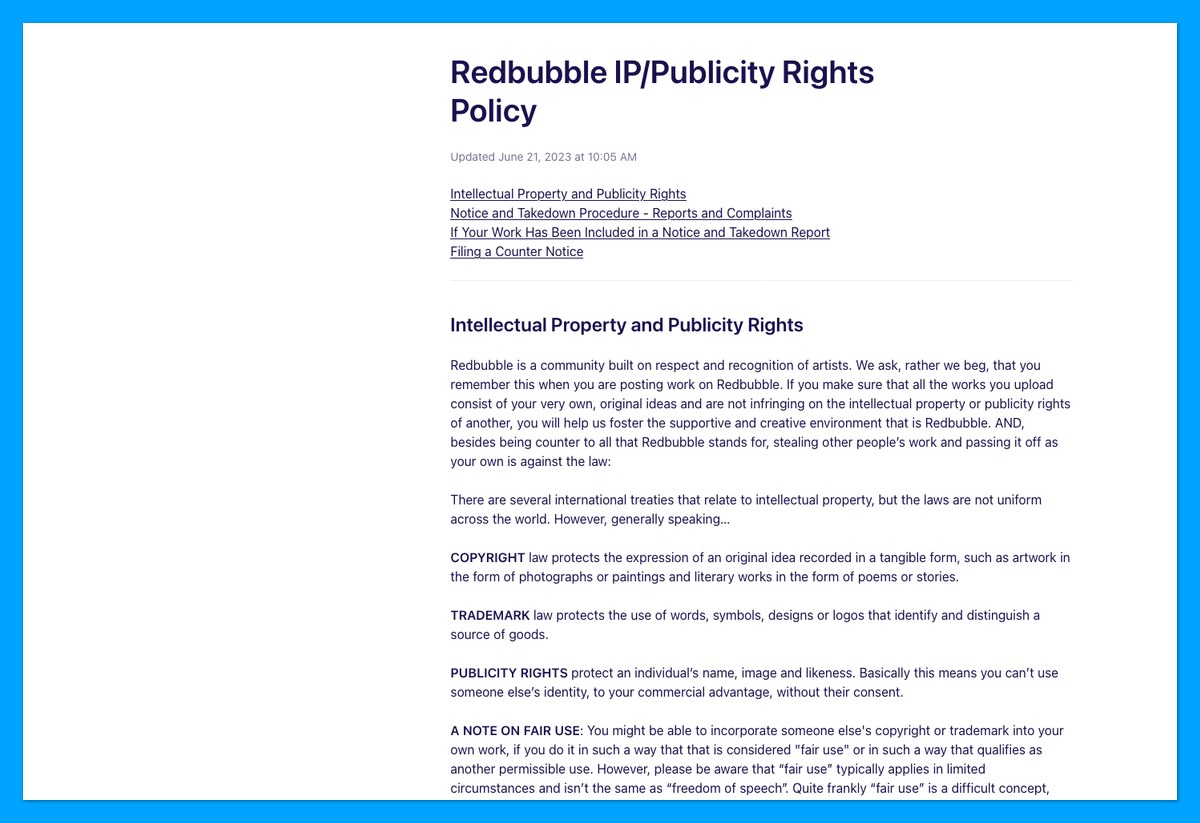
On Etsy, reported IP infringement can trigger removal or disabling of content. Etsy sends the reporter’s contact information, but doesn’t decide which listings legally infringe.
Do not create replacement listings for disputed content unless you resolve the issue with the other party. Repeat infringement reports can cost account privileges. For copyright reports, a DMCA counter notice is available.
Etsy offers listing-level appeals for Creativity Standards removals made after July 15, 2025. That’s separate from resolving an IP dispute. For POD, disclose the real production partner; listing a reseller as a partner can lead to suspension.
Protect the work behind either account:
- Save source files and dated sketches that document your authorship.
- Keep product files and a copy of your design library outside the marketplace.
- Retain takedown emails and resolve the reported issue before relisting.
- Use Etsy’s reporting process if another seller copies your original designs.
A marketplace account should never be your only archive. Keep enough records to respond to a complaint without relying on a suspended dashboard. Review Etsy alternatives as distribution options, not as a way to evade unresolved policy action.
AI Terms: What Each Platform Can Do With Your Art
Etsy’s revised terms still authorize AI training, despite adding a promise against copycat models. Section 5.C was revised on November 23, 2026 and takes effect December 16, 2026.
The clause says: “As part of this license we, and our partners and vendors, may use Your Content to develop, train, test and improve artificial intelligence and machine learning technologies to help us provide, operate and improve the Services to, for example: help buyers find, discover and understand items; give sellers tools to run their shops; provide and improve customer support; promote and advertise items and Etsy; and protect our community and Services, including keeping accounts secure, detecting fraud and enforcing our policies.”
The new commitment reads: “Your original, creative work is what makes Etsy special. We won’t use Your Content to train AI models designed to replace your creativity or to create copycat versions of the items you sell on Etsy. When we work with partners and vendors that provide or train AI models, our purpose is to support our sellers and the Etsy community and not to enable them to imitate your items.”
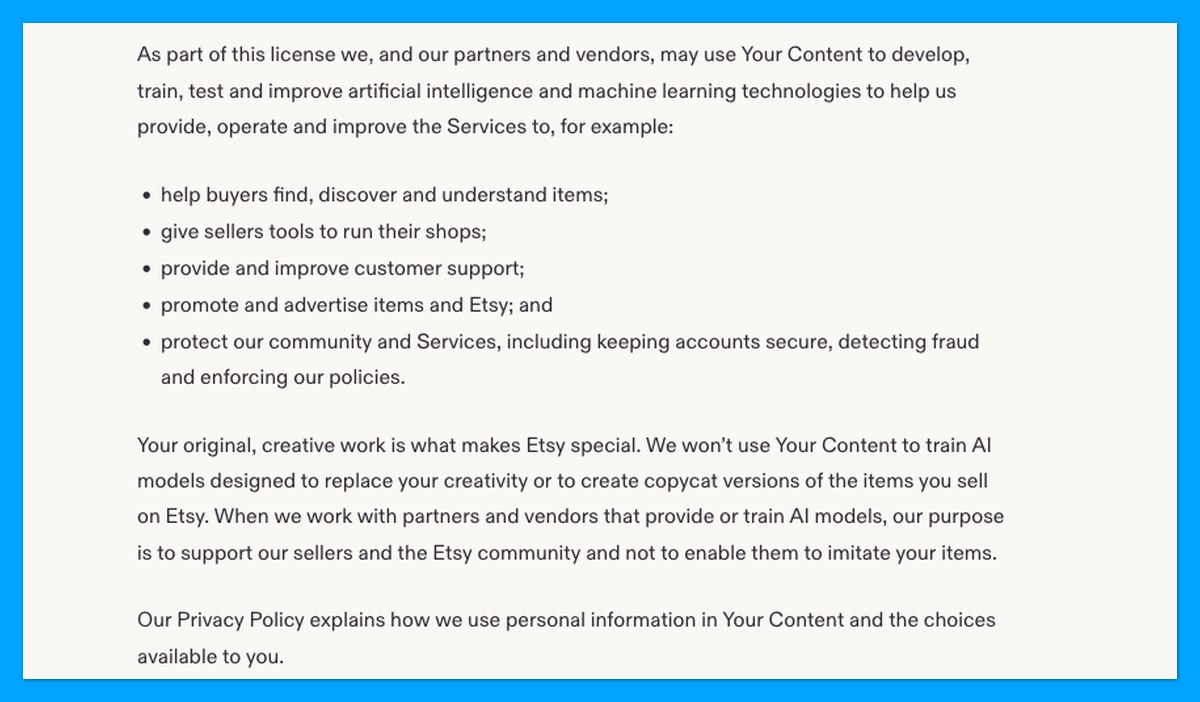
The license remains perpetual and irrevocable. The copycat promise limits stated purposes; it does not remove the AI permission. The Terms provide no general AI-training opt-out for US sellers, and closing a shop may not end the license.
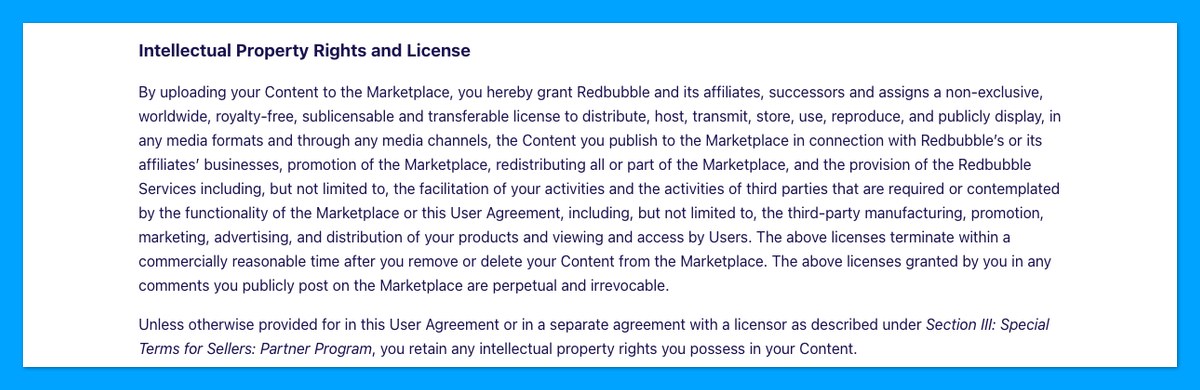
Redbubble’s User Agreement, last updated May 15, 2026, contains no artificial-intelligence or machine-learning training wording. Its content license is non-exclusive and covers use connected with its businesses and services.
Its termination language says: “The above licenses terminate within a commercially reasonable time after you remove or delete your Content from the Marketplace.”
Redbubble’s Community and Content Guidelines mention AI only in the nudity restriction, including photorealistic AI-generated imagery. That is a content rule, not an AI-training commitment.
No AI wording is not a promise either way. Redbubble’s license ends after you delete your content, unlike Etsy’s perpetual one, but a contract’s silence doesn’t spell out every use Redbubble may or may not make of your files.
If these permissions determine where you sell, review them before uploading your library. The Big Cartel vs Etsy comparison offers another selling-model decision; it isn’t a substitute for reviewing that platform’s content terms.
Running Both From One Design Library
Neither platform requires exclusivity, so you don’t have to move your entire catalog to make Etsy worthwhile. Redbubble’s license is non-exclusive; Etsy allows your original designs made by a disclosed production partner.
Use Redbubble for the full library and stickers at a 20% starting markup. Reserve Etsy for proven sellers adapted into tees and prints with prices that cover fulfillment and marketplace fees.
The same source artwork can support different listings. Use product-specific mockups, rather than assuming a sticker design’s placement and scale suit a tee.
- Do: Keep an organized master file for each original design and export versions suited to the chosen products.
- Do: Review Redbubble’s Product Pricing settings instead of leaving the whole library at 10%.
- Do: Build Etsy listings around proven artwork and connect a disclosed partner such as Printify.
- Do: Save sales records from each marketplace so you can distinguish popular artwork from profitable products.
- Don’t: Upload every Redbubble design to Etsy automatically. Listing renewals make an inactive catalog cost money.
- Don’t: Use Etsy messages or QR codes to redirect Etsy-initiated purchases elsewhere.
- Don’t: Assume a design selling on stickers will earn the same response on a $30.00 poster.
This is one library with two jobs, not two identical storefronts. Redbubble keeps more artwork available without listing costs; Etsy concentrates your operating effort where higher margins can justify it.
Compare other places to sell art online and Teespring alternatives only when they serve a distinct product or selling goal. Another account adds little if it merely duplicates work.
Which One Should You Start On? A Stage-Based Verdict
Start with Redbubble if avoiding order management matters most; choose Etsy for proven designs you can support as a shop. The $24 tee calculation favors Etsy’s earnings, but you must fund fulfillment and manage buyers.
Under 20 designs, no audience: Start on Redbubble. Complete setup with at least five public designs, use original artwork and review the default markup. You can make designs available without paying listing renewals or funding supplier orders. Treat initial sales as evidence of demand, not dependable income.
A library of 50+ designs and a few proven sellers: Run both. Keep the broader library on Redbubble and turn the strongest designs into Etsy tees and prints. Price Etsy products after shipping and fees, then disclose the production partner correctly. Don’t copy the whole library merely because the files are ready.
Selling 18+ tees a month on Etsy: Make Etsy the main shop for those sellers and evaluate Printify Premium. The $2.25 saving per example tee covers the $39 monthly subscription on the 18th sale. Compare print-on-demand sites before choosing a supplier, including Printful at the margins calculated above.
Ready to own the customer: Evaluate an independent store through Shopify. Plan it as a separate selling operation, not a destination for diverting Etsy transactions. Embedding Redbubble products still sends checkout back to Redbubble.
Redbubble Standard leaves $2.00 on the $24 tee; Etsy with Printify Free leaves $5.99, including delivery. Redbubble pays less for less operational responsibility. Etsy pays more when you accept the costs and work of running the shop.
Start your Etsy shop for proven sellers, or start on Redbubble to put your design library to work.