Etsy’s fees reduce what you keep. Its new AI-training permission, effective December 16, 2026, adds another question: what rights are you granting over your work?
My first choice among the best Etsy alternatives is Shopify for building an independent brand. Squarespace comes next for a portfolio-led shop, while Big Cartel suits a small catalog and tighter budget.
Moving doesn’t automatically solve the AI problem. I compare selling costs and each platform’s own content terms, including unanswered questions. Whether you sell handmade goods or want other ways to sell stuff online, compare the business model and license before uploading your work.


Key Takeaways
- Shopify is my overall recommendation: Your own domain and customer list provide a foundation for an independent brand.
- Etsy kept AI-training permission: Its November 23 revision adds a no-copycat promise, effective December 16, 2026.
- None offers a blanket written no-training promise: Content licenses, crawler controls, and AI-product restrictions mean different things.
- Marketplaces trade control for buyer access: Amazon Handmade and eBay offer marketplace exposure alongside broad licenses and percentage-based fees.
- Low-cost starts include Big Cartel and Ko-fi: Big Cartel Gold is free for five products; Ko-fi charges $0 monthly plus 5% on shop sales.
Best Etsy Alternatives Compared
Choose the selling model before the cheapest plan: independent storefronts require you to attract buyers; marketplaces provide access to shoppers already browsing.
| Platform | Type | Starting price | Selling fees | AI and content terms | Best for |
|---|---|---|---|---|---|
| Shopify | Independent store | $39/month; $29/month billed yearly | Basic: 2.9% + $0.30 with Shopify Payments | Broad license; agentic opt-out controls; training unclear | Independent brands |
| Squarespace | Website and store | $25/month; $19/month billed annually | Basic: 2% plus processing | Perpetual license; optional AI crawler blocking | Portfolio-led shops |
| Big Cartel | Independent store | Free Gold plan, five products | Processing only | Service-focused license; AI Shield bot controls | Small art catalogs |
| Ko-fi | Creator page and shop | $0/month | 5% shop fee plus processing | Limited license; platform-wide training-bot blocks | Creators with followers |
| Amazon Handmade | Handmade marketplace | $39.99 first month, then waived for approved eligible sellers | 15%; $0.30 minimum per item | Broad license; seller-content training unstated | Handmade marketplace sales |
| eBay | General marketplace | 250 free listings monthly | Most categories: 13.6% + $0.40 on orders over $10 | Perpetual license; recommendation-model training disclosed | Vintage items |
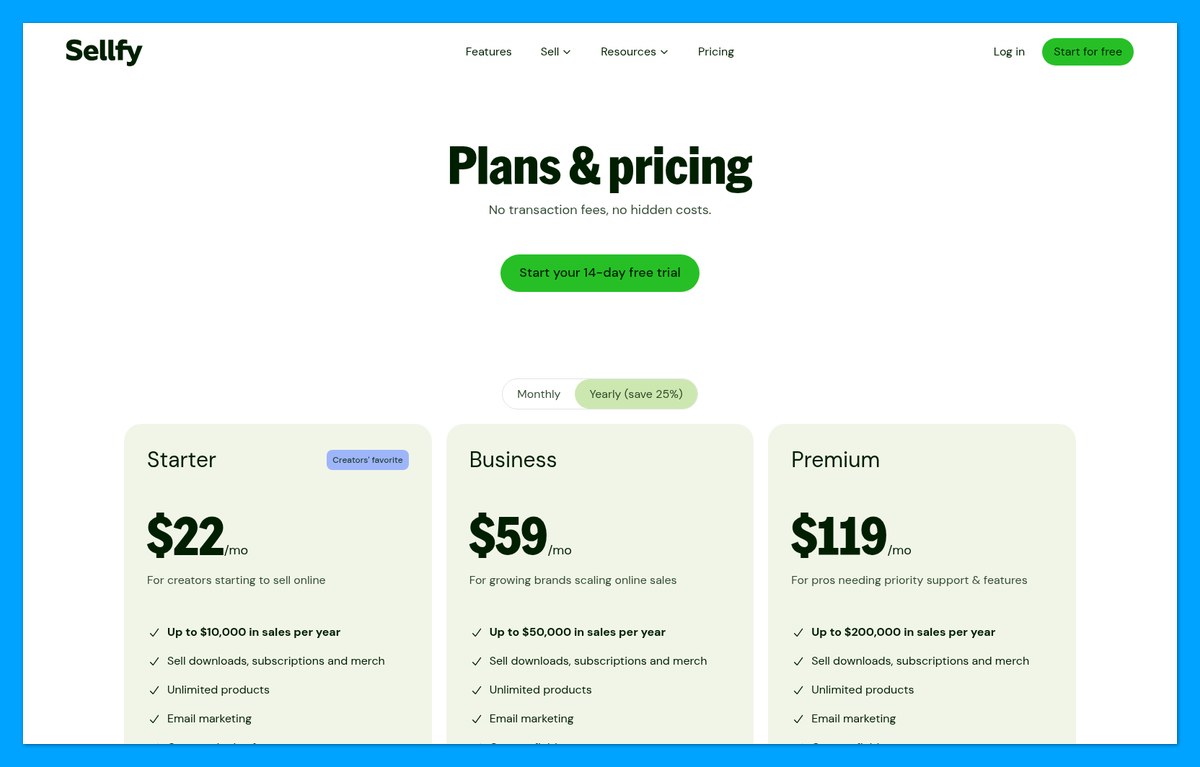
| Sellfy | Hosted storefront | $29/month; $22/month billed yearly | Processing; possible 2% above sales cap | No seller-content license clause or training statement | Digital downloads |
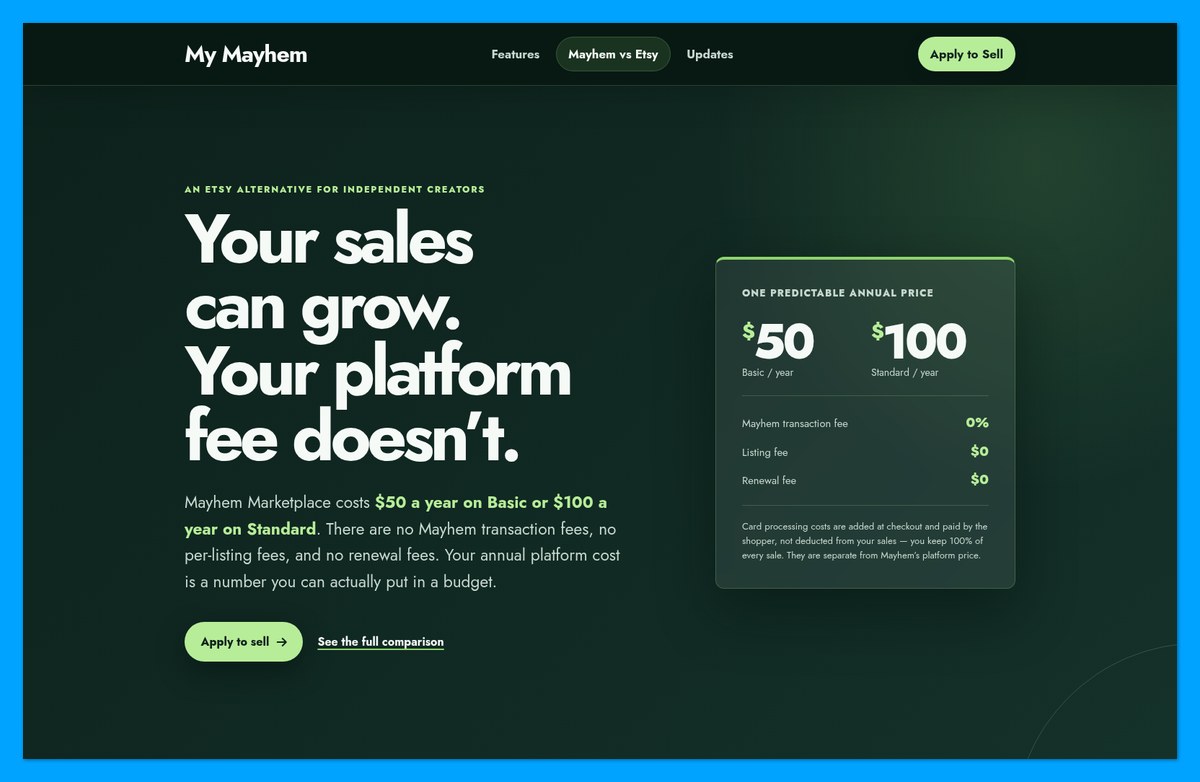
| Mayhem Marketplace | Human-made marketplace | $5/month or $50/year | No seller transaction fees; shopper pays processing | AI-created listings and products prohibited; training unstated | Human-created work |
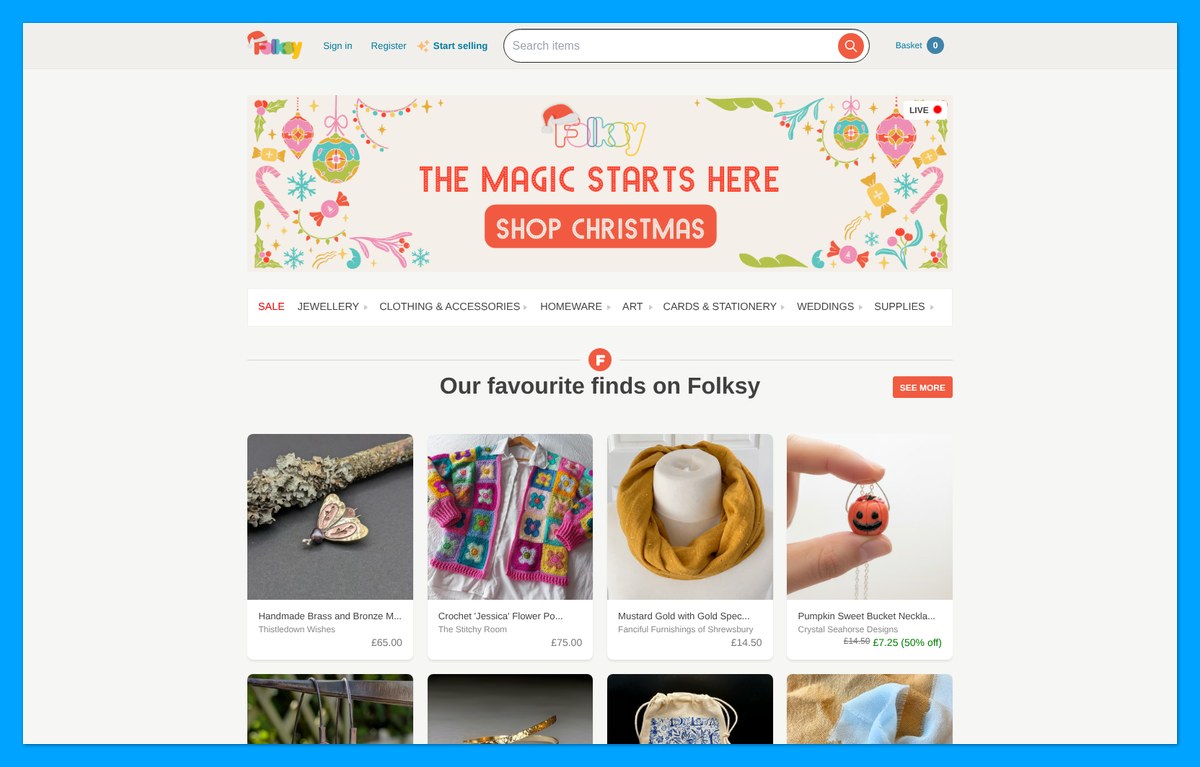
| Folksy | UK maker marketplace | No Basic subscription; £0.15 + VAT per quantity listed | 6% + VAT commission, plus processing | Perpetual license; AI-generated artwork prohibited | UK makers |
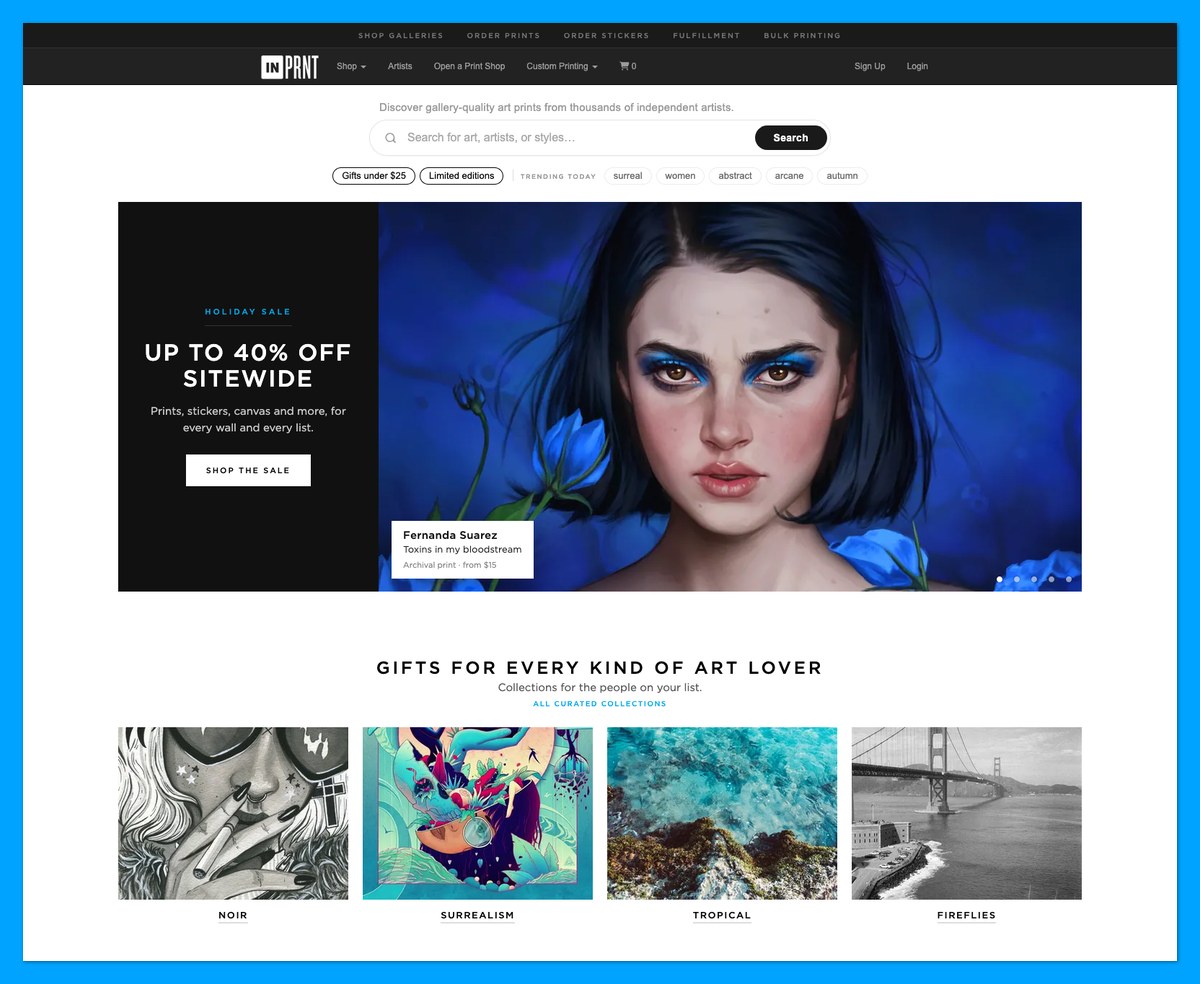
| INPRNT | Curated print-on-demand marketplace | Revenue-share model | Fine art artist earnings: 25% Studio; 50% Gallery | Business-use license; AI-generated art prohibited | Outsourced print fulfillment |
Cost examples assume $500 monthly sales from 20 orders of $25, excluding shipping, tax, advertising, and optional extras. Annual-plan monthly equivalents require annual billing. Folksy’s fees remain in pounds without a currency conversion.
Which Etsy Alternative Fits You?
- If you want an independent brand: Pick Shopify for your own domain, customer list, and multichannel selling.
- If your portfolio helps sell your work: Pick Squarespace.
- If you have five products or fewer: Pick Big Cartel Gold; choose Ko-fi if commissions and memberships matter.
- If you need marketplace discovery: Pick Amazon Handmade for eligible handmade goods or eBay for vintage pieces.
- If you sell downloads: Pick Sellfy for a dedicated storefront or Ko-fi for an existing following.
- If product rules or fulfillment decide it: Pick Mayhem for human-created work, Folksy for UK makers, or INPRNT for outsourced printing.
What Changed in Etsy’s AI Terms
Etsy’s November 23, 2026 revision keeps AI-training permission. It restricts what certain models are designed to do rather than removing permission.
The October 26 version of section 5.C allowed Etsy and its partners and vendors to use seller content to develop, train, test, and improve AI and machine-learning technologies. Sellers publicly closed shops, and The New York Times reported the departures on November 20. On November 23, Etsy CEO Kruti Patel Goyal acknowledged in a seller community post that Etsy should have given more context, and Etsy published revised wording the same day.
The revised wording remains effective December 16, 2026. Its stated purposes include:
- Shopping discovery: Helping buyers find items.
- Seller tools and support: Providing tools and customer assistance.
- Promotion: Advertising items and Etsy.
- Community protection: Security, fraud prevention, and policy enforcement.
Etsy now promises: “We won’t use Your Content to train AI models designed to replace your creativity or to create copycat versions of the items you sell on Etsy.” It also says partners and vendors providing or training AI models aren’t used to enable them to imitate your items.
However, the explicit opt-out reference was removed. The revised clause points to choices in the Privacy Policy, which names a right to object in the EEA, UK, and other countries, not a general US training switch.
The license remains non-exclusive, worldwide, royalty-free, irrevocable, sub-licensable, and perpetual. Closing your shop doesn’t cancel rights already granted.
Etsy’s US selling fees include:
- Listings: $0.20 per item.
- Transactions: 6.5%.
- Processing: 3% plus $0.25 per order.
- Attributed Offsite Ads: 15% or 12%, depending on eligibility.
On $500 in sales from 20 orders of $25, those fees total $56.50 before Offsite Ads. My Etsy review covers the broader decision, but first decide whether the revised permission is acceptable to you.
1. Shopify: Best Overall for Building Your Own Brand
Shopify is my first choice for building beyond Etsy. You get your own domain and customer list, with themes and apps to shape your store.
Marketplace Connect can sync Etsy, Amazon, and eBay listings, supporting a gradual transition. My Shopify review covers its capabilities; Shopify vs Etsy explains the storefront-versus-marketplace decision.
AI and Content Terms
Shopify’s section 8.1 grants a transferable, sublicensable, royalty-free worldwide license, including modification and derivative works, to operate, improve, evaluate, and promote its services. It includes a moral-rights waiver but doesn’t mention AI or machine learning.
Agentic storefronts are active by default for eligible stores. Their license extends to participating partners and survives termination; product-feed training rights remain unclear. Open Sales channels > Agentic, disable Allow Shopify to manage for me, then Shopify Catalog access globally or by channel; ChatGPT changes can take up to seven days, ordinary crawling can still surface products, and the Shop channel is separate.
Pros
- Brand control: Use your own domain and build customer relationships.
- Connected selling: Marketplace Connect supports a gradual Etsy transition.
- Growth tools: Email marketing and POS support selling beyond your storefront.
Cons
- Traffic responsibility: You need a plan to attract buyers.
- Payment-provider surcharge: Basic adds 2% for third-party providers.
- AI uncertainty: Channel controls aren’t a blanket no-training promise.
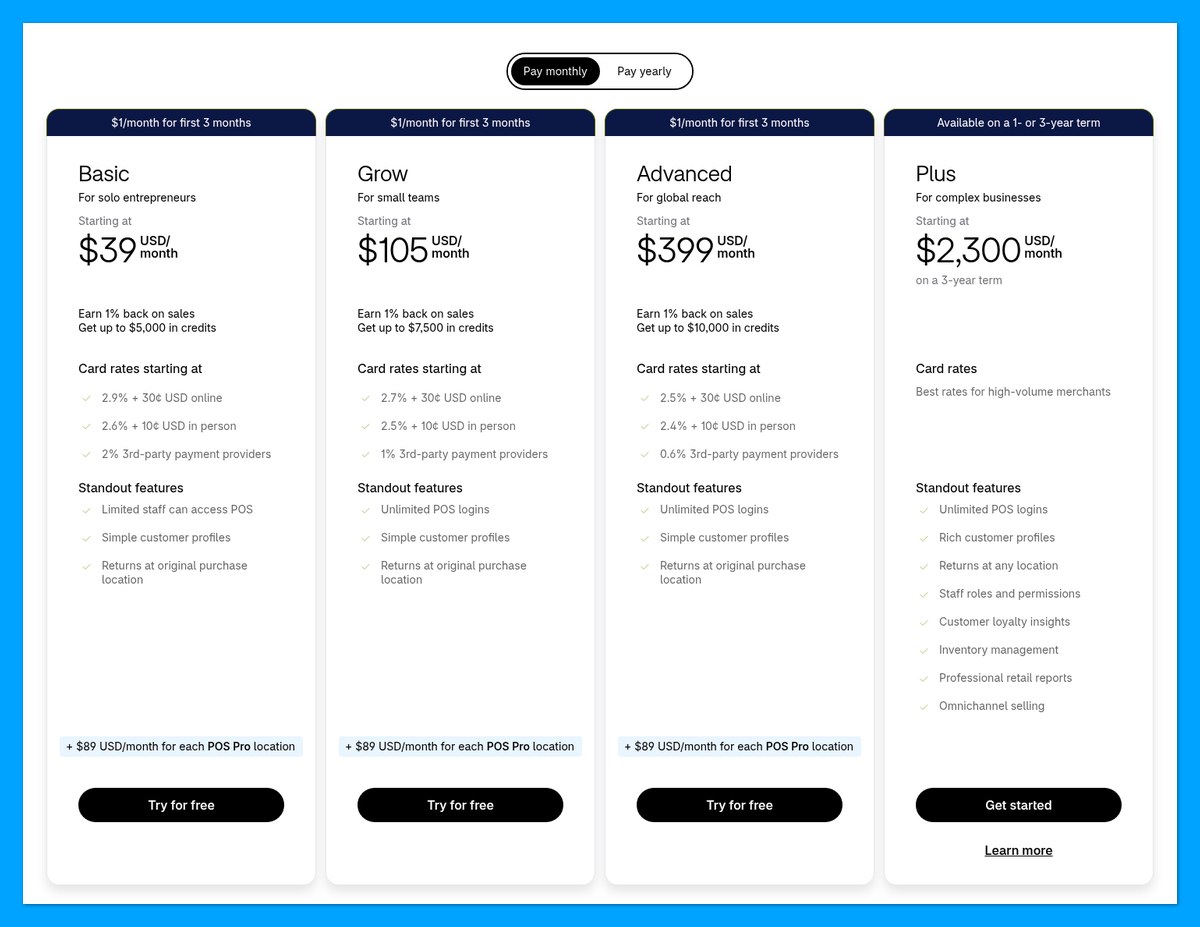
Pricing
- Basic: $39 monthly or $29/month billed yearly.
- Grow: $105 monthly or $89/month billed yearly.
- Advanced: $399 monthly.
Basic’s US Shopify Payments rate is 2.9% plus $0.30, with no Shopify listing or transaction fees. The Shopify pricing guide explains the plans.
$500 example: Basic totals $59.50 on monthly billing or $49.50 on yearly billing, including processing.
Who It’s For
Choose Shopify for an independent brand with room to grow, not as an escape from all AI-related permissions.
2. Squarespace: Best for a Portfolio and Shop in One
Squarespace suits sellers whose portfolio helps sell the product. Present your work alongside a store instead of sending every visitor straight to a product grid.
Physical and digital products plus member areas give you several selling formats. My Squarespace review covers the platform; Shopify vs Squarespace compares commerce-led and portfolio-led websites.
AI and Content Terms
Squarespace takes a perpetual, irrevocable, transferable, sublicensable license, limited to providing, improving, promoting, and protecting its services. Its terms don’t say whether it trains AI on user content; AI-feature inputs may go to an AI provider.
Under Settings > Crawlers, enable Block known artificial intelligence crawlers, which is off by default. This adds a robots.txt request, doesn’t bind scrapers that ignore it, and doesn’t change the license.
Pros
- Portfolio presentation: Design templates showcase your work alongside your shop.
- Product flexibility: Sell physical work and downloads together.
- Crawler control: Request exclusion through a named setting.
Cons
- Basic selling fee: The entry plan adds 2% to online store sales.
- License permanence: Crawler blocking doesn’t remove perpetual permissions.
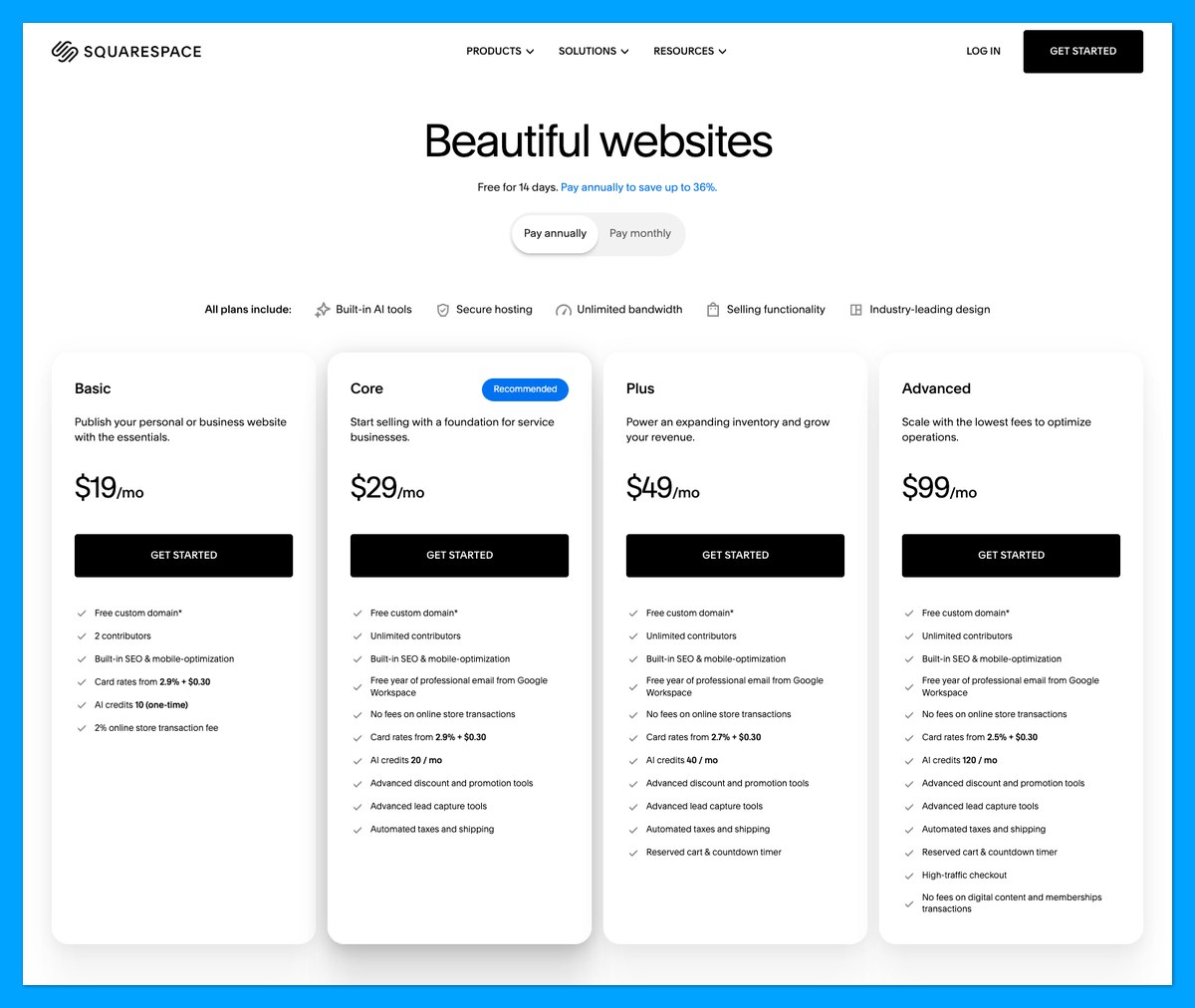
Pricing
- Basic: $25 monthly or $19/month annually; 2% store transaction fee.
- Core: $39 monthly or $29/month annually; 0% store transaction fee.
- Plus: $65 monthly or $49/month annually.
- Advanced: $139 monthly or $99/month annually.
Squarespace Payments processing starts at 2.9% plus $0.30. A 14-day trial lets you evaluate the format.
$500 example: Basic costs $35 on monthly billing or $29 on annual billing, plus $20.50 processing at the starting rate.
Who It’s For
Choose Squarespace when presentation drives purchases. I favor Shopify when multichannel commerce matters more than your portfolio.
3. Big Cartel: Best Low-Cost Store for Small Art Shops
Big Cartel gives a five-product shop a free starting plan. It’s a practical option when subscriptions would consume too much of your early sales.
Built for artists and makers, it has fewer features than Shopify. My Big Cartel review explains the fit; compare these Big Cartel alternatives if its catalog limits look restrictive.
AI and Content Terms
Big Cartel’s irrevocable, sublicensable license is service-focused, covering store hosting, tools, service provision, and platform promotion and management. It agrees not to use content after termination except for legal, claims, and record-keeping needs, although copies may remain and section 4.4 survives termination.
AI Shield is available on every plan. Open Shop Settings > AI Shield > Block AI training bots; a separate toggle covers AI shopping assistants. These are robots.txt controls, and AI search crawlers aren’t covered.
Pros
- Free small catalog: Gold accommodates five products without a subscription.
- No platform transaction fees: Big Cartel doesn’t take a sales percentage.
- Separate bot controls: Training bots and shopping assistants have distinct settings.
Cons
- Product ceilings: Diamond stops at 500 products.
- Limited expansion: Fewer features and no marketplace traffic constrain the fit.
Pricing
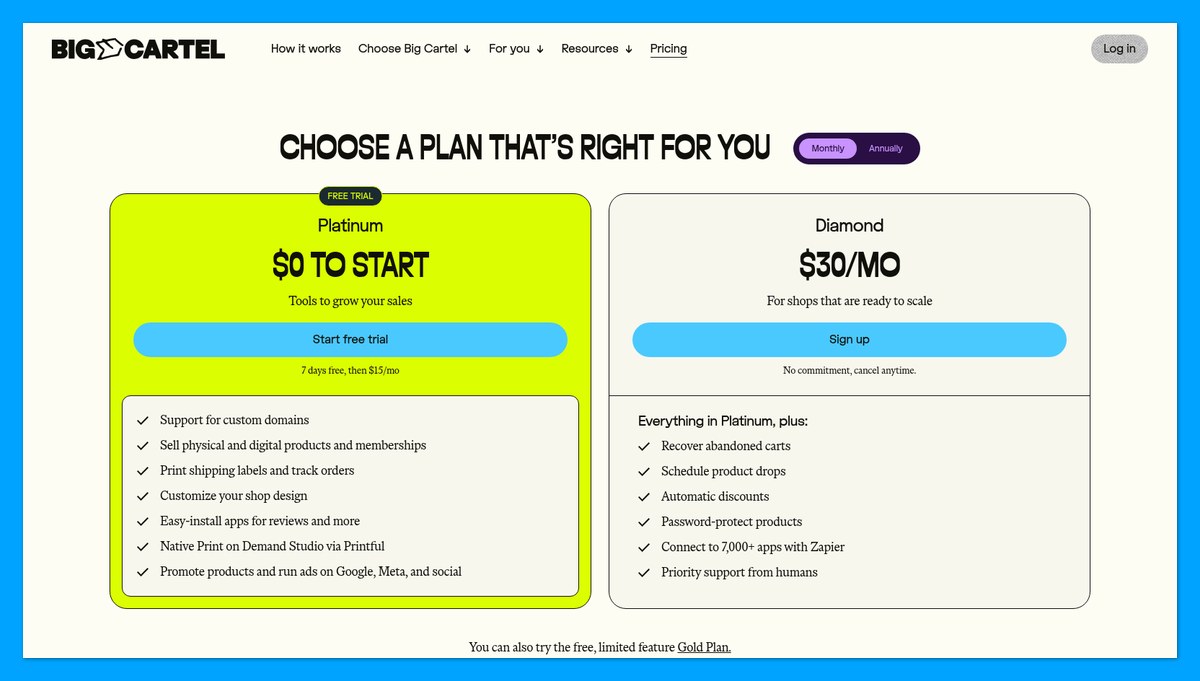
- Gold: Free for five products.
- Platinum: $15/month or $144/year for 50 products.
- Diamond: $30/month or $288/year for 500 products.
Stripe or PayPal processing is extra. Platinum includes a seven-day free trial.
$500 example: Platform costs are $0 on Gold or $15 on monthly Platinum, plus processing.
Who It’s For
Choose Big Cartel for a small art shop. Start with Gold if five products cover your range and you can attract buyers yourself.
4. Ko-fi: Best for Creators Who Already Have Followers
Ko-fi combines shop sales with commissions, memberships, and tips. It suits customers who support you as a creator, not just a particular product.
I recommend it for sellers with existing followers. Among places to sell art online, Ko-fi offers little buyer discovery compared with a marketplace.
AI and Content Terms
You keep ownership while granting Ko-fi and other users a limited license to use, store, copy, and distribute content. Its terms also permit using content to improve Ko-fi and its business, without mentioning AI.
Ko-fi’s help guidance opposes training models on creators’ work. It blocks major AI-training bots platform-wide and bans scraping, with no per-seller switch. Honestly labelled AI-made products are allowed, a separate rule from its training stance.
Pros
- Multiple income sources: Combine products with memberships and commissions.
- No mandatory subscription: Start with percentage-based shop fees.
- Platform-wide bot blocking: Restrictions don’t require individual setup.
Cons
- Limited discovery: Bring followers rather than expecting marketplace traffic.
- Free-plan deductions: Shop sales carry a 5% fee before processing.
Pricing
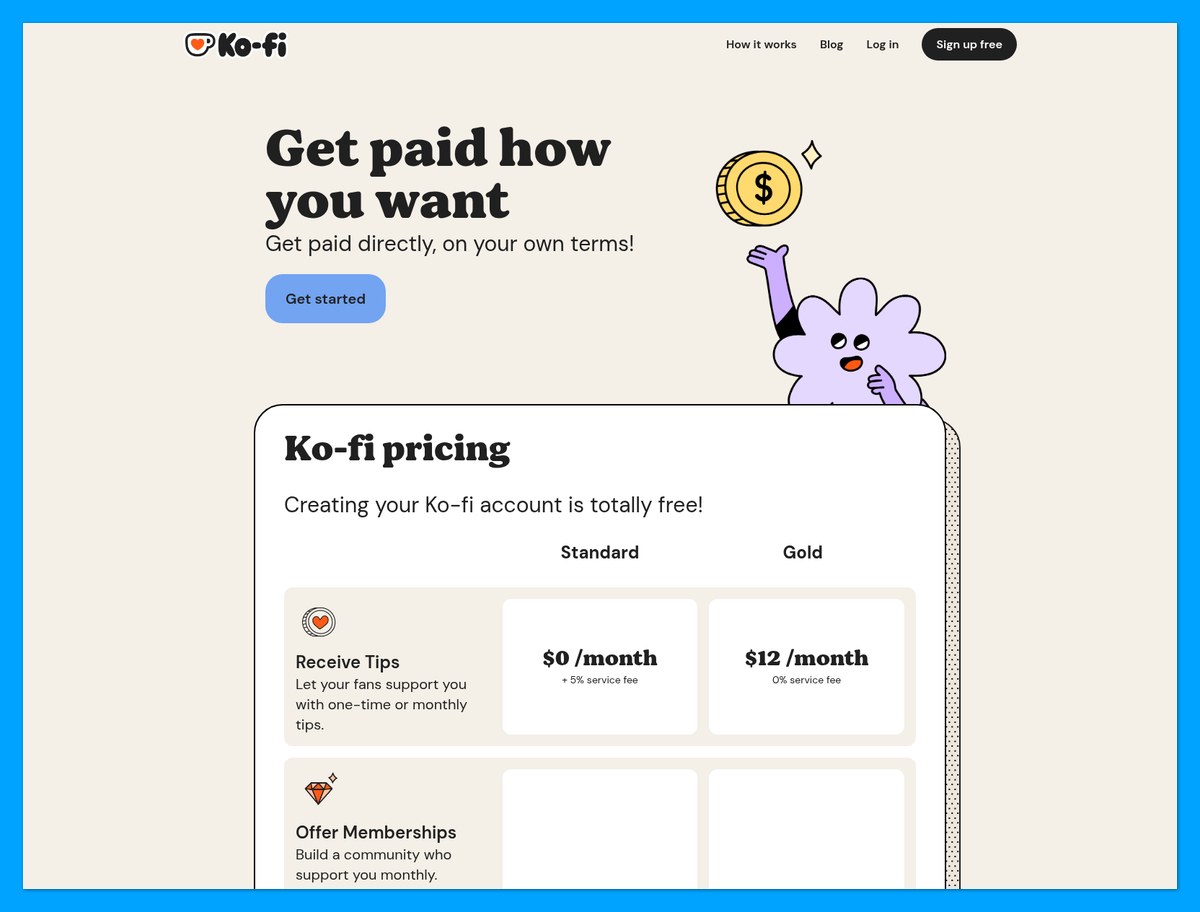
- Free: $0/month; 5% on shop sales, memberships, and commissions; 0% on tips.
- Gold: $12/month with 0% service fees; new creators can only pay monthly.
PayPal or Stripe processing is additional. Gold breaks even against the 5% shop fee at $240 in monthly sales.
$500 example: Pay $25 in Free-plan service fees or $12 for Gold, plus processing.
Who It’s For
Choose Ko-fi if followers already want to support you. I’d choose a dedicated storefront when the shop needs its own brand identity.
5. Amazon Handmade: Best Marketplace Traffic for Makers
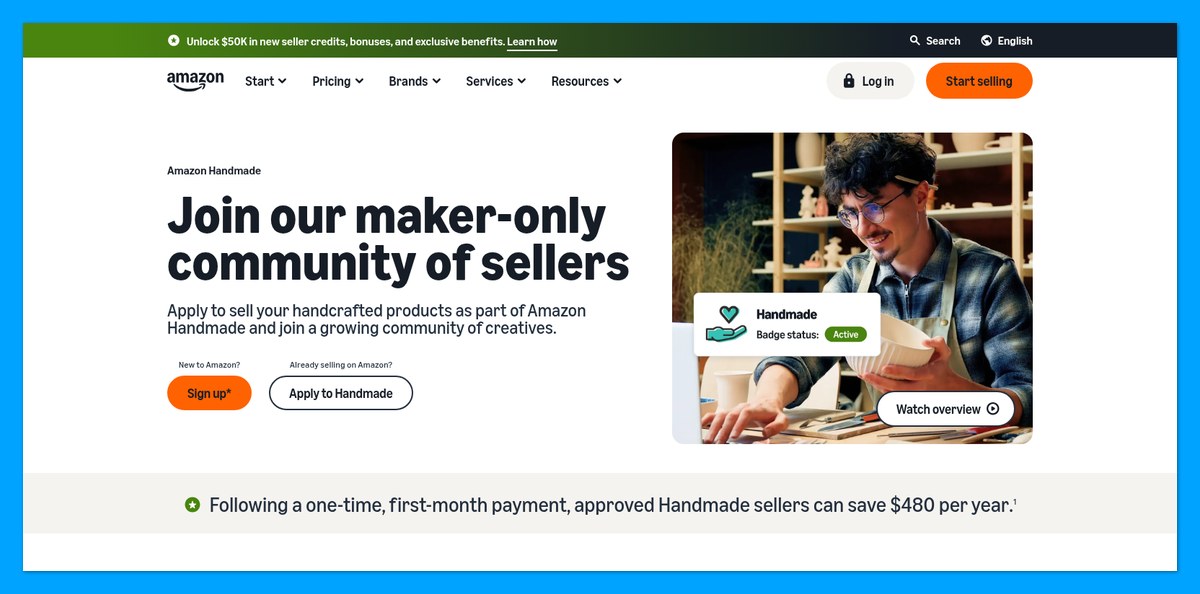
Amazon Handmade gives eligible makers access to Amazon shoppers. I’d shortlist it when marketplace exposure matters more than owning an independent storefront.
Approval requires production details and photos showing your business name or logo. Products must be designed and produced by you; outsourced production, dropshipping, reselling, and downloads aren’t allowed. My Amazon Handmade vs Etsy comparison explains its fit among online marketplaces.
AI and Content Terms
Amazon’s license lasts for the duration of your original and derivative intellectual-property rights. It permits use of materials for its services or other Amazon products and services, with sublicensing to affiliates.
The Business Solutions Agreement doesn’t state whether seller content trains AI. Its machine-learning restriction concerns sellers using Amazon’s materials, not Amazon using yours. Handmade has no AI-specific product rule, so approval doesn’t establish an AI-art ban.
Pros
- Marketplace exposure: Reach shoppers within Amazon.
- Etsy import option: Bring existing listings into the transition.
- Subscription waiver: Approved, eligible Handmade sellers avoid recurring Professional-plan charges.
Cons
- Approval requirements: Your production process must qualify and can be audited.
- 15% referral fee: Marketplace access costs more than processing alone.
- No downloads: Digital-product sellers need another platform.
Pricing
The Professional plan requires a $39.99 first-month payment, then the monthly charge is waived while you remain approved with eligible products.
The referral fee is 15% of the buyer’s total excluding tax, including shipping and gift wrap, with a $0.30 minimum per item. There are no separate listing, transaction, or processing fees.
$500 example: Pay $75 in referral fees, plus $39.99 in the first month only.
Who It’s For
Choose Amazon Handmade for qualifying physical products and marketplace reach. Skip it for downloads or outsourced production.
6. eBay: Best for Vintage and One-of-a-Kind Pieces
eBay fits vintage sellers better than handmade-only marketplaces. It also accommodates art and crafts without Handmade approval.
I’d consider it for individual collectible pieces, not solely to escape Etsy’s terms. Read my eBay review and guide to selling on eBay; apparel sellers can compare the best places to sell clothes online.
AI and Content Terms
eBay takes a perpetual, irrevocable, royalty-free license, sublicensable through multiple tiers, for providing, expanding, and promoting its services, including new offerings. Sellers waive enforcement of intellectual-property and moral rights for those uses and remain responsible for AI-generated listings.
Its Privacy Notice effective November 26, 2026 says certain user data, including listed and sold items, may train recommendation models after de-identification. Certain users, including those in the EEA, Switzerland, and UK, have objection rights; no general US opt-out is identified.
Pros
- Vintage fit: Sell older pieces without handmade-only eligibility.
- Free listing allowance: Start with 250 free listings monthly.
- Marketplace access: Reach buyers already browsing and searching.
Cons
- Broad fee base: Final value fees include shipping and sales tax.
- Disclosed AI use: Recommendation-model training conflicts with a blanket anti-training requirement.
Pricing
- Without a Store: 250 free listings monthly, then $0.35 each.
- Starter Store: $7.95 monthly or $4.95/month on yearly renewal.
- Basic Store: $27.95 monthly or $21.95/month on yearly renewal.
Most categories without a Store charge 13.6% up to $7,500, then 2.35% above, plus $0.40 per order over $10 or $0.30 otherwise. Basic or higher reduces most Art and Crafts categories to 12.7% up to $2,500.
$500 example: Without a Store, fees total $76, excluding additional shipping and tax effects.
Who It’s For
Choose eBay for vintage and unique stock, not a promise against AI training.
7. Sellfy: Best for Digital Downloads and Patterns
Sellfy gives downloadable products a dedicated hosted storefront. It also supports subscriptions, physical goods, and print-on-demand merchandise.
I’d shortlist it for patterns and other digital files when a creator-support page isn’t enough. My Sellfy review covers the platform; the guide to selling digital products helps you plan your offer.
AI and Content Terms
Sellfy’s terms contain no seller-content license clause and no AI-training statement. That isn’t a written no-training guarantee. Data is deleted 30 days after a subscription expires or immediately when you close the account.
AI-created products are allowed. Connecting ChatGPT or Claude through Sellfy’s MCP connector puts that data under the AI provider’s terms, separate from Sellfy’s own policy.
Pros
- Digital-product fit: Sell downloads and subscriptions alongside physical products.
- No standard transaction fee: All plans charge 0% within their limits.
- Print-on-demand option: Add merchandise without changing storefront providers.
Cons
- Annual sales caps: Growing revenue can require a higher plan.
- No free plan: Subscriptions continue during slow months.
Pricing
- Starter: $29 monthly or $22/month yearly; $10,000 annual sales cap.
- Business: $79 monthly or $59/month yearly; $50,000 cap.
- Premium: $159 monthly or $119/month yearly; $200,000 cap.
Stripe or PayPal processing is extra. Sellfy may charge 2% on sales above your cap until you upgrade; a 14-day free trial is available.
$500 example: Starter costs $29 monthly or $22/month on yearly billing, plus processing.
Who It’s For
Choose Sellfy for a focused digital-download business. Compare annual sales caps as well as subscriptions, especially if sales arrive in seasonal bursts.
8. Mayhem Marketplace: Best for Strictly Human-Made Work
Mayhem bans AI use in products and listings. Its eligibility policy goes further than prohibiting AI-generated artwork alone.
Print-on-demand is allowed when the design is yours; dropshipping isn’t. Vintage items must have been owned for at least six months, and products must be legal in the US.
AI and Content Terms
Titles, descriptions, tags, and images must be human-created, including image enhancement. Using AI just to polish listing copy still conflicts with this rule.
The seller terms contain no content-license clause or statement about Mayhem training AI. Its privacy notice says it uses AI services for support and moderation, so the human-made requirement isn’t a platform-wide AI ban.
Pros
- Human-created positioning: Rules cover listings as well as products.
- No percentage deduction: Sellers keep the full sale price.
- Original-design POD allowed: Sell your designs through print-on-demand.
Cons
- No AI-assisted listings: Even AI image enhancement is prohibited.
- Shopper-paid processing: Buyers pay processing added at checkout.
Pricing
- Basic: $5/month or $50/year.
- Standard: $10/month or $100/year.
There are no transaction, listing, or renewal fees. The shopper pays card processing at checkout.
$500 example: Monthly platform costs are $5 on Basic or $10 on Standard, with the full sale price retained.
Who It’s For
Choose Mayhem for entirely human-created work. Its seller-product rules don’t establish a no-training promise.
9. Folksy: Best for UK Makers
Folksy only accepts UK sellers, but buyers can shop from anywhere. Check seller eligibility before comparing fees.
Plus includes Etsy shop import, helping an existing catalog move. I’d shortlist Folksy for a UK maker who wants marketplace selling rather than a standalone website.
AI and Content Terms
Folksy prohibits artwork generated using AI software. Its terms don’t address training, so that restriction governs seller uploads, not every potential use of them.
Clause 18 grants a perpetual, royalty-free, non-exclusive license to use, reproduce, modify, adapt, and create derivative works for purposes such as marketing Folksy and your work. Clause 14 also describes permissions lasting in perpetuity.
Pros
- UK maker focus: A marketplace specifically for UK-based sellers.
- Worldwide buyers: Customers aren’t restricted to Britain.
- Etsy import: Plus supports bringing over your existing shop.
Cons
- Geographic restriction: Sellers outside the UK can’t join.
- Quantity-based charges: Basic bills each quantity listed, not each product page.
Pricing
- Basic: No subscription; £0.15 plus VAT per quantity listed; first three listings free.
- Plus: £7.50/month or £75/year, with unlimited free listings.
Both plans charge 6% plus VAT commission on item prices, excluding postage. VAT of 20% applies to fees, making commission 7.2% and each Basic listing £0.18; processing is additional.
£500 example: On £500 of item sales, commission is £30 plus VAT, or £36 with 20% VAT, before listing fees and processing.
Who It’s For
Choose Folksy for UK marketplace selling, not a contractual promise against AI training.
10. INPRNT: Best for Art Prints Without Handling Inventory
INPRNT handles printing, shipping, and customer service. You supply approved artwork instead of managing finished-print inventory.
The curated marketplace requires an application. Compare other print-on-demand sites for artists and broader print-on-demand platforms if you want more fulfillment control.
AI and Content Terms
INPRNT’s license permits reproduction and derivative works to make and sell products, promote them, and support other business purposes. It is non-exclusive, sublicensable, and transferable.
Artists warrant that their work isn’t AI-generated, and the Code of Conduct bans AI-generated art. The agreement doesn’t state whether INPRNT trains AI on artwork and provides no training opt-out.
Pros
- Outsourced fulfillment: INPRNT handles printing and shipping.
- Included customer service: You don’t manage print-order support.
- Gallery discovery: Gallery accounts appear in INPRNT search.
Cons
- Shared revenue: Artists receive only part of the selling price.
- Studio restrictions: Studio holds ten prints and lacks marketplace search visibility.
Pricing
- Fine Art Prints: Artists receive 25% on Studio or 50% on Gallery.
- Most other products: Artists receive 15% on Studio or 30% on Gallery.
- Frames: Artists receive a flat $5.
Gallery accounts have unlimited prints and search visibility, unlike Studio accounts.
$500 example: Fine art print sales pay you $125 on Studio or $250 on Gallery, without inventory or shipping work.
Who It’s For
Choose INPRNT when avoiding fulfillment is worth sharing revenue. Compare artist earnings with your production costs, not just Etsy’s fees.
How I Chose the Best Etsy Alternatives
I compared business fit and content permissions together, using official terms and prices reviewed on November 23, 2026. Lower fees don’t resolve a license that conflicts with your priorities.
- Fees and fixed costs: I compared subscriptions and per-sale deductions, separating processing from platform fees.
- AI and content terms: I reviewed license scope alongside training language, crawler controls, and AI-product restrictions.
- Buyer traffic: I distinguished marketplaces from storefronts that require you to attract customers.
- Product fit: I compared eligibility rules for handmade goods, vintage pieces, and digital work.
- Ease of moving: I considered import options and limits on transferring Etsy content.
Shopify ranks first for brand-building, not a blanket no-training guarantee. If you’ve chosen an independent store, my Shopify alternatives guide narrows the comparison to that route.
For every shortlist, separate product rules from platform permissions. A ban on AI-generated artwork answers what you can sell, not how the service may use your uploads.
How to Move Your Shop Off Etsy
Save your records before hiding listings or closing your shop. A new storefront won’t automatically inherit verified Etsy reviews or original image files.
- Export your listings CSV. Open Shop Manager > Settings > Options > Download Data > Download CSV. The export contains active-listing details, including titles, descriptions, prices, and quantities. Keep an untouched backup before editing a copy for your destination.
- Download your reviews. Use Download Your Reviews to save the file. Keep it as a business record; don’t assume another platform can import those reviews as verified purchases.
- Save original photos. The CSV contains image URLs, not image files. Preserve originals separately so rebuilding your catalog doesn’t depend on access to Etsy-hosted images.
- Tell followers through your own channels. Etsy permits sharing website and social links, but shop announcements and vacation auto-replies must not direct buyers to purchase from your website. Never move an Etsy transaction off Etsy; announce your new shop through your own channels within those rules.
- Use Vacation Mode before closing. Open Shop Manager > Settings > Options > Vacation Mode to hide listings and pause sales. Settle open orders and fees before using Shop Manager > Settings > Options > Close Shop. Closing doesn’t revoke the content license already granted.
The Bottom Line
Shopify is my top recommendation for an independent brand. Your own domain and customer list give you business control, while marketplace connections support a gradual move.
Choose Squarespace for a portfolio-led shop or Big Cartel for a small catalog with low fixed costs. Ko-fi fits creators whose followers want commissions or memberships alongside products.
For marketplace sales, choose Amazon Handmade for qualifying handmade goods or eBay for vintage and unique stock. Sellfy is my digital-download pick, Mayhem suits entirely human-created listings, and Folksy serves UK makers. Choose INPRNT when outsourcing print fulfillment matters more than retaining the full selling price.
An AI-art ban isn’t a no-training promise. Etsy’s revised wording keeps training permission, and competing platforms have their own licenses, controls, and unanswered questions.
Before moving, compare your actual Etsy costs with one shortlisted platform. Include subscriptions and processing, then account for the work of attracting customers. Decide whether its content permissions are acceptable before uploading your catalog, and preserve your Etsy records before closing anything.
FAQ
What is the best alternative to Etsy?
Shopify is my best overall Etsy alternative for building an independent brand. It offers your own domain and customer list, plus multichannel selling tools. Squarespace fits a portfolio-led shop, while Big Cartel suits a small catalog on a tight budget. Choose Amazon Handmade if marketplace exposure matters more than an independent storefront.
Does Etsy use my photos to train AI?
Etsy’s terms effective December 16, 2026 grant permission to use your content for AI training, but permission doesn’t establish whether a particular photo has been used. The November 23 revision retains that permission while promising not to train models designed to replace your creativity or create copycat versions of your items.
Which Etsy alternative does not train AI on my work?
None of these ten provides a blanket written no-training promise in the terms reviewed. Big Cartel offers AI Shield, Ko-fi blocks major training bots, and Squarespace has optional crawler blocking. Those controls aren’t contractual prohibitions on every training use. Banning AI-generated products also doesn’t establish how a platform uses seller content.
Is there a site like Etsy with lower fees?
Yes, but compare total costs rather than transaction rates alone. Big Cartel Gold has no subscription or platform transaction fee for five products; processing still applies. Ko-fi charges 5% on free-plan shop sales or $12 monthly for Gold with no service fee. Neither replaces Etsy’s buyer discovery, so include customer acquisition in your decision.
Can I move my Etsy reviews to another platform?
You can download Etsy reviews, but they don’t automatically transfer as verified reviews. Use Download Your Reviews to preserve the file, then follow your destination’s rules for displaying previous feedback. Don’t present imported reviews as verified purchases on the new site. See How to Move Your Shop Off Etsy above for the export sequence.