If you are looking for a Sellfy alternative, you have probably run into its ceilings.
Sellfy is a clean way to sell digital downloads and print on demand products, but the revenue caps built into every plan force an upgrade right as your store starts to grow, and merch, memberships, and community can feel like features bolted on rather than the main event.
A modern creator store is no longer just a checkout page for a PDF.
You want a platform that can sell physical merch, digital products, and memberships, handle global sales tax, and, above all, give you room to scale without hitting a wall. The good news is that the platforms below do exactly that, and several of them let you launch without paying a cent up front.
Top pick: For sellers leaving Sellfy who want maximum control and room to grow, Shopify is the strongest alternative. It removes Sellfy’s revenue caps entirely, gives you complete ownership of a real store, and scales from your first sale to enterprise without ever forcing you to switch platforms.
We compared the top Sellfy alternatives on the things that actually decide whether a store is worth building on:
- Ease of use: Can you launch in an afternoon, or do you need to wrestle with themes and code?
- What you can sell: Digital, physical, memberships, courses, or all of the above in one place?
- Fees and pricing: Flat monthly cost, per sale cut, or a mix, and how it scales as you grow.
- Taxes and admin: Does the platform act as Merchant of Record and handle VAT and sales tax, or is that your problem?
- Room to grow: Are there revenue caps or product limits waiting to slow you down?
The Master List: Top 5 Sellfy Alternatives
| Platform | Best For | Our Score | Starting Price |
|---|---|---|---|
| Shopify – Full ecommerce engine | Full control and scaling a real store with no caps | 9.6 / 10 | $39 / mo |
| Fourthwall – All in one creator commerce | Selling merch, digital products, and memberships under one brand | 9.4 / 10 | Free |
| Payhip – Simple digital storefront | Beginners and solo creators on a budget | 9.1 / 10 | Free |
| Podia – Courses and community | Course creators, coaches, and membership sites | 9.0 / 10 | $42 / mo |
| Gumroad – Fastest setup | Indie creators selling one off digital products | 8.6 / 10 | Free* |
| Sellfy – The incumbent | Straightforward digital and POD stores | 8.5 / 10 | $22 / mo |
*Gumroad has no monthly subscription, but it takes a fee on every sale.
1. Shopify: The Most Powerful Sellfy Alternative

Shopify is the headliner for anyone who has outgrown Sellfy’s lightweight builder and its revenue caps.
Where Sellfy treats your store as a simple checkout with a ceiling on how much you can earn, Shopify is a full commerce engine built to handle large catalogs, global shipping rules, point of sale for physical shops, and high order volumes without breaking a sweat.
There are no revenue caps and nothing you will outgrow, which is exactly why it tops this list.
It is less a creator storefront and more the infrastructure serious stores are built on. If your reason for leaving Sellfy is that you want real control and a platform that grows with you rather than against you, this is the one.
Pros
- No revenue caps, scales from first sale to enterprise
- Unrivaled inventory, shipping, and point of sale tools
- The best converting checkout for physical goods
- Enormous app store for almost any function you need
- AI features like Sidekick now built into the Basic plan
Cons
- Monthly cost climbs once you add paid apps
- Transaction fees apply unless you use Shopify Payments
- More platform than a creator selling a few digital files needs
Ease of Use and Customization
Shopify is intuitive for managing orders and inventory, and its guided setup gets a store live quickly. Building highly custom, non store pages is more rigid than a free form creator tool, and you may lean on paid themes and apps to get exactly the look you want, but the trade is near total control over a real storefront. It asks a little more of you at the start than Sellfy, and gives back far more headroom.
Products and Ecosystem
Shopify sells physical products, digital downloads, subscriptions, and services, and its app store of thousands of tools means almost any feature you can think of already exists. That flexibility is the whole point: rather than being limited to what one builder ships, you assemble exactly the store your business needs. The flip side is that stacking apps can turn into a pile of separate monthly subscriptions, so it pays to add only what genuinely earns its place.
The Full Control Advantage
Sellfy keeps you inside a tidy but limited box, and its plans literally cap how much you are allowed to earn before an upgrade is forced on you. Shopify removes the box entirely. You own your store, your data, and your customer relationships, you can sell across a website, social channels, and physical point of sale from one back office, and there is no revenue ceiling waiting to punish your success. For a business that intends to grow, that freedom is the difference maker.
Fees and Pricing
The Basic plan is $39 per month, or $29 per month on annual billing, with Grow at $105 per month and Advanced at $399 per month for larger operations.
Card processing runs around 2.9% and $0.30 on Basic, and choosing a payment provider other than Shopify Payments adds a separate transaction fee. The sticker price is rarely the final cost, since a growing store often stacks several paid apps on top, so budget for the ecosystem rather than just the subscription. In return you get a platform you will not replatform away from.
Best For: Sellers who want full ownership of a real store with no revenue caps and room to scale indefinitely.
2. Fourthwall: The Best All in One Alternative

If Shopify is more store than you need, Fourthwall is the runner up and the best pick for creators who want simplicity.
Where Sellfy treats merch and memberships as add ons to a download store, Fourthwall was built from the ground up as a single home for a creator brand: physical merch, digital products, memberships, and donations all live in one dashboard, on one storefront, under your own domain.
The part that matters most for anyone tired of admin is that Fourthwall acts as your Merchant of Record. That means it collects and remits sales tax, VAT, and GST worldwide on your behalf, and it handles production, shipping, and customer service for products from its catalog. As the platform likes to put it, you get a brand, not a business to run.
Pros
- No required monthly fee, with a genuinely usable free plan
- Merchant of Record handles global taxes automatically
- Sells merch, digital products, and memberships in one place
- Premium print on demand quality with no minimums
- Native integrations with YouTube, Twitch, TikTok, and Discord
Cons
- Free plan charges a 5% fee on digital products and memberships
- Less suited to large traditional retail catalogs than Shopify
Ease of Use and Customization
Fourthwall is built for creators, not developers. You pick a product from the catalog, drop your artwork onto it, and design a fully hosted storefront without touching code. The onboarding is fast enough that most people go from sign up to a live shop in a single sitting, which is a big part of why it keeps winning over creators who found other platforms fiddly.
Products and Ecosystem
This is where Fourthwall pulls ahead of Sellfy. Merch, digital downloads, memberships, and tips are all first class features rather than awkward extras, so a creator whose income comes from a blend of formats can keep everything in one place.
The native integrations with YouTube, Twitch, TikTok, and Discord let you sell where your audience already gathers, and the premium blanks and Signature collection give your merch a retail grade finish rather than the flat look of generic print on demand.
The All in One Advantage
Sellfy can technically sell physical and digital products, but you are still the one on the hook for taxes, and its revenue caps mean success eventually costs you a forced upgrade. Fourthwall flips that model. There are no revenue caps, no monthly commitment to start, and the boring but expensive work of tax compliance, fulfillment, and support inquiries is absorbed by the platform. For a creator who would rather make things than manage a back office, that trade is the whole pitch.
Fees and Pricing
You can start on the free plan, which lets you list up to 50 products, sell merch, digital products, and memberships, and get customer support handled for you.
The free plan carries a 5% fee on digital products and memberships, plus standard payment processing of 2.9% and $0.30 per transaction. Upgrading to Pro at $19 per month, or $180 per year, raises the limit to 500 products, drops the digital product fee to 0%, and adds unlimited team members, a free .store domain, $120 a year in sample credit, 100GB of storage, and priority support. For physical products, you simply cover the listed catalog cost and keep the rest.
Best For: Creators who want one branded storefront for merch, memberships, and digital products, with taxes and fulfillment off their plate.
3. Payhip: The Simplest Free Storefront

If your main reason for leaving Sellfy is that you resent paying a monthly fee before you have made real money, Payhip is the obvious landing spot. It offers a genuine free forever plan with every feature included, so you can list digital downloads, courses, coaching, memberships, and physical products without a subscription.
Pros
- Free forever plan with all features unlocked
- Sells digital products, courses, memberships, and physical goods
- Automatic EU and UK VAT handling
- Built in affiliate system and coupons
Cons
- 5% fee on the free plan adds up quickly at volume
- Only covers EU and UK VAT, not full global tax compliance
Ease of Use and Customization
Payhip is about as frictionless as digital selling gets. The dashboard is clean, the learning curve is close to flat, and you can have a storefront live in well under an hour. You upload a file, set a price, and share the link, which makes it ideal for creators who want to validate an idea without a project on their hands.
Fees and Pricing
Payhip keeps pricing refreshingly simple, and the only thing you pay more for is a lower cut. The Free plan takes 5% per sale, Plus at $29 per month drops that to 2%, and Pro at $99 per month removes the platform fee entirely. Every plan includes the full feature set, so you are paying to reduce fees, not to unlock tools.
Standard Stripe or PayPal processing of roughly 2.9% and $0.30 applies on top of all plans. The rule of thumb: stay free while you are small, and upgrade once your monthly sales make the flat fee cheaper than the percentage.
Best For: New creators who want a no cost, no risk way to start selling digital products today.
4. Podia: Best for Courses and Community
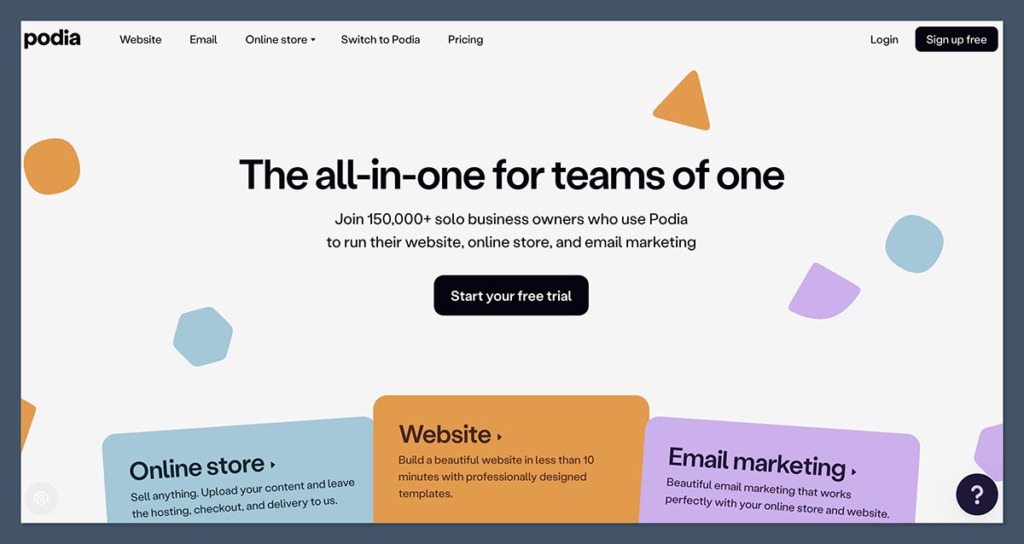
Sellfy can host a digital download, but it was never built to run a full course or a paying community.
Podia was. If your product is knowledge rather than files or merch, Podia bundles courses, digital downloads, coaching, webinars, a community space, email marketing, and a website builder into one platform.
Pros
- Strong course, coaching, and community tools in one place
- Built in email marketing included on every plan
- Website and landing page builder with no coding
- No revenue caps or product ceilings on higher tiers
Cons
- No free plan, only a 30 day trial
- Entry level Mover plan still charges a 5% fee
Products and Ecosystem
Podia’s strength is that everything talks to everything. A visitor can find your free community, buy a course, and get added to your email list without you stitching three tools together. Built in email marketing is included on every plan, which quietly replaces a separate subscription many creators would otherwise pay for.
Fees and Pricing
Podia dropped its free plan and now runs three paid tiers on annual billing: Mover at $42 per month, Shaker at $84 per month, and Earthquaker at $150 per month. Mover carries a 5% transaction fee, while Shaker and Earthquaker remove the platform fee entirely and add affiliate tools, PayPal, and higher limits.
As with every platform here, standard payment processing applies on top. The 5% fee on Mover is the number to watch, so once your sales climb past roughly $1,000 a month, moving up to Shaker usually pays for itself.
Best For: Creators whose main product is courses, coaching, or a paid community rather than files or merch.
5. Gumroad: The Fastest Way to Start Selling
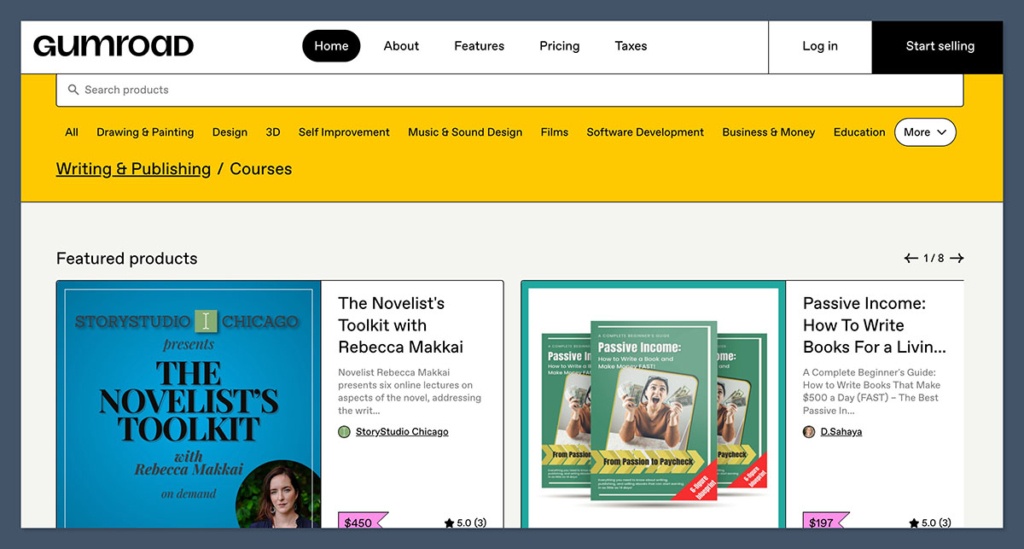
Gumroad is the alternative for creators who want the shortest possible distance between an idea and a paid sale.
There is no monthly fee and no store to design in any depth. You upload a product, get a link, and start selling, which is why it remains a favorite for one off digital products, ebooks, and quick launches.
Pros
- No monthly fee, you only pay when you sell
- Merchant of Record handles global taxes for you
- Built in Discover marketplace can send you buyers
- Almost nothing to set up or maintain
Cons
- 10% plus $0.50 per direct sale is steep at higher volumes
- Discover marketplace sales are charged a much higher 30%
- Limited storefront branding and customization
Fees and Pricing
Gumroad charges no subscription. Instead it takes 10% plus $0.50 on every direct sale, and a flat 30% on sales that come through its Discover marketplace. Since January 2025 Gumroad has acted as a full Merchant of Record, so it handles global sales tax, VAT, and GST for you at no extra charge.
The flat percentage is friendly when you are starting out, but because the rate never drops as you grow, high volume sellers who bring their own traffic often find a flat monthly platform works out cheaper.
Best For: Creators who want to launch a single digital product in minutes with zero upfront cost.
How to Choose the Right Sellfy Alternative
The best platform depends entirely on what you sell and how you want to grow. Pick the format that describes your business and the choice gets simple.
- You want full control and room to scale a real store: Shopify, the heavyweight with no revenue caps.
- You sell a mix of merch, memberships, and digital products: Fourthwall, which keeps everything under one brand and handles taxes and fulfillment for you.
- You want the cheapest possible start: Payhip, with a genuine free plan and every feature included.
- Your product is courses or a paid community: Podia, built specifically for teaching and membership businesses.
- You want to sell one digital product fast: Gumroad, the quickest path from idea to checkout.
How We Compared These Platforms
| Criteria | What We Looked At |
|---|---|
| Ease of use | How quickly a non technical creator can launch and manage a store |
| Product range | Support for digital, physical, memberships, and courses in one place |
| Fees | Monthly cost, per sale cuts, and how total cost scales with revenue |
| Tax handling | Whether the platform acts as Merchant of Record for global taxes |
| Scalability | Revenue caps, product limits, and room to grow without replatforming |
Final Verdict
Every platform here beats Sellfy at something specific, but one stands out as the best all round replacement.
Shopify wins for most sellers leaving Sellfy. It removes the single biggest frustration with Sellfy, the revenue caps, and replaces a lightweight builder with a full commerce platform you own outright and will never outgrow.
It costs more than a simple creator storefront and asks a bit more of you to set up, but for a business that plans to grow, that control and scalability are worth it.
If your needs are narrower, the runners up are clear. Choose Fourthwall for an all in one creator brand with taxes handled, Payhip for a free digital storefront, Podia for courses and community, and Gumroad for the fastest possible launch.
Frequently Asked Questions
Why should I switch from Sellfy to an alternative like Shopify?
Sellfy caps how much you can earn on each plan, so growth eventually forces you into a more expensive tier, and its lightweight builder limits how far you can take a store. Shopify removes those revenue caps completely and gives you full ownership of a real commerce platform, with the inventory, shipping, point of sale, and app ecosystem to scale from your first sale to enterprise. You take on a little more setup and cost, but you gain a platform you will not have to leave later.
Which Sellfy alternative has no monthly fee?
Three options let you start without a subscription. Fourthwall and Payhip both offer free plans with the full storefront included, and Gumroad has no monthly fee at all. Each one instead takes a percentage of your sales, so the cheapest choice depends on your volume: free plans win while you are small, and a flat monthly plan like Shopify tends to win once sales are consistent.
Which alternative is best for selling merch and print on demand?
Fourthwall is the strongest pick for merch. It offers premium print on demand blanks with no minimums, handles production and shipping for you, and lets you sell that merch alongside memberships and digital products under one brand. Its Signature collection and higher quality printing give products a retail grade finish rather than the generic look common to basic print on demand.
Can I migrate my existing Sellfy store to these platforms?
There is no one click export from Sellfy, since it is a closed platform, but most creators find rebuilding straightforward. Products are usually just files, images, and descriptions, so you can recreate them on a new platform in an afternoon. Shopify, Payhip, and Podia all offer migration help or import tools on certain plans, and a fresh start is often a chance to clean up your catalog and improve your storefront.
Which Sellfy alternative is the easiest to use?
For pure simplicity, Payhip and Gumroad are the fastest to learn, since you can list a product and share a link in minutes, and Fourthwall strikes a good balance of easy setup with room to grow into merch and memberships. Shopify asks a little more upfront, but its guided onboarding is still approachable, and the extra effort buys you a platform with no ceiling on where your store can go.