Shopify and Booqable both promise to get your business selling online, but they are built for very different jobs. Shopify is a general-purpose commerce platform that handles physical and digital products across web, social, and in-person channels.
Booqable is rental management software, designed around bookings, availability, and inventory that goes out the door and comes back. The honest framing is not “which one wins,” but “when do you use one, and when do you run both together.”
To work that out, I spent weeks setting up test accounts on both platforms: running through onboarding, building catalogs, processing mock orders, and pushing each tool into the use cases it was not designed for.
This comparison walks through pricing, selling features, rental logic, inventory, checkout, marketing, and the combined Shopify plus Booqable setup, so you can match the right stack to your actual business model.
Shopify vs Booqable: Quick Verdict
- Shopify is best if you sell products outright: apparel, cosmetics, DTC goods, or any omnichannel retail where you do not need time-based availability.
- Booqable is best if rentals are your core business: camera and AV gear, tools, event and party equipment, studios, or anything booked by the day, week, or weekend.
- Shopify plus Booqable is the ideal combo for hybrid merchants who both sell and rent, and who want Shopify’s storefront and marketing stack on top of Booqable’s rental engine.
In other words, these are not really rivals.
Shopify can technically bolt on rentals through third-party apps, and Booqable can run as a standalone store, but each does its best work in a different lane. Below I break down where each one earns its place.
Quick Comparison: Shopify vs Booqable
Here is a side-by-side overview before we get into the detail:
| Dimension | Shopify | Booqable |
|---|---|---|
| Primary focus | General ecommerce and omnichannel retail | Equipment and product rentals, bookings, inventory |
| Rental features | Not built in; available via third-party apps | Built-in rental logic: dates, contracts, deposits |
| Starting price | $29/mo (Basic, billed yearly) | $29/mo (Start, billed yearly) |
| Higher tiers | $79 and $299/mo, plus Shopify Plus from ~$2,300/mo | $69 and $149/mo, plus a custom plan from $349/mo |
| Checkout | High-converting, extensible ecommerce checkout | Rental-specific checkout with deposits; can embed in Shopify |
| Inventory model | SKU stock per location, no native date logic | Time-based availability, bundles, rental calendars |
| In-person | Full retail POS (Lite and Pro) | Mobile rental workflows and Tap to Pay add-on |
| Website and CMS | Powerful themes, blog, CMS, SEO tools | Rental site builder add-on, embeddable booking widgets |
| Ecosystem | Large app store, agencies, marketplaces | Integrations and API, but a smaller ecosystem |
| Best for | Product-led brands, DTC, omnichannel retail | Rental-first businesses, or hybrid via the Shopify integration |
Key Takeaways
- They solve different problems. Shopify is for selling; Booqable is for renting. Treating them as direct competitors usually leads to the wrong choice.
- Entry pricing is nearly identical at $29 per month (billed yearly), but the fee structures differ: Shopify takes payment processing on sales, while Booqable takes no commission on bookings.
- Booqable owns availability. Its core advantage is understanding that an item is booked from date A to date B, which Shopify cannot do natively.
- Shopify owns reach. Marketing, SEO, content, multichannel selling, and the app ecosystem are far deeper than anything Booqable offers.
- The combined stack is the sweet spot for hybrids, giving you Shopify’s front end with Booqable’s rental back office, at the cost of running two systems.
Best for Pricing and Value: It Is a Tie
At the entry level, the two platforms are matched almost dollar for dollar. Both start at $29 per month on annual billing, and both reserve their more useful features for higher tiers.
Shopify’s core plans, billed yearly, look like this:
- Basic at $29 per month ($39 billed monthly): a full online store with unlimited products, abandoned-cart recovery, and one staff account.
- Grow at $79 per month ($105 billed monthly): up to 5 staff accounts, standard analytics, multi-location inventory, and lower transaction fees.
- Advanced at $299 per month ($399 billed monthly): up to 15 staff accounts, advanced reporting, and the lowest standard processing rates.
- Shopify Plus from around $2,300 per month: enterprise-grade volume, B2B features, deeper customization, and priority support.
Booqable’s plans, billed yearly, run as follows:
- Start at $29 per month ($35 billed monthly), for solo operators and one active user
- Grow at $69 per month ($87 billed monthly), which adds the website booking integration, up to 5 extra users, product bundles, and advanced reports
- Scale at $149 per month ($187 billed monthly), which adds 10 extra users, activity logs, multi-location, and API access
- Custom from $349 per month for larger teams needing SSO and advanced security
The important difference is in the fee mechanics. Shopify charges payment processing on every sale (from 2.9% plus 30 cents on Basic, dropping on higher tiers), and adds a surcharge if you use a gateway other than Shopify Payments.
Booqable takes no commission on bookings and no setup fees; you simply pay your own processor (Stripe, PayPal, Square, and others) for what you collect. Both offer free trials: Shopify runs a 3-day trial plus a $1 introductory deal, while Booqable gives a full 14-day trial with no card required.
One cost note for anyone considering both: a combined setup means stacking at least one Shopify plan with at least Booqable’s Grow tier, since the Shopify embed integration only unlocks at Grow. That is a real line item to budget for.
The winner: Pricing is a genuine draw
Entry costs are effectively the same, and each platform’s fee model favors a different kind of business. Booqable’s zero-commission booking model rewards rental operators, while Shopify’s tiered processing rewards high-volume sellers who use Shopify Payments.
Best for Selling Products Online: Shopify

If your revenue comes from selling products outright, this is not a close contest. Shopify is purpose-built for it, and the breadth shows the moment you start setting up a store.
Shopify covers product catalogs with variants, discount and promotion engines, abandoned-cart recovery, blogging and CMS, B2B tooling through Shopify Collective, and marketplace connections via Shopify Marketplace Connect to channels like Amazon and Etsy.
Its checkout is one of the most optimized in ecommerce, with a steady stream of conversion-focused updates and dozens of APIs for extending it. There is also a growing suite of financial products layered on top, including Shopify Payments and Shopify Credit.
Booqable does have a cart and checkout, but they are built around rentals rather than outright sales.
You can sell items in Booqable, and it handles “sales items” alongside rental stock, but you will quickly miss the merchandising depth, the promotional flexibility, and the channel reach that Shopify treats as table stakes.
The Winner: Shopify is built for selling, end to end
From catalog management to a high-converting checkout and multichannel selling, Shopify gives product-led businesses tools Booqable was never designed to match.
Best for Rental Operations: Booqable
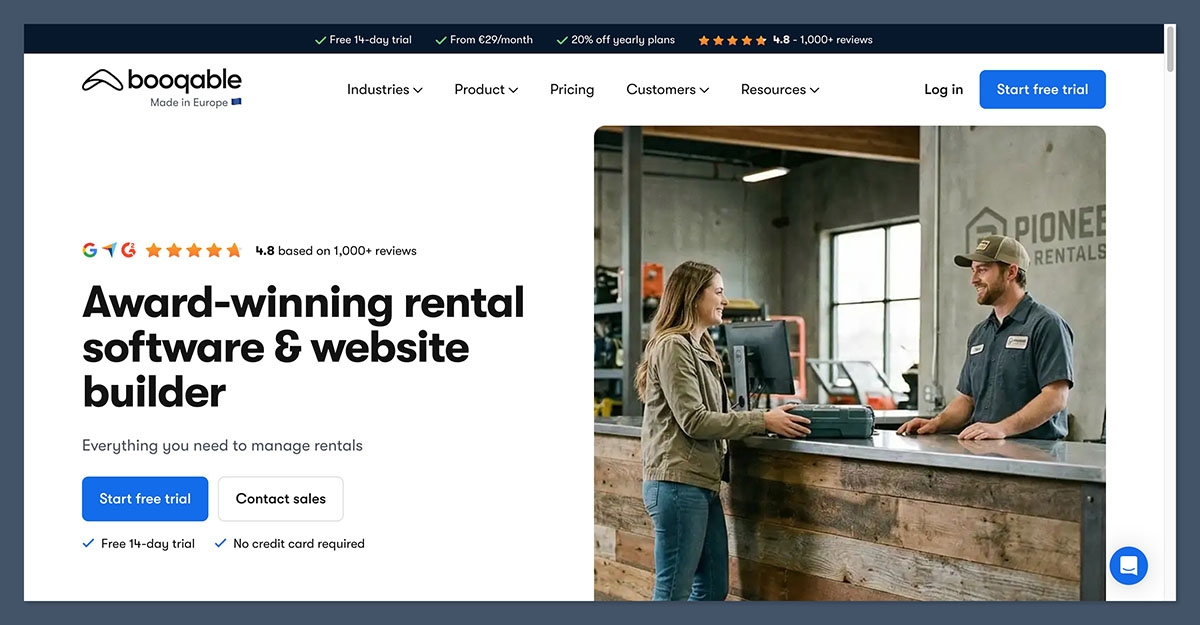
Flip the use case to rentals and the result flips with it. Booqable is purpose-built rental software, and it handles the things a generic ecommerce platform simply does not understand.
That means time-based reservations, rental pricing rules (flat fees, fixed prices, seasonal and weekend rates), security deposits applied per order or per product, quotes, and contracts you can create, send, and have signed.
The sales process for a rental business often starts with a quote and a conversation rather than a self-service cart, and Booqable is shaped around that reality. It also handles the operational side: pull sheets, pickup and return tracking, and a customer database with rental history.
Shopify can approximate rentals only through third-party apps and manual workarounds, and even then it is fighting its own data model. If rentals are how you make money, that friction compounds with every booking.
The Winner: Booqable is rental-native
Deposits, contracts, quotes, time-based pricing, and pickup or return workflows are all built in. For a rental-first business, that is the difference between software working with you and against you.
Best for Inventory and Availability: Booqable
This is the single clearest line between the two platforms, so it deserves its own section.
Shopify’s inventory model is SKU-based: you track stock counts across locations, and it is solid for retail. What it does not natively understand is “this specific item is booked out from Friday to Sunday and is available again on Monday.” There is no concept of a return date freeing up stock.
Booqable is built entirely around that concept. It tracks inventory at the level of individual items or bulk stock, ties each unit to specific time windows, and validates every booking against live availability so you do not double-book.
Recent updates have pushed this further with more precise time selection on stock, better behavior for product bundles, buffer time between rentals, and clearer calendar filtering. If your business lives or dies on knowing what is free on a given date, Booqable is doing real work that Shopify cannot.
The Winner: Booqable understands time
Live, date-aware availability and double-booking prevention are core to Booqable and absent from Shopify’s stock model. For rentals, this is non-negotiable.
Best for Checkout and Payments: Depends on the Sale
Both platforms have strong checkouts, but they are optimized for different transactions.
Shopify’s checkout is engineered for conversion on outright sales, with extensive extensibility and a mature payments stack behind it. If you are moving volume on products, it is hard to beat.
Booqable’s checkout is engineered for rentals: it collects deposits, supports pre-authorizations and partial or down payments, and applies rental-specific pricing automatically. It connects to 40-plus payment methods through processors like Stripe, PayPal, and Square.
The interesting part is that you do not always have to choose. In an integrated setup, customers can browse on Shopify and then complete the rental checkout through Booqable’s cart, which can run on your own custom domain so the branding stays consistent.
Availability and pricing sync from Booqable into the embedded elements.
The Winner: A split decision
Shopify wins checkout for product sales; Booqable wins checkout for rentals because deposits and time-based pricing are handled natively. Pick based on what you are actually charging for.
Best for Marketing, SEO, and Content: Shopify
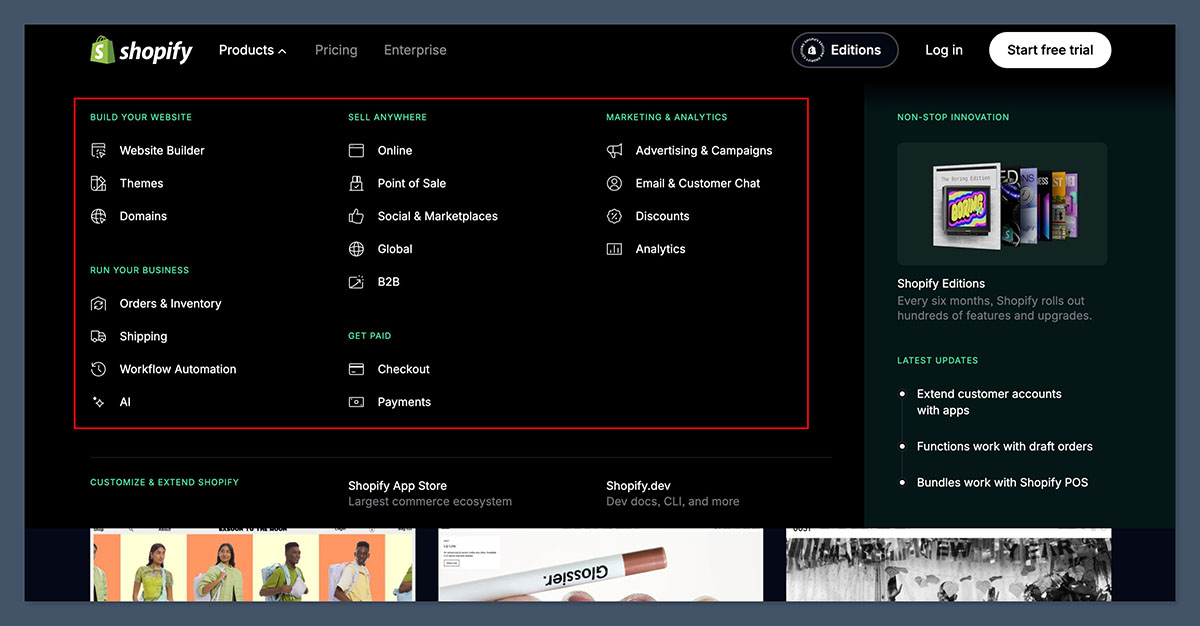
Setting up a store is only half the job. Customers cannot buy what they cannot find, and this is where Shopify pulls clearly ahead.
Shopify gives you a real content platform: flexible themes, a built-in blog and CMS, and a solid set of SEO features including sitemaps, alt text, and a Semrush-powered optimization app.
On the promotion side, you can connect to Instagram, TikTok, and marketplaces, run email campaigns with Shopify Email, and tap an enormous library of marketing and automation apps.
For brands that grow through content and channels, this is a deep toolbox.
Booqable is far more focused. It offers a rental website builder as an add-on and embeddable booking widgets, plus integrations for Google Analytics, Meta Pixel, and Mailchimp.
That is enough to market a rental business competently, but it is not trying to be a full content and growth platform, and it does not pretend to be.
The Winner: Shopify is the growth engine
Content, SEO, email, social, and marketplace reach are all stronger and deeper on Shopify. If marketing is central to your strategy, this matters a lot.
Using Shopify and Booqable Together
For a lot of businesses, the smartest answer is not one or the other. Booqable offers a native Shopify integration (available from its Grow plan) that turns a Shopify storefront into a rental front end while Booqable handles stock, dates, and checkout behind the scenes.
How the integration works
Booqable’s Shopify app lets you embed rental products, date pickers, and real-time availability directly inside Shopify product pages and content sections.
Product information has to exist in both systems, but rental availability, pricing, and inventory updates sync from Booqable into the Shopify-embedded elements. The embedded cart and checkout can be branded and optionally hosted on your own domain to keep the journey cohesive.
Pros of the combined stack
- You get Shopify’s storefront design, themes, SEO, and content tools, plus its app ecosystem for marketing, analytics, subscriptions, and B2B.
- You also get Booqable’s rental-first workflows: live calendars, bundles, deposits, contracts, and reporting tuned to rentals rather than generic orders.
- It is particularly strong for hybrid merchants who sell some items and rent others, or who need a content-rich site (blogs, guides, landing pages) wrapped around the rental business.
Trade-offs to weigh
- You maintain products in both Shopify and Booqable, which adds content duplication and governance overhead as catalogs grow.
- Your team may juggle two back offices for order management, reporting, and customer history unless you define clear internal processes.
- It is overkill for a very small, rental-only business that just needs a simple booking flow and a basic catalog.
The combo wins for hybrids and scalers
If you both sell and rent, or you need a marketing-grade site on top of rental-grade operations, pairing the two beats forcing either tool to do the other’s job. The cost is extra complexity and two systems to keep in sync.
Best for Support and Ecosystem: Shopify
Both platforms support their users well, but the scale is different.
Shopify offers 24/7 support through live chat and, for many merchants, phone, plus a deep help center with guides, tutorials, courses, and a community.
Around that sits a huge partner network of agencies and freelancers, and an app store with thousands of integrations covering nearly any need. Booqable provides chat and email support on every plan, with one-on-one onboarding and support calls on Grow and Scale, a knowledge base, videos, and live training.
Its support is more focused and rental-literate, but the team and ecosystem are smaller, and it leans on integrations rather than a sprawling marketplace.
For emerging needs like AI merchandising or expanding into marketplaces, Shopify is more likely to have a ready-made solution. Booqable tends to integrate into that wider ecosystem rather than try to replicate it.
The Winner: Shopify’s ecosystem is in a different league
More support channels, more partners, and thousands of apps give Shopify the edge. Booqable’s smaller, rental-focused support is a fair trade if a niche fit matters more to you than sheer breadth.
When to Choose Shopify, Booqable, or Both
Pulling the testing together, here is how the decision usually shakes out.
Choose Shopify alone when
- You sell products outright and do not need time-based availability.
- Any “renting” you do is lightweight and not your core revenue, so a basic app or manual workaround is acceptable.
- You care most about brand storytelling, multichannel selling, and growth marketing.
Choose Booqable alone when
- You run a pure rental operation (camera house, tool hire, AV production, event rentals) and mainly need an efficient booking engine with inventory control.
- Your sales often start with quotes, contracts, and offline relationships rather than self-service carts.
- You want to keep the tech stack and training simple, without a large CMS or app ecosystem.
Choose Shopify plus Booqable when
- You operate a hybrid model: selling some items, renting others, maybe adding memberships or subscriptions around your inventory.
- Your brand depends on a polished, content-rich site and marketing automation, but your operations demand rental-grade scheduling.
- You are planning to scale and want best-in-class tools for both marketing and operations rather than one compromise platform.
How We Tested
To keep this comparison grounded in real use rather than spec sheets, I set up working accounts on both platforms and evaluated them across the areas that matter most to a rental or hybrid business, weighted by importance to readers.
| Testing area | Weight | What we assessed |
|---|---|---|
| Core use-case fit | 30% | How well each platform handles its primary job (selling vs renting) |
| Inventory and availability | 20% | Stock tracking, date logic, and double-booking prevention |
| Checkout and payments | 15% | Conversion, deposits, processing fees, and payment options |
| Marketing and SEO | 12% | Content tools, SEO features, email, and channel reach |
| Ease of use | 10% | Onboarding, dashboard clarity, and day-to-day workflows |
| Support and ecosystem | 8% | Support channels, documentation, partners, and integrations |
| Value for money | 5% | Pricing, fee structure, and what each tier actually unlocks |
Pricing was verified against each provider’s official pricing page at the time of writing. SaaS pricing changes often, so check the current plans before you commit.
Shopify vs Booqable: Final Verdict
The cleanest way to choose is to be honest about what you actually do. If you sell products, Shopify is the stronger platform by a wide margin: deeper selling features, a better checkout for outright sales, far more marketing and SEO firepower, and an ecosystem nothing in the rental space can match.
If you rent, Booqable is the obvious pick: it understands availability, deposits, quotes, and contracts in a way Shopify never will natively, and it does it at a comparable entry price with no commission on bookings.
And if you do both, you do not have to compromise. The Shopify plus Booqable integration lets you keep Shopify’s storefront and marketing while Booqable runs the rental engine underneath, which is the best outcome for hybrid and scaling businesses willing to manage two systems.
Whichever way you lean, both platforms offer free trials, so the lowest-risk move is to spin up a test account and run your real workflow through it before deciding.
Frequently Asked Questions
Can Shopify handle rentals on its own?
Only through third-party apps and workarounds. Shopify’s inventory model tracks stock counts but has no native concept of an item being booked from one date to another, so rental functionality is bolted on rather than built in. For occasional, low-volume rentals that might be fine, but for a rental-first business it creates ongoing friction.
Is Booqable a full replacement for Shopify?
For a pure rental operation, yes. Booqable includes its own website builder add-on, booking page, checkout, and payments, so you can run a standalone rental store. What it does not replace is Shopify’s depth in merchandising, content, SEO, and multichannel selling, which is why product-led brands still prefer Shopify.
How much does it cost to run Shopify and Booqable together?
You stack two subscriptions. At minimum that is a Shopify plan (from $29 per month billed yearly) plus Booqable’s Grow plan (from $69 per month billed yearly), since the Shopify embed integration unlocks at Grow. On top of that you pay your payment processor’s fees, and Shopify’s processing fees on any direct sales.
Does Booqable charge commission on bookings?
No. Booqable does not take a cut of your revenue and charges no setup fees. You only pay the subscription plus your own payment processor’s standard rates. Shopify, by contrast, applies payment processing fees on sales and adds a surcharge if you use a gateway other than Shopify Payments.
Which is easier to get started with?
Both offer quick onboarding and free trials. Shopify’s 3-day trial plus $1 introductory deal lets you explore the full platform cheaply, while Booqable’s 14-day trial gives you more time with no credit card required. For a rental business, Booqable will feel more intuitive out of the box because the workflows already assume you are renting; for a product store, Shopify’s setup flow is purpose-built for selling.
This article is for general information about ecommerce and rental platforms and is not financial or business advice. Verify current pricing and features with each provider before purchasing.