Shopify and Printful are the two names that come up in practically every “how to start a print on demand business” conversation, as if picking one settles the question. So which platform wins once you look closely at how they run inside a real store?
After going through both platforms in detail, I can tell you that Shopify and Printful are not direct competitors: they sit at different layers of the ecommerce stack, and the right answer depends on which job you need done. Shopify is the storefront, the checkout, and the marketing hub; Printful is the factory floor, printing, packing, and shipping the product.
For most print on demand sellers, the strongest setup is not Shopify or Printful alone but Shopify and Printful used together, with Shopify running the customer-facing store and Printful producing and shipping every order behind it.
Shopify vs Printful: Quick Verdict
- Shopify – Best for building and scaling a branded store with checkout, payments, and marketing control
- Printful – Best for producing and shipping custom products with in-house quality control and white-label branding
- Best overall option for most sellers: Shopify + Printful together
In this comparison, I’ll break down how Shopify and Printful compare on pricing, selling, product creation, fulfillment, branding, and margin left on a t-shirt.
💡 Key Takeaways
- Shopify and Printful sit at different layers of the stack and are not direct competitors
- Shopify supplies the storefront, checkout, payments and app ecosystem
- Printful supplies product creation, printing, and shipping from its own facilities
- Shopify costs a monthly subscription plus payment processing on every order
- Printful has no mandatory subscription and charges per product and shipping
- Printful’s free Quick Stores can replace Shopify for testing, but it is US only and cannot run a real brand
Why This Comparison Is So Confusing
At first glance, Shopify and Printful look like rivals: both sell custom products online, both have low-cost entry points, and both show up in the same “how to start a print on demand business” guides. The confusion is expensive: picking the wrong tool costs you the storefront you need to scale, or the production partner you need to ship anything at all.
Two definitions clear it up:
- Shopify is an ecommerce platform. It runs your website, cart, checkout, payments, analytics, and apps: the hub of your business whatever you sell.
- Printful is a print on demand production and fulfillment company. You upload a design, and when a customer orders, Printful prints, packs, and ships it under your brand. It holds no real storefront ambitions.
The useful question isn’t “Shopify or Printful.” It’s “do I need a storefront, a fulfillment partner, or both.” The same confusion applies to Shopify vs Printify: one runs the store, the other makes the product.
Why You Probably Need Both
For most sellers, the winning combination is Shopify as the storefront with Printful running fulfillment behind it. Here’s where you fall:
| Situation | Recommended Stack |
|---|---|
| Just testing a design | Printful Quick Stores |
| Building a long-term brand | Shopify + Printful |
| Selling on Etsy or eBay only | Printful connected to that marketplace |
| Running paid ads or retargeting | Shopify + Printful |
| Selling outside the US | Shopify + Printful |
Printful’s free Quick Stores only works for US tax residents selling to US addresses, so international sellers have no Quick Stores option at all. Printful doesn’t replace Shopify; it complements it, costing you branding control, conversion optimization, email capture, and sales outside the US.
Feature Comparison: Shopify vs Printful
One table shows the division of labor.
| Feature | Shopify | Printful |
|---|---|---|
| Storefront | Yes, full website and checkout | Only via Quick Stores, US only |
| Payment processing | Shopify Payments plus 100+ gateways | Handled by your sales channel |
| Product creation | Listings and variants | Design Maker across hundreds of products |
| Fulfillment | None built in, needs a partner | 7 in-house facilities |
| Custom domain | Yes | No, printful.me subdomain only |
| Apps | Large app ecosystem | Integrations with 20+ platforms |
| Monthly cost | From $29/month billed annually | $0, Growth optional at $24.99/month |
| Branding | Full storefront and checkout control | Product level: labels and pack-ins |
| Analytics | Full reporting | Minimal, no Google Analytics or Meta Pixel |
1. Best for Pricing: It Depends
Shopify and Printful price on different axes, so asking which is cheaper misses the point. Shopify charges a fixed subscription plus processing on every order; Printful charges nothing monthly and takes its cut per product and per shipment. That makes Printful look cheaper on day one, but Shopify’s cost becomes predictable as you scale while Printful’s per-unit costs multiply with every sale. The real question is what’s left after both take their cut.
🥇 The Winner: It Depends
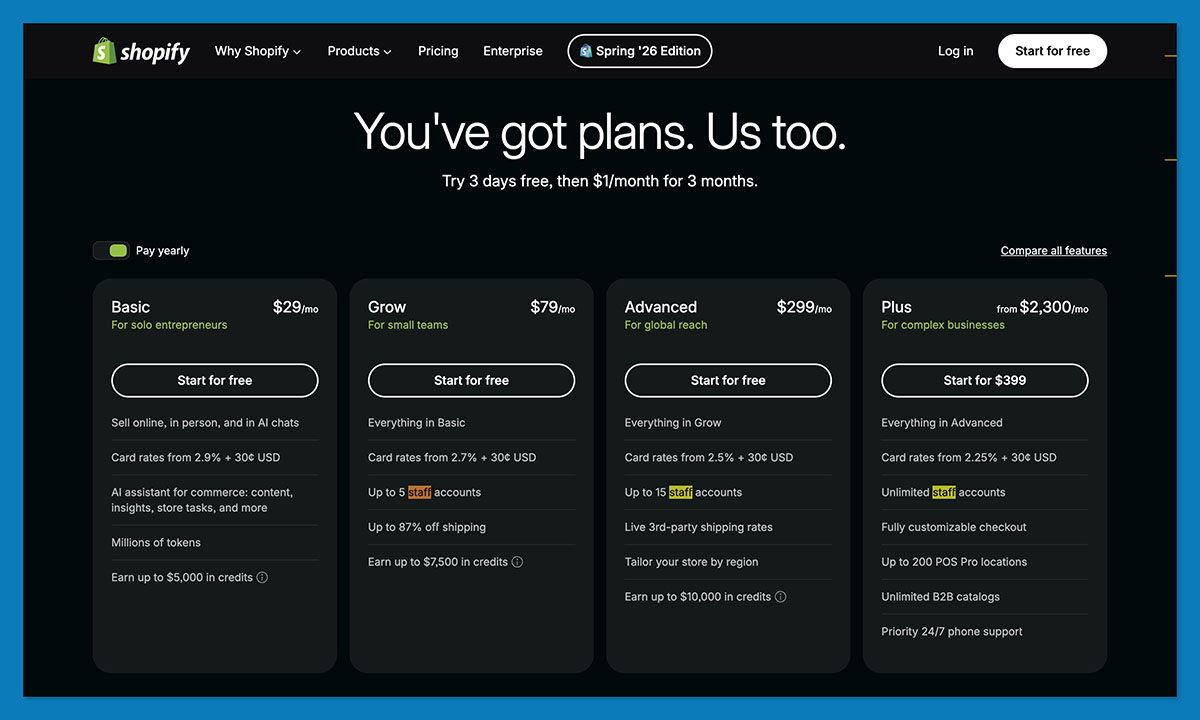
Shopify Pricing
| Plan | Monthly (billed annually) |
|---|---|
| Basic | $29 |
| Grow | $79 |
| Advanced | $299 |
| Plus | From about $2,300 |
Shopify Payments rates by plan: Basic 2.9% plus $0.30 per transaction, Grow 2.7% plus $0.30, Advanced 2.5% plus $0.30. An outside processor like PayPal adds a fee on top of its own charges: 2% on Basic, 1% on Grow, 0.6% on Advanced.
Printful Pricing
Printful has three tiers; only one carries a fee.
| Plan | Monthly | What It Unlocks |
|---|---|---|
| Free | $0 | Hundreds of products, unlimited connected stores, up to 10 Quick Stores, Design Maker |
| Growth | $24.99, after a 14-day trial | Up to 33% off base costs, 9% off branding add-ons, 25% off samples |
| Enterprise | Custom | Volume pricing for high-output sellers |
The Growth fee is waived at $12,000 in qualifying annual sales. No plan is mandatory; run on Free indefinitely, or see the Printful pricing page for details.

What’s Actually Left on a T-Shirt
Here’s the math that almost no comparison page shows. I’m using a $24.99 retail price and assuming 50 orders per month to spread the Shopify subscription. Both numbers are assumptions you should replace with your own pricing and volume.
On Shopify Basic (annual) + Printful Free, one Bella + Canvas 3001 tee:
- Retail price: $24.99
- Printful base cost: $12.25
- Printful US shipping, first item: $4.75
- Shopify Payments processing (2.9% + $0.30): $1.02
- Shopify Basic amortized (50 orders): $0.58
- Profit per shirt: $6.39, roughly 25.6%
Same shirt with Printful Growth active (33% product discount):
- Discounted base cost: $8.21
- Printful Growth amortized (50 orders): $0.50
- Total cost including Shopify and shipping: $15.06
- Profit per shirt: $9.93, roughly 39.7%
Same shirt through Printful Quick Stores only (no Shopify, Stripe processing):
- Total cost: $18.02 (no monthly subscription)
- Profit per shirt: $6.97
The Quick Stores route saves about $0.58 per shirt over Shopify Basic, its entire financial upside, and it still costs you a custom domain, real analytics, ad pixel tracking, email capture, and abandoned cart recovery.
Verdict: Start on Printful Free while you validate designs and pricing. Add Growth once the volume math above makes the $24.99 membership pay for itself, which happens fast at the 33% discount rate. Budget Shopify as a fixed cost, not a variable one, and compare the full stack.
2. Best for Selling Online: Shopify
Printful doesn’t try to win this category, by design: its own comparison page states the two complete each other rather than compete. Shopify converts visitors into paying customers, from product page through checkout to post-purchase emails; Printful assumes the sale already happened elsewhere, and its job starts only when the order arrives.
🥇 The Winner: Shopify
Shopify Selling Features
- Built-in cart and one-page checkout you control end to end
- Multichannel selling from one backend: Facebook, Instagram, TikTok, wholesale
- Discount codes, automatic promotions, and tiered pricing built in
- Abandoned cart recovery emails on every paid plan
- Large app ecosystem for upsells, cross-sells, subscriptions, and anything the core platform lacks
Printful Selling Features
Printful is a supplier, not a selling platform. It connects to 20+ platforms, including Shopify, Etsy, eBay, Wix, and Squarespace, and depends on them for orders. Its only native selling option is Quick Stores, covered in round 5.
Verdict: Use Shopify for the storefront and marketing layer. Use Printful as the fulfillment partner plugged into it.
3. Best for Product Creation and Fulfillment: Printful
This is the half of the ecommerce stack Shopify doesn’t do: no printing presses, no blank garment inventory, no shipping dock. Printful runs its own facilities rather than brokering jobs to third-party shops, the source of both its higher costs and steadier output. That tradeoff, higher price for tighter quality control, is the core Printful bet.
🥇 The Winner: Printful
Printful Fulfillment Features
- Seven in-house fulfillment facilities: Charlotte, Dallas, Tijuana, Riga, Barcelona, Birmingham, and Toronto, plus partners in Brazil, Japan, and Australia
- Average fulfillment time of 2 to 5 business days, with over 97% shipping within 5 days and more than half within 3
- Hundreds of customizable products across apparel, accessories, home goods, and drinkware
- Design Maker tool for positioning artwork on product mockups
- Sample orders at 20% off on Free and 25% off on Growth, one order a month with up to three items
- White-label fulfillment so customers see your brand, not Printful’s, on the label and packaging
Shopify Fulfillment
Shopify has no print on demand production; it integrates with partners like Printful, Printify, and Gelato, or your own 3PL. The fulfillment tab is a connection point, not a factory.
Verdict: Use Printful to make and ship, Shopify to sell. If Printful’s base costs don’t fit your margins, other print on demand suppliers are worth comparing.
4. Best for Branding and Customization: Shopify
Branding splits into two problems: how the store looks to a visitor, and what arrives in the box. Shopify owns the customer-facing experience, from the domain name to the checkout button color; Printful owns the unboxing moment, and the winner depends on which problem you’re solving.
🥇 The Winner: Shopify
Shopify Branding Features
- Custom domain on every paid plan so your store lives at yourbrand.com, not a subdomain
- Full theme control with drag-and-drop sections and CSS-level customization
- Customizable product pages, collection pages, and checkout styling
- Apps for loyalty programs, referral rewards, and post-purchase upsells
- Built-in SEO controls for page titles, meta descriptions, and URL structure
Printful Branding Features
Printful’s white-label options are genuinely better than most POD suppliers, earning its premium over cheaper aggregators. The branding lives on the product and the parcel, not the storefront:
- Inside garment labels at $0.99 each, outside labels at $2.49
- Pack-in inserts at $0.50 per insert per order, plus branded mailers at $0.50 per order
- Storing branding materials costs a minimum of about $25 a month
- Embroidery digitization: a one-time $2.95 to $6.50 per design
- 9% off branding add-ons with Growth
Verdict: Use Shopify for how the store looks and converts, Printful for what arrives in the box. If you want storefront and merch bundled into one product, Fourthwall tackles that differently for creators.
5. Printful Quick Stores vs a Shopify Store: Shopify
Every seller asks whether Printful’s free storefront can replace the Shopify subscription. Quick Stores is genuinely free, with no setup, monthly, or per-listing fee, but it’s also limited once you treat your store as a business rather than a test.
🥇 The Winner: Shopify
| Feature | Printful Quick Stores | Shopify Store |
|---|---|---|
| Domain | storename.printful.me only | Custom domain |
| Monthly cost | $0 | From $29 billed annually |
| Who can sell | US tax residency only | No such restriction |
| Who can buy | US shipping addresses only | International |
| Tracking | No Google Analytics, no Meta Pixel | Full analytics and pixels |
| Marketing | No email capture, no abandoned cart | Both, plus apps |
Payouts on Quick Stores are automatic at a $25 minimum, and Stripe handles processing at standard rates.
Verdict: Quick Stores is a validation tool, not a store. Test a design or gauge demand before committing to a subscription. The moment you want paid ads, retargeting, an email list, or a customer outside the US, it stops being an option, and Shopify becomes the only way forward.
6. Printful vs Printify: Which Supplier Should You Connect?
Once you decide to run your store on Shopify, the next question is which supplier to connect. Many readers are choosing a storefront and a production partner, and the honest answer splits on cost versus control.
🥇 The Winner: It Depends
On cost, Printify wins consistently for equivalent blanks. One April 2026 comparison put Printify’s Gildan 64000 near $8 versus about $12 at Printful; a separate March 2026 analysis found roughly a $1.33 gap on the Bella + Canvas 3001. Printify’s own comparison page, a vendor claim, puts its lowest-cost tee at about $7 versus $8.17 at Printful. Printify’s plans are Free at $0, Premium at $39 a month or $24.99 billed annually, and Enterprise at custom pricing.
On control, Printful wins because it prints in its own facilities rather than routing orders across independent providers, the source of both Printify’s price edge and its quality variance, since providers differ.
One disclosure: the parent companies merged in November 2024, though Printful and Printify still run independently in 2026, with separate catalogs, pricing, and accounts.
Verdict: Choose Printify if margin is the binding constraint and you can manage provider selection carefully. Choose Printful if consistency and branding options matter more than the per-unit cost gap. See Printful vs Printify and Printify pricing for the full breakdown.
Final Verdict: Use Shopify and Printful Together
- Use Shopify to build the store, run checkout, own the customer relationship, and grow the brand with real marketing tools
- Use Printful to design, print, and ship custom products without holding inventory or managing a production line
The honest exception: if you’re only validating a design and sell nothing outside the US, Printful Quick Stores alone will do for now, and it costs nothing to start.
Want to start simple? Test a design on Quick Stores or Printful Free connected to a marketplace. Ready to grow? Put Shopify in front of Printful and stop worrying about the $29 subscription once the margin math clears it.
FAQ
Do I need Shopify to use Printful?
No. Printful connects to 20+ platforms, including Etsy, eBay, Wix, and Squarespace, and also runs its own free Quick Stores. But Quick Stores is restricted to US tax residents selling to US addresses, and lacks a custom domain, real analytics, and marketing tools.
Is Printful cheaper than Shopify?
They aren’t substitutes, so the comparison misleads. Printful has no mandatory subscription and charges per product and per shipment; Shopify starts at $29 a month billed annually plus payment processing per order. Running both is the normal cost of a real print on demand store.
How much profit can I make on a Printful t-shirt?
On a $24.99 Bella + Canvas 3001 sold through Shopify Basic billed annually with Shopify Payments, after the $12.25 base cost, $4.75 US shipping, $1.02 in processing, and an amortized subscription share, you net roughly $6.39 per shirt at 50 orders a month. With Printful Growth’s 33% product discount, that rises to about $9.93. The $24.99 retail price is an assumption; substitute your own.
Is Printful Growth worth $24.99 a month?
It pays for itself with volume and is waived once your store passes $12,000 in qualifying annual sales. In the t-shirt example above, the 33% discount adds roughly $3.54 per shirt in profit at the same volume, so moderate sales clear the fee quickly.