Volusion has been around since the late 1990s, years before Shopify existed, yet the two platforms have ended up in very different places. Shopify now powers more than two million active stores worldwide and operates in over 175 countries. Volusion sits at roughly 5,000 active stores and has been shrinking year over year. That gap matters, but bigger does not automatically mean better for your specific store.
So the real question is not which platform is more popular. It is which one fits the way you actually plan to sell: your product type, your sales volume, where your customers are, and how much you want to do yourself. I have compared both across pricing, performance, search visibility, features, design, integrations, and support so you can see exactly where each one wins.
Quick verdict
Shopify is the stronger choice for most merchants today. It is faster, sells internationally, has a vastly larger app and theme ecosystem, and now surfaces your products inside AI assistants like ChatGPT and Google’s AI Mode at no extra cost. You pay for that reach with transaction fees on non-native gateways and app costs that add up.
Volusion still makes sense in a narrow lane: a United States based small business that wants a lot of built-in features (CRM, loyalty, ratings) without stacking apps, and that does not plan to scale aggressively or sell digital products. Be aware of its long-term stability questions before committing.
| Volusion | Shopify | |
|---|---|---|
| Starting price | $35/mo (Personal) | $39/mo (Basic), $5/mo Starter |
| Top standard plan | $299/mo (Business) | $399/mo (Advanced) |
| Sales / product caps | GMV and product caps per plan | Unlimited products, no revenue cap |
| Transaction fees | None from Volusion; gateway fees apply | 0.2% to 2% if not using Shopify Payments |
| Sells outside the US | No (US merchants only) | Yes, 175+ countries |
| Native blog | No | Yes |
| Digital products | Not supported natively | Yes (via apps) |
| App marketplace | Small, limited | 8,000+ apps |
| AI / agentic commerce | None | Built in on all plans |
| Free trial | 14 days | 3 days, then $1/mo for 3 months |
Key takeaways
- Shopify wins on reach. International selling, a huge app and theme library, and built-in AI shopping channels give it a ceiling Volusion cannot match.
- Volusion wins on built-in simplicity for US SMBs. Reward points, CRM, ratings, and recurring billing come standard on the right plan, with no Volusion transaction fee.
- Volusion is US only. If your business is based outside the United States, this decision is effectively made for you.
- Watch Volusion’s stability. The platform filed for bankruptcy in 2020 and has been losing stores since, which is worth weighing for a multi-year commitment.
- Neither is a digital-product specialist, but Shopify handles downloads through apps while Volusion does not support them natively at all.
Volusion at a glance
Volusion is one of the older hosted ecommerce platforms, built around point-and-click simplicity and a generous set of built-in features for small to mid-sized US sellers. Its strength is that you get tools like a CRM, customer loyalty, and ratings without paying for separate apps. Its weakness is that the platform has not kept pace with newer rivals, the app marketplace is thin, and it cannot serve merchants based outside the United States.
Pros
- Many features built in (CRM, loyalty, ratings, abandoned cart on higher plans)
- No transaction fees charged by Volusion itself
- Beginner-friendly admin with strong onboarding
- Recurring and subscription billing supported
Cons
- US merchants only; no international selling
- No native blog and no native digital downloads
- GMV and product caps force upgrades as you grow
- Small app marketplace and dated design tooling
- Stability and support concerns following its 2020 bankruptcy
Shopify at a glance
Shopify is the most widely used hosted ecommerce platform, with a deep app ecosystem, fast hosting, and a strong track record on conversion and checkout. It is built to scale from a first sale to enterprise volume, and it has moved early on AI-driven shopping. The trade-offs are transaction fees if you avoid its native payment system and the way app subscriptions can quietly inflate your monthly cost.
Pros
- Fast, reliable hosting with a high-converting checkout
- Sells in 175+ countries with multi-currency support
- Massive app and theme ecosystem for almost any need
- Built-in AI shopping channels (ChatGPT, Google AI Mode and more)
- Unlimited products and no revenue caps on any plan
Cons
- Transaction fees of 0.2% to 2% if you do not use Shopify Payments
- App costs can add up quickly
- Some features that Volusion includes require paid apps
1. Pricing and value
The two platforms look similar on paper, and both offer a free trial with no card required up front. The differences show up in what each price actually includes.
| Volusion plan | Price | Key limits |
|---|---|---|
| Personal | $35/mo | Up to $50K GMV/yr, 100 products, 1 staff |
| Professional | $79/mo | Up to $100K GMV/yr, 5,000 products, 5 staff, phone support |
| Business | $299/mo | Up to $400K GMV/yr, unlimited products, 15 staff |
| Prime | Custom | GMV-based, unlimited, VIP support |
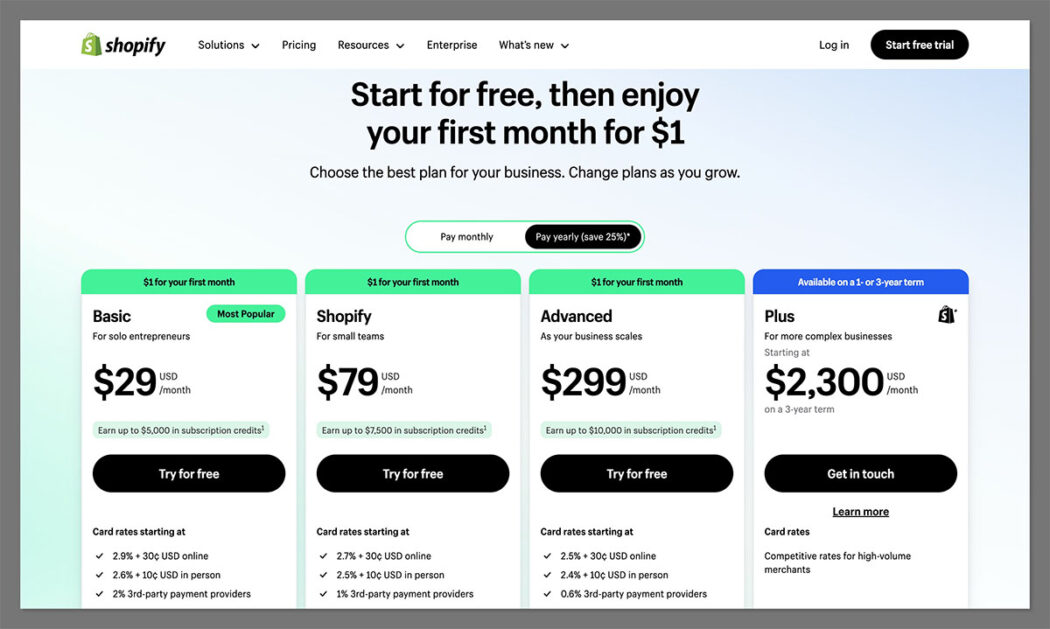
| Shopify plan | Monthly | Annual (per mo) | Notes |
|---|---|---|---|
| Starter | $5 | $5 | Checkout link only, not a full store |
| Basic | $39 | $29 | Full store, 2 staff, unlimited products |
| Grow | $105 | $79 | 5 staff, lower fees, pro reports |
| Advanced | $399 | $299 | 15 staff, lowest fees, custom reports |
| Plus | From $2,300 | Term-based | Enterprise tier |
The headline numbers are close, but the value diverges in two important ways. First, Volusion caps both your annual gross merchandise volume and your product count on lower plans, so growth forces an upgrade. Shopify lets you sell unlimited products and earn unlimited revenue even on Basic. Second, Shopify charges a transaction fee of 0.2% to 2% on top of your processor if you do not use Shopify Payments, while Volusion charges no fee of its own. Volusion’s catch is that its payment options are far more limited, and extra fees can apply if you are not on a preferred gateway.
Shopify also tends to include more for the price once you factor in its native abandoned-cart recovery, real-time shipping rates, and the AI shopping channels covered below. Volusion answers with features it builds in that Shopify charges apps for, such as reward points and a CRM. The honest read is that the better-value platform depends entirely on which of those features you will actually use.
Winner: Tie. Prices are comparable, so value comes down to fit. Volusion is better value for a feature-rich US store that stays under its caps; Shopify is better value if you need to scale, sell internationally, or sell unlimited products.
2. Performance and speed
Store speed affects both how customers experience your site and how well it ranks. Shopify runs on global infrastructure with a content delivery network and a modern theme framework (Online Store 2.0) whose default themes are engineered for speed. Shopify also promotes its checkout as converting meaningfully better than other platforms on average, a claim worth testing against your own funnel rather than taking at face value.
Volusion is the older architecture of the two, and it shows. Reviewers consistently describe a platform that feels dated next to Shopify and BigCommerce, with heavier page templates and fewer recent performance improvements. For a content-light catalog this may not be a dealbreaker, but as your store and traffic grow, Shopify’s infrastructure gives you more headroom.
Winner: Shopify, for faster modern themes, stronger hosting infrastructure, and a checkout optimized for conversion.
3. SEO and AI search visibility
Both platforms cover the SEO basics well. You can edit page titles and meta descriptions, both generate an XML sitemap automatically, and both support 301 redirects so you do not lose ranking equity when URLs change. Shopify gives you a built-in blog, which is useful for attracting search traffic and earning links. Volusion has no native blog; sellers either repurpose its Articles feature (which does not behave like a true blog and cannot collect comments) or connect an external WordPress install, which is fiddly to set up.
URL control is messier on Volusion. Even with search-friendly URLs enabled, Volusion leaves fixed strings such as a product code and a .htm extension in the path that you cannot fully remove. Shopify keeps some fixed segments too, such as /products/, but those are at least readable keywords.
The bigger story now is AI search. Shopify has rolled out agentic commerce across all of its plans, which makes your products discoverable by default inside ChatGPT, Microsoft Copilot, Google’s AI Mode, and Gemini, with orders flowing back into your Shopify admin and you remaining the merchant of record. As AI assistants take on more product discovery, that built-in distribution is the kind of channel that used to require a dedicated budget. Volusion has no equivalent.
Winner: Shopify, for a native blog, cleaner URLs, and built-in visibility inside AI shopping assistants that Volusion does not offer.
4. Features and built-in tools
This is where Volusion makes its strongest case. On the right plan it builds in features that Shopify pushes to its app store: a CRM, customer loyalty and reward points, ratings and reviews, and a suggested-products tool. If you want those capabilities without managing and paying for separate apps, Volusion can be cheaper in practice than its sticker price suggests.
The flip side is what Volusion lacks. It does not support selling digital products natively, so ebooks, music, or downloadable files are off the table. Several features many merchants consider essential, such as ratings and abandoned-cart recovery, are missing from its entry plan and require the $79 tier. And the features Volusion does include do not help if your business does not need reward points or a built-in CRM.
Shopify takes the opposite approach: a leaner core with a vast app ecosystem (more than 8,000 apps) to add almost anything, including digital downloads, subscriptions, advanced upsells, and one-click cross-sells. You will pay for many of those apps on top of your subscription, but the ceiling on what you can build is far higher, and the up-sell and cross-sell tools Volusion simply does not have are readily available.
Winner: Tie. Volusion wins for built-in features on a single subscription; Shopify wins for breadth, digital products, and revenue-boosting tools through apps. The right call depends on your business model.
5. Themes and design
Shopify has the clear edge in selection and modernity. Its theme store offers around two dozen free themes plus more than 100 premium themes, typically priced between $140 and $500 as a one-time purchase. The free themes, led by Dawn and Horizon, are fast and used by hundreds of thousands of stores, which is a reasonable starting point for most new sellers.

Volusion offers a smaller library of free mobile-first themes plus a set of premium themes (commonly around $180). The selection is enough to launch, but it is narrower than Shopify’s, many storefronts look dated, and customizing beyond the template, such as adding a section the theme does not include, is harder because there is no flexible drag-and-drop editor.

Winner: Shopify, for a larger, more modern theme library and easier page customization.
6. Integrations and app ecosystem
Shopify connects to thousands of services, most either built in or available through a free or paid app. That includes the marketing tools merchants rely on (Klaviyo, Mailchimp, Drip, and others), print-on-demand apps like Printful and Printify, and full two-way sync with Amazon, eBay, Google, and social channels.
Volusion is far more constrained. It offers a free Mailchimp integration, but connecting tools like Klaviyo or other automation platforms often requires custom scripts or a workaround through Zapier, which is not a full integration and loses some functionality. Volusion has no native print-on-demand path and lacks integrations for things like Amazon FBA or Alibaba sourcing. Marketplace sync exists for Amazon and eBay, but not on the entry plan.
Winner: Shopify, by a wide margin, for the size and depth of its integration ecosystem.
7. Ease of use and support
Both platforms are approachable for first-time store owners. Volusion’s admin is well organized after its redesign, with a setup checklist and automatically generated About and Contact pages, though it can over-explain simple tasks and lacks a true visual page editor. Shopify’s admin is cleaner for building and arranging pages, and while it has no full drag-and-drop builder either, adding and rearranging sections is more intuitive.
On support, Shopify offers help across all plans, including phone and 24/7 channels, and it has a much larger community and knowledge base, so self-service answers are easier to find. Volusion limits phone support to its Professional plan ($79) and above, and some users have reported slower or harder-to-reach support in recent years. The platform’s V1 and V2 split has also created confusion about which features and documentation apply to a given account.
Winner: Shopify, for support available on every plan, a larger community, and a cleaner design interface.
How we compared them
This comparison weighs the factors that most affect an online store’s success, with pricing and features verified against each platform’s current published plans.
| Criteria | What we looked at |
|---|---|
| Pricing and value | Plan costs, caps, transaction fees, and what each price includes |
| Performance | Hosting infrastructure, theme framework, and checkout |
| Search visibility | On-page SEO controls, blogging, and AI shopping channels |
| Features | Built-in tools versus app-dependent capabilities |
| Design | Theme selection, modernity, and customization |
| Integrations | Marketing, marketplace, and fulfillment connections |
| Ease of use and support | Admin experience, support access, and documentation |
Final verdict: which should you choose?
For most merchants, Shopify is the safer and more capable choice. It is faster, sells worldwide, scales without caps, has the larger ecosystem, and puts your products in front of AI shoppers out of the box. Volusion holds onto a real but narrow niche: a US-based small business that values built-in features over apps and does not plan to grow past its plan limits.
Choose Volusion if
- Your business is based in the United States
- You want CRM, loyalty, and ratings built in without apps
- You run a subscription or recurring-billing model
- You are a small or mid-sized seller staying within its caps
Choose Shopify if
- You sell internationally or plan to expand abroad
- You want room to scale with unlimited products and revenue
- You need digital products, print-on-demand, or deep integrations
- You want visibility inside AI assistants and search
Before you commit: Volusion filed for bankruptcy in 2020 and its active store count has been declining. That does not mean it will disappear, but stability is a fair factor to weigh when you are choosing a platform to build years of business on.
Frequently asked questions
Is Shopify or Volusion cheaper?
Their plan prices are comparable, starting around $35 to $39 per month. Shopify can cost more once you add paid apps, while Volusion can cost more in practice if you outgrow its sales and product caps and have to upgrade. The cheaper option depends on your feature needs and growth.
Can I use Volusion if my business is outside the United States?
No. Volusion states that it serves US-based merchants only, largely due to its payment gateway restrictions. If your business is based outside the United States, Shopify is the practical choice, since it operates in more than 175 countries.
Does Shopify charge transaction fees?
Shopify charges no extra transaction fee if you use Shopify Payments. If you use a third-party gateway instead, it adds a fee of roughly 0.2% to 2% depending on your plan, on top of your processor’s own rate. Volusion does not charge its own transaction fee, though gateway and service fees can still apply.
Can I sell digital products on Volusion or Shopify?
Shopify supports digital products through apps, so you can sell downloads, files, and licenses. Volusion does not support selling digital products natively, so it is not a fit if downloadable goods are central to your store.
Does either platform help with AI search visibility?
Shopify does. Its agentic commerce features make products discoverable inside AI assistants such as ChatGPT, Microsoft Copilot, Google’s AI Mode, and Gemini, included on all plans, with orders flowing back to your admin. Volusion currently offers no equivalent capability.
Which platform is better for SEO?
Both handle core SEO well, with editable titles and meta descriptions, automatic sitemaps, and 301 redirects. Shopify pulls ahead with a native blog and cleaner URLs, whereas Volusion has no native blog and leaves fixed strings in its URLs that you cannot fully remove.
Is Volusion still a reliable platform?
Volusion remains operational and works well for the right kind of small US store, but it filed for bankruptcy in 2020 and has seen its active store count decline since. Some users also report slower support and confusion between its older and newer platform versions, so weigh long-term stability before committing.